
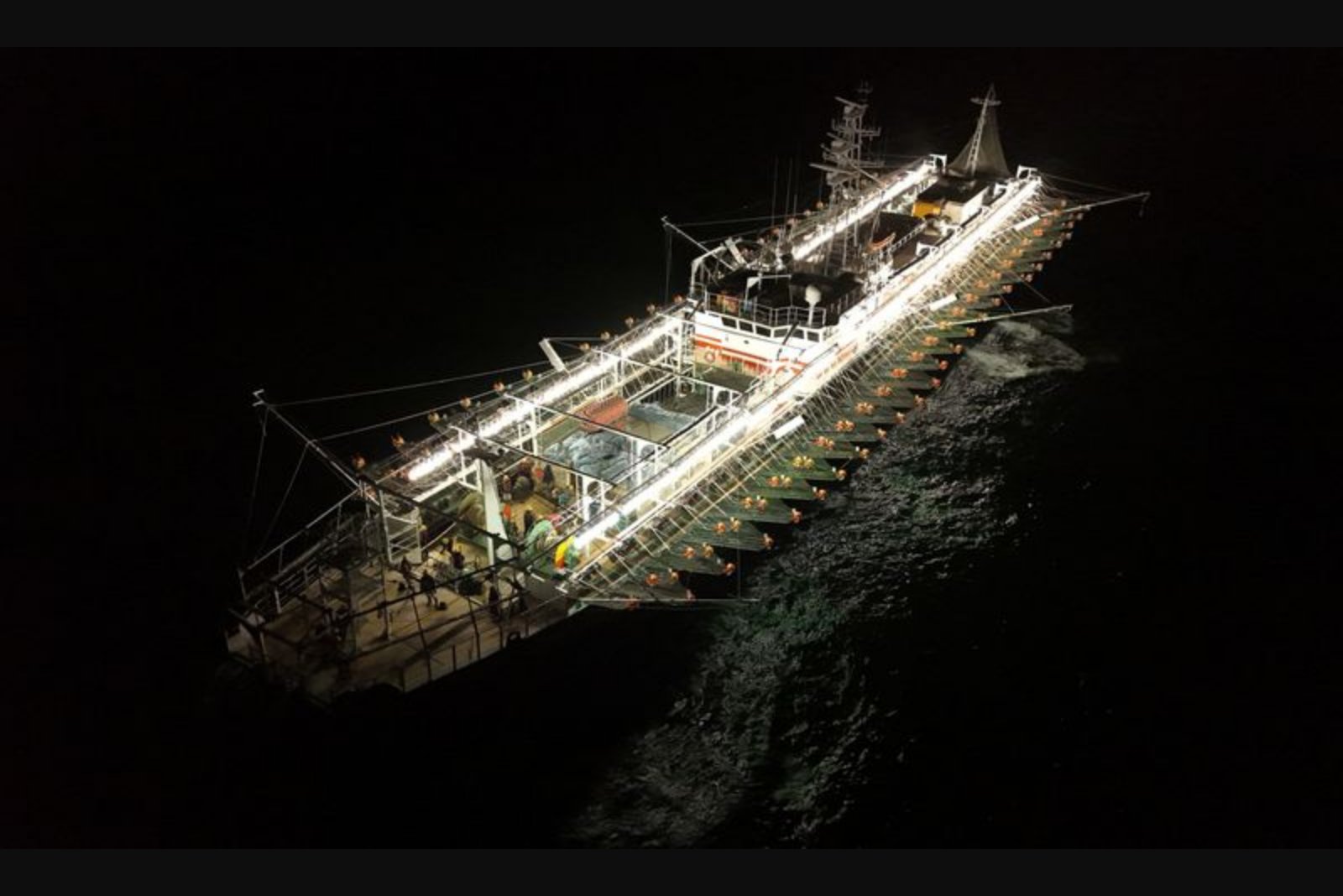
On a warm night in January, crew aboard an Argentine coast guard vessel intercepted a fragmented Mandarin broadcast over the radio emanating from vessels clustered nearby. Those boats were part of a flotilla of roughly 200 Chinese-flagged fishing vessels that spend extended periods each year off the coast of Argentina, largely harvesting squid destined for the world’s biggest squid market.
The presence of the fleet has grown substantially - up nearly 50% in the last decade - prompting Buenos Aires to expand surveillance capabilities to prevent incursions into its exclusive economic zone (EEZ), where Argentina has sole rights to marine resources. Yet officials in Buenos Aires and Washington continue to worry about two linked issues: aggressive fishing pressures just outside national waters and the possibility that elements aboard some vessels could be collecting intelligence.
Those concerns were voiced in interviews with four Argentine and four U.S. former and current officials. The U.S. started highlighting problems linked to distant-water fishing by Chinese-flagged vessels in the late 2010s as strategic rivalry with Beijing became a priority for the first Trump administration. Trump, who last year extended a $20 billion economic lifeline to Argentine leader Javier Milei’s government, later framed U.S. “dominance” over the Western Hemisphere as a central goal of his administration, placing Washington and Beijing at odds in parts of Latin America.
China’s economic ties with the region have expanded over two decades. Beijing has been a major investor in areas ranging from oil sectors to port infrastructure, and it operates a space-observation station in Argentina run by its military - a facility that has attracted scrutiny from U.S. officials. China’s government responded to questions about the fishing fleet by describing the allegations of intelligence collection as "pure speculation, lacking any factual basis." The Foreign Ministry added that "China is a responsible fishing nation, strictly enforcing the regulation of its distant-water fishing activities and engaging in mutually beneficial fisheries cooperation with relevant countries in accordance with international law."
Surveillance and bilateral cooperation
Washington has supported Argentina in improving its maritime oversight, including approving the sale of U.S.-origin P-3C Orion maritime surveillance aircraft to Buenos Aires. Argentine officials said they noted some Chinese vessels equipped with antennas that did not appear consistent with ordinary fishing operations. Marcelo Rozas Garay, who served as Argentina’s vice minister of defense in 2025, said, "We think what they were looking for in reality was information or intercepting communication," though he did not provide technical specifics about the antennas.
Juan Battaleme, who served as defense secretary for international affairs under President Javier Milei until December 2025, said Argentina and the United States have discussed Chinese vessels that moved in patterns suggesting possible mapping of the continental shelf for undersea resources. Under international law, exploration and exploitation of continental-shelf resources fall solely to the coastal state, which in this case is Argentina.
One former U.S. official, speaking anonymously because of the sensitivity of the subject, said Washington was concerned China might be using its distant-water fishing fleet to build a regional presence and to test Argentina’s capacity to control waters in the South Atlantic - an area that also offers access to Antarctica and key maritime passages. The people interviewed for this story did not present direct evidence supporting those suspicions.
Independent tracking and limited evidence
A Reuters review of vessel movements from January 2025 to March 2026, using data from a ship-tracking platform developed by New Zealand’s Starboard Maritime Intelligence, found no indication of mass seabed mapping by Chinese-flagged vessels in Argentine waters during that period. The firm’s dataset, the review noted, did not exclude the possibility of smaller-scale mapping activity.
Argentine authorities said they alerted Beijing when they detected trajectories they considered suspicious. According to Battaleme, Chinese officials responded with what he described as "ambiguous" explanations for altered vessel courses. China’s Foreign Ministry did not comment specifically on those bilateral interactions in its statement.
Argentina’s defense ministry and coast guard did not respond to requests for comment. A U.S. Department of Defense spokesperson declined to discuss the details of private diplomatic and intelligence exchanges with Buenos Aires, but said Washington "views Argentina as a key leader in regional security." The Pentagon said it was concerned by actions that "challenge the ability of sovereign nations to manage their own waters" and was "aware of global concerns regarding the dual-use nature of certain distant-water fishing fleets."
Scale of the fleet and global overfishing concerns
Concerns about global overfishing are amplified by the sheer scale of China’s distant-water fishing capacity, which analysts say is heavily subsidized and is the world’s largest. Estimates diverge: the London-based ODI think-tank has placed the fleet at over 16,000 vessels, while the Chinese government stated in 2023 that its distant-water fleet comprised about 2,500 boats. A U.S.-based nonprofit, Oceana, has said roughly half of all visible global fishing activity can be attributed to Beijing.
Much of the expansion of Chinese fleets abroad followed heavy exploitation and depletion of stocks in China’s own coastal waters. In other theatres, such as the South China Sea, some fleet elements are reported by analysts to have militia-like characteristics - crews that are primarily fishermen but who can be mobilized for security tasks. Scholars caution that evidence of such maritime militia activity has not been established universally, and U.S. analysts studying the presence off Argentina have not found evidence of systematic militia behavior in Latin American waters.
Within U.S. policy circles, officials have raised questions about whether any boats in the Argentine-area flotilla could play roles in intelligence collection. Jana Nelson, a senior Pentagon official responsible for the region during the Biden administration, said U.S. analysts "wondered ... whether or not these boats had any role in intel collection for the Chinese," but she added she did not know whether a definitive conclusion had been reached.
Strategic geography and past incidents
The fleet operates near strategically sensitive waters. U.S. aircraft carriers have at times transited the Strait of Magellan, the route linking the Atlantic and Pacific oceans that serves as an alternative to the Panama Canal. Argentine leaders have at times publicly criticized foreign fishing near their waters. President Milei, despite his close ties to former U.S. President Trump and past remarks that Argentine waters were being "invaded by illegal fishermen," has generally avoided directly naming China when discussing the foreign fishing presence. While many of the vessels in the area fly the Chinese flag, fishing boats from other countries also operate there.
Argentina’s economic relationship with China is substantial. By March, Beijing was the country’s second-largest trading partner and an important purchaser of agricultural exports including soybeans and beef. Chinese capital has flowed into Argentine sectors from lithium to renewable energy and infrastructure projects. Battaleme said that, notwithstanding strong trade and investment ties, it remains Argentina’s interest to determine whether any intelligence activities are occurring via the fleet. "So in that sense, the North American interest and our interests coincided," he said.
Operationally, much of the squid fishing off Argentina takes place at night, when vessels use intense beams of light to attract Illex squid migrating into high seas. Trawlers work during daylight hours to capture alternate catches. Scientists and Argentine fisheries specialists have voiced concern about the intensity of the activity around these stocks. Marcela Ivanovic, a squid expert at Argentina’s National Institute for Fisheries Research and Development, said, "They are fishing savagely in the area."
Coast guard tactics and enforcement history
Reuters accompanied the Argentine coast guard ship Azopardo in January as it steamed beyond the EEZ toward the illuminated squid fleet. Onboard, a radar display showed a red line marking the legal limit of the EEZ, while clusters of green triangle icons denoted hundreds of foreign vessels concentrated just outside that boundary.
Coast guard auxiliary officer Bruno Cian described an enforcement approach that emphasizes tactical surprise: "The idea is to have the surprise factor," he said. "To see who is committing an infraction." The expanded monitoring capacity has changed how Argentina enforces its maritime jurisdiction. Whereas earlier responses included high-seas chases, warning shots and attempts to seize vessels - one notable case being the sinking in 2016 of a Chinese trawler Argentina said was fishing illegally - enhanced surveillance has reduced the need for such maritime confrontations.
Coast guard data show only four suspected incidents of illegal fishing by foreign boats inside Argentina’s EEZ between 2021 and 2025. Battaleme said those numbers, alongside improved monitoring, have reinforced Argentine confidence that the Chinese fleet is aware of Buenos Aires’ ability to keep watch over its waters. "We are now certain that the Chinese know that we have the capacity to monitor them," he said.
Evidence limits and ongoing uncertainties
While officials have articulated worries that range from overfishing to potential dual-use intelligence activity, the documentary evidence available to the public is limited. The interviews conducted for this article did not yield concrete proof of systematic intelligence operations or mass seabed mapping tied to the Chinese-flagged fleet. Independent vessel-tracking data for the January 2025 to March 2026 window did not identify large-scale seabed mapping, though it did not exclude smaller-scale or episodic activities.
China denied intelligence allegations, describing the claims as speculative and reiterating that its fishing operations comply with regulations and international law. U.S. and Argentine officials continue to exchange information and to build Argentina’s surveillance capabilities, balancing concerns about maritime resource protection with the broader economic and diplomatic relationships involved.
For now, Argentina’s government appears to focus on enforcement and monitoring tools to manage the immediate fisheries challenge, while diplomats and defense officials on both sides of the hemisphere continue to weigh suspicions that have not yet been substantiated in open-source evidence.