
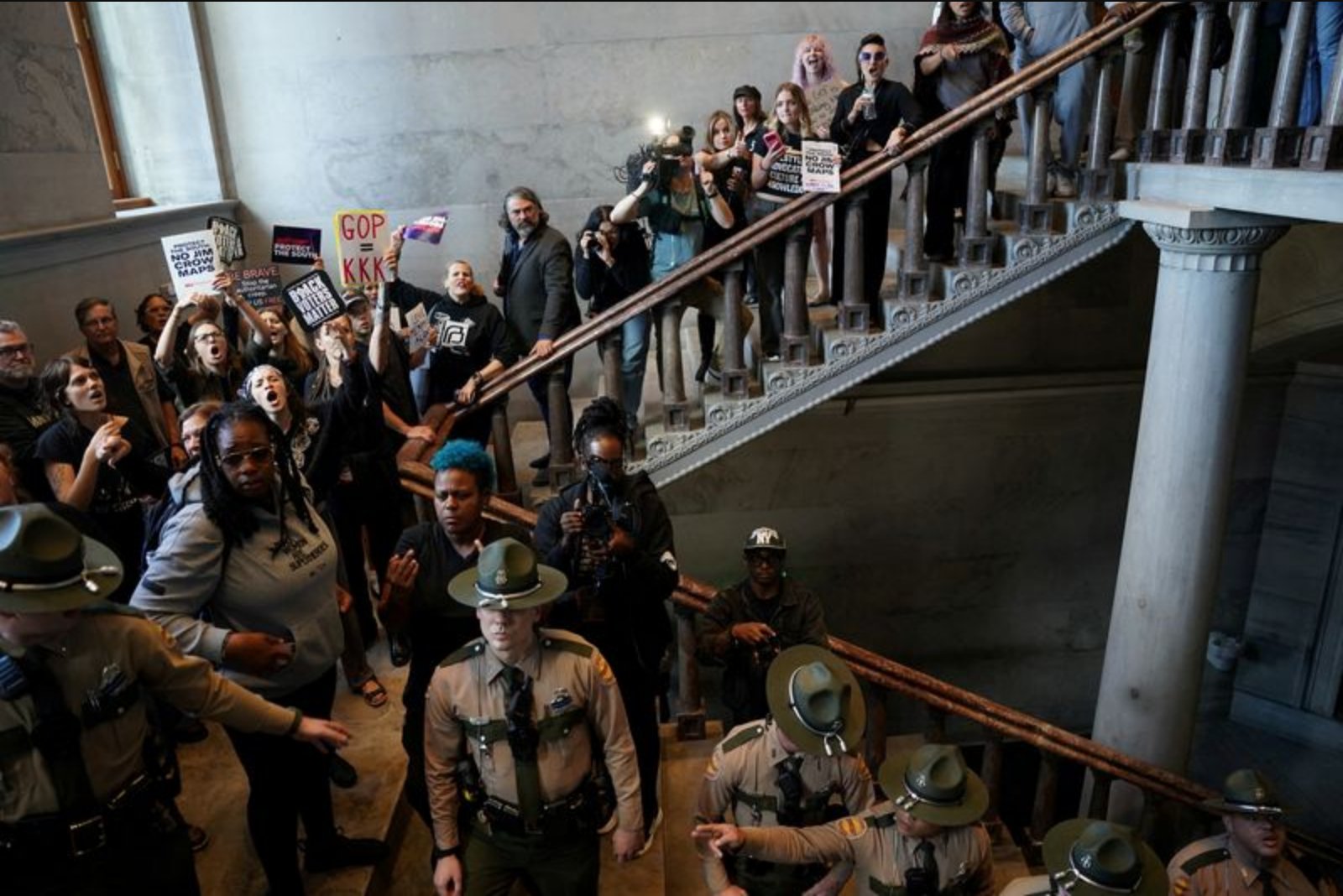
The Republican speaker of the Tennessee House of Representatives on Tuesday revoked committee and subcommittee assignments for Democratic members, citing their participation in disruptive protests during last week’s special session on a new congressional map.
Lawmakers in the Republican-controlled chamber approved a redrawn congressional map last Thursday that dismantled a Black-majority U.S. House district built around the predominantly African American city of Memphis. The measure passed five days before the speaker’s decision to remove Democrats from their legislative panels.
Legislative leaders and activists described last Thursday’s proceedings as chaotic. Protesters in the visitors’ gallery repeatedly shouted and used noisemakers while Black Democratic lawmakers at the front of the chamber linked arms and prayed. Demonstrators sounded air horns and chanted slogans objecting to the new map.
Opponents of the redrawing likened the elimination of the majority-Black district to a return to Jim Crow-era racial discrimination in the Deep South. The article of redistricting is likely to shift the nearby U.S. House seat from Democratic to Republican control in November’s midterm elections, according to the legislature’s own vote on the map.
In a letter to House Democratic leader Karen Camper, Speaker Cameron Sexton said the removals were disciplinary action for what he described as Democrats "instigating and encouraging" disruptions and causing "disorder on the House floor." He cited specific conduct, including lawmakers "interlocking arms in the well of the House," "blocking aisles on the House floor" and using "prohibited props and noisemakers."
Of the Tennessee House’s 99 seats, Republicans hold 75 and Democrats hold 24. The numerical supermajority gave the Republican leadership the authority to reassign committee roles unilaterally.
Representative Justin Jones, a Democrat who represents Nashville and is Black, posted online a copy of the letter he said notified him of his committee and subcommittee removals and directed questions to Camper. On social media he called the action "the same pattern of racial discrimination and authoritarian abuse we have come to expect."
Democratic leader Karen Camper, who represents Memphis and is Black, posted an open letter on her Facebook page criticizing the redrawing of the Memphis-area congressional district as "one of the most troubling abuses of power this legislature has seen in recent memory." In that letter she wrote: "When Democrats stand up, speak out, and expose what is happening in this chamber, the response from this supermajority is retaliation. We are hurt. We are disappointed. But we are not intimidated."
The broader context to the session included responses by several Southern states that have taken steps after a recent U.S. Supreme Court decision that significantly weakened key protections in the Voting Rights Act. That shift in federal legal terrain was cited in connection with the timing and content of the Tennessee map vote.
The speaker’s action to strip committee assignments represents a formal disciplinary step taken by the GOP majority in response to protests tied to the passage of a map that dismantled a majority-Black congressional district centered on Memphis. The move highlights both the partisan control of the legislature and the contentious nature of recent redistricting efforts in the state.