
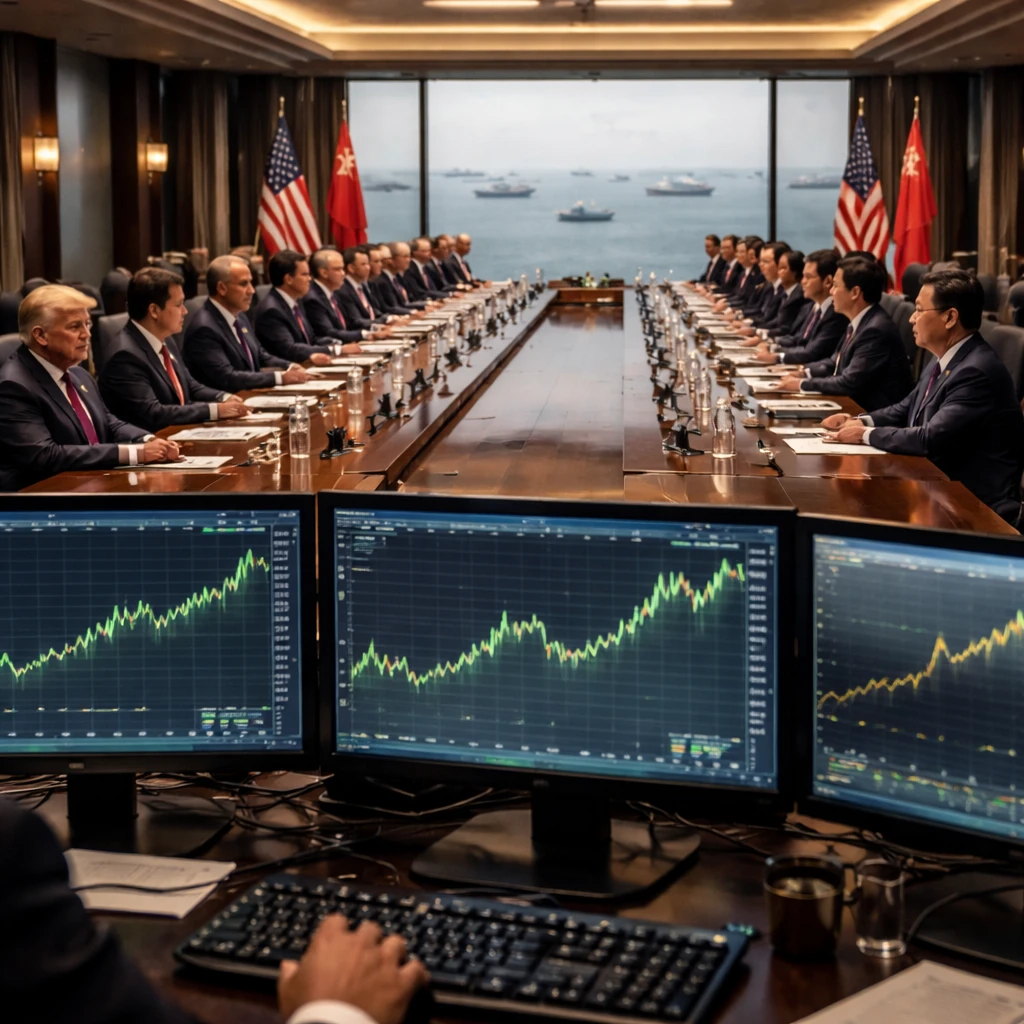
U.S. stock-index futures moved higher early Thursday as market participants weighed brisk interest in artificial intelligence against diplomacy-level talks between the U.S. and China. Traders are also parsing fresh inflation data and elevated oil prices that reflect ongoing geopolitical uncertainty.
By 03:40 ET (07:40 GMT), futures for the Dow rose 176 points, or 0.4%, S&P 500 futures were up 18 points, or 0.2%, and Nasdaq 100 futures advanced 144 points, or 0.5%. The benchmark S&P 500 reached a new all-time peak on Wednesday, the Nasdaq Composite climbed 1.2% and the blue-chip Dow Jones Industrial Average lagged, slipping 0.1%.
Analysts at Vital Knowledge attributed some of the recent momentum to developments tied to chipmakers after news that Nvidia’s chief executive, Jensen Huang, will accompany President Trump on his trip to China. The firm noted, however, that software and services had not been included in the same wave of excitement and that underlying price action ‘‘wasn’t nearly as robust,’’ pointing to weakness in the equal-weight S&P index.
Sentiment also appeared to absorb hotter-than-expected U.S. producer price index data, which marked a second consecutive upside inflation print within two days. Vital Knowledge said equity bulls largely dismissed the PPI print as a result of Iran-related developments, and observed that the market consensus expects an eventual accord with Tehran, implying inflation should ease once any such deal materializes.
Diplomacy under the microscope
President Trump and Chinese leader Xi Jinping concluded their first round of conversations during a two-day summit, with Xi telling state media that trade talks showed signs of progress. He cautioned, however, that friction over U.S. positions on Taiwan could undermine the relationship.
Market attention was particularly focused on whether the discussions would produce any developments tied to the Iran war. Some market watchers have proposed that President Trump might seek to secure China’s involvement as a guarantor of any durable peace agreement, given China’s role as a major importer of Iranian oil. It remains unclear whether Beijing would be willing to assume such a role.
Investors are also mindful of the economic implications while the Strait of Hormuz remains largely closed. The waterway off Iran’s southern coast is a critical artery for global oil flows, carrying about one-fifth of world supplies, and its shutdown adds a layer of uncertainty to the global economic outlook.
Oil markets
Crude prices edged higher as strategists at ING said traders were ‘‘eagerly awaiting the outcome of the meeting between [Trump and Xi], and whether it could yield some positive results on the Iran war.’’ Brent crude futures were trading above $105 a barrel, compared with a pre-war level roughly near $70 a barrel.
The sharp rise in energy prices has contributed to inflation concerns in economies worldwide, a theme reinforced by the recent run of stronger U.S. consumer and producer price readings. Morgan Stanley analysts warned that the energy shock could coincide with slower economic growth and trigger inflationary pressures that extend beyond commodities such as oil and gas.
Cisco’s AI-driven restructuring
Cisco Systems shares jumped in extended trading after the networking equipment maker revealed an extensive restructuring aimed at accelerating its AI initiatives. The company said it anticipates incurring a roughly $1 billion charge associated with severance and related costs tied to the reorganization.
The plan calls for a reduction of about 4,000 roles, or close to 5% of the company’s workforce. Cisco indicated it expects to record approximately $450 million of the total charge in the fourth quarter of fiscal 2026, with the balance recognized during fiscal 2027. The company described most of the charges as cash-based.
CEO Chuck Robbins, speaking on a post-earnings call, emphasized the effort is intended to reallocate resources to areas where Cisco will need them going forward, rather than emphasizing pure cost savings. The announcement comes as many enterprises increase spending on AI processors and the high-speed networking infrastructure required to link large modern data centers.
In addition to the restructuring, Cisco updated its fiscal 2026 revenue outlook. The firm now projects revenue in a range between $62.8 billion and $63.0 billion, up from an earlier forecast of $61.2 billion to $61.7 billion.
Federal Reserve leadership change
The U.S. Senate confirmed Kevin Warsh as chair of the Federal Reserve on Wednesday, elevating the 56-year-old lawyer and financier to lead the central bank at a time of rising inflationary pressure. The Senate vote followed approval of Warsh’s appointment to the Fed’s seven-member Board of Governors by the Republican-majority body earlier on Tuesday.
Warsh will take over from Jerome Powell, whose term ends on Friday. Powell will remain on the Federal Reserve Board as a governor. To accommodate Warsh’s confirmation, Fed Governor Stephen Miran will step down from his board seat.
Market implications and near-term focus
Investors are balancing cyclical and structural drivers: excitement about AI-driven spending that is lifting parts of the technology sector, and macro risks related to elevated energy prices and geopolitical uncertainty. Markets will likely remain sensitive to any outcomes from high-level diplomatic talks in China and to incoming data that could reflect the spillover effects of elevated oil prices on inflation and growth.
Key items to watch in the near term include any public statements or agreements coming out of the Trump-Xi summit related to Iran and trade, follow-through on Cisco’s stated reallocations, and the Fed’s policy direction under new chair Kevin Warsh as officials respond to inflation dynamics.