
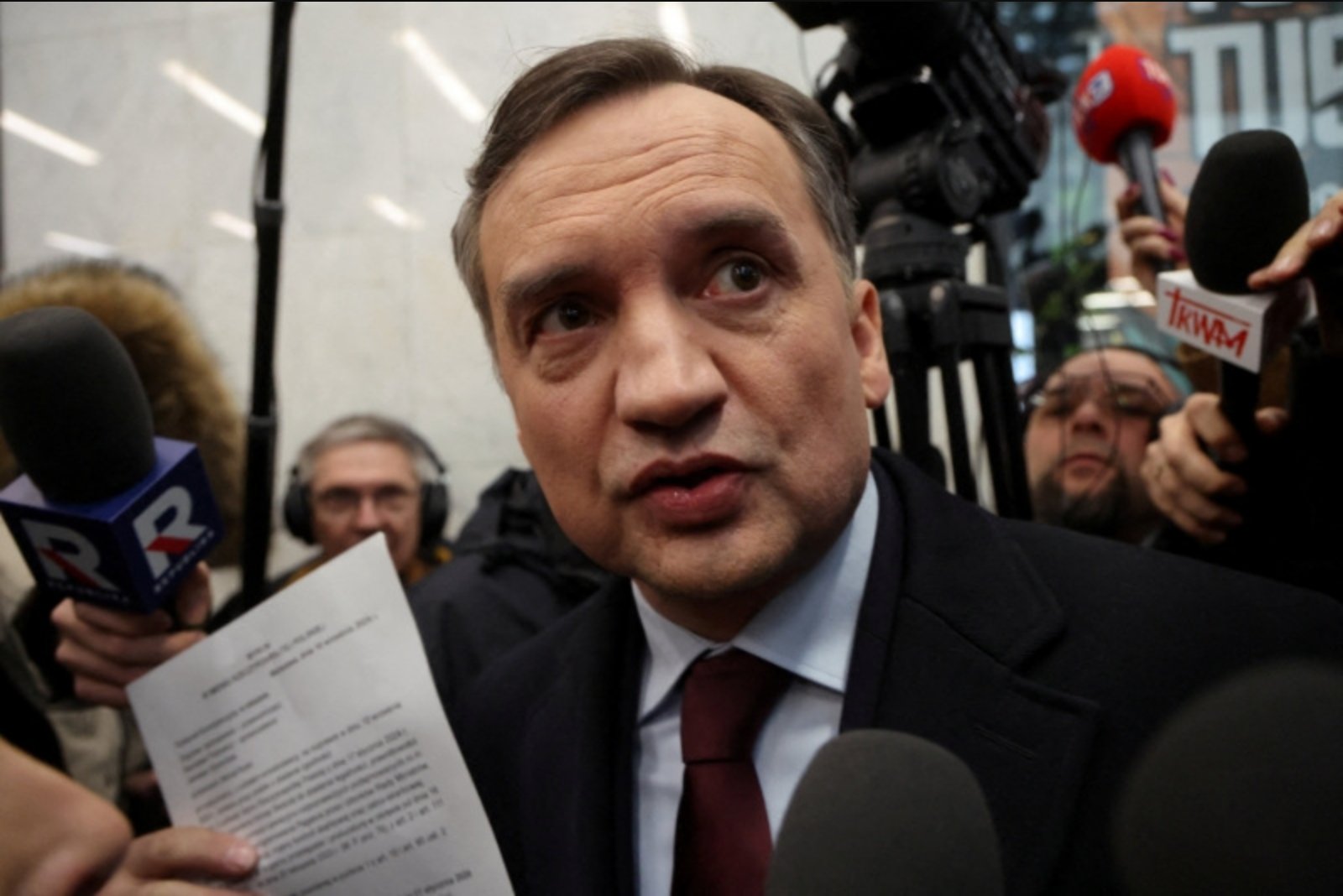
U.S. Deputy Secretary of State Christopher Landau instructed senior State Department officials to take steps that led to the issuance and approval of a visa for Zbigniew Ziobro, a former Polish justice minister wanted by Warsaw on criminal charges, three people familiar with the matter said. The visa enabled Ziobro to travel from Hungary to the United States, the sources said.
Poland seeks to prosecute Ziobro, who served as justice minister during the 2015-2023 tenure of the conservative Law and Justice party (PiS). He faces 26 charges, largely alleging the misuse of funds from a crime victims fund for political purposes. Ziobro has denied wrongdoing and asserted he is the target of a politically motivated campaign by Poland’s current ruling pro-European Union coalition. Journalists were unable to reach Ziobro in the United States. His lawyer in Poland, Bartosz Lewandowski, said he would pass on questions to Ziobro; there was no response.
Granting a visa to a politician who is the subject of criminal charges in a U.S. ally is an uncommon step, even as the Trump administration has made support for conservative forces in Europe a priority. Hungary’s then-prime minister Viktor Orban granted Ziobro asylum in January. After Orban’s defeat by pro-EU rival Peter Magyar in an April election, Warsaw had expected that Ziobro could be returned to Poland, and Magyar had indicated he would extradite him on his first day in office.
According to three sources familiar with the case, Landau directed senior officials in the State Department’s Consular Affairs Bureau in Washington to instruct the U.S. embassy in Budapest to issue a visa for Ziobro. One of the sources said the visa was for journalistic purposes. The sources, who spoke on condition of anonymity to discuss non-public details, said the intervention allowed Ziobro to obtain the visa before Magyar’s May 9 swearing-in.
The sources said they were not aware of any direct involvement by U.S. President Donald Trump in the decision. It was not determined what role, if any, Secretary of State Marco Rubio played in the matter. A separate source said Landau first learned about Ziobro’s situation earlier in the spring from Tom Rose, the U.S. ambassador to Poland, and viewed Ziobro as someone who had been unfairly prosecuted.
When directing officials in the Consular Affairs Bureau to issue the visa, the deputy secretary characterized the situation as urgent and framed it as a national security matter, according to one source. The specific grounds for labeling it a national security issue were not provided.
Landau declined to comment for this report. A State Department spokesperson, citing visa record confidentiality, declined to provide detailed answers about the case, including questions about involvement by the secretary of state or the ambassador to Poland. The White House did not respond to a request for comment. The offices of Polish Prime Minister Donald Tusk and Poland’s Justice Ministry did not reply to requests for comment. A spokesperson for Hungarian Prime Minister Peter Magyar’s government also did not comment.
U.S. political rhetoric has increasingly included the charge that European conservatives face so-called "lawfare," a contention advanced by supporters of the Trump movement who argue judicial tools have been used unjustly against them. Critics in the United States have drawn parallels, alleging prosecutorial powers are being used against perceived adversaries. The visa decision sits within that contentious debate.
Ziobro, 55, is identified as a principal architect of judicial reforms under PiS that the European Union said undermined judicial independence. Among the allegations against him are the improper use of Justice Fund monies, a fund intended to assist victims of crime. Prosecutors allege some of that money was used to purchase the Pegasus spyware system, which has the capability to transform a mobile phone into a surveillance device and has been used by governments against political opponents and journalists in other contexts. The Justice Fund did not reply to requests for comment.
Ziobro’s departure to the United States has intensified diplomatic sensitivities for Poland’s new government led by Prime Minister Donald Tusk. While bilateral ties between Washington and Warsaw have generally been stable, recent developments have shown strains. The Pentagon last week canceled the deployment of 4,000 U.S. troops to Poland, stating that it "made the most sense for that brigade to not do its deployment in theater."
A Polish Foreign Ministry spokesperson indicated that Warsaw will seek the legal and factual basis from both Washington and Budapest for the circumstances that allowed Ziobro to leave Hungary. Polish authorities had already annulled his passport.
Following his arrival in the United States, Ziobro began working as a television commentator for the Polish channel TV Republika; the broadcaster announced his role on May 10. In a May 10 appearance on that channel, Ziobro said: "I’m in the United States ... It’s an incredibly complex, beautiful country, the world’s strongest democracy."
The case raises questions about how diplomatic interventions, visa procedures and political considerations intersect when an individual faces legal proceedings at home but has allies abroad. The immediate facts recorded here - the deputy secretary’s instruction, the consular action, the timing ahead of a new Hungarian administration and the related legal and diplomatic responses - are publicly reported details based on accounts from people with knowledge of the matter.