
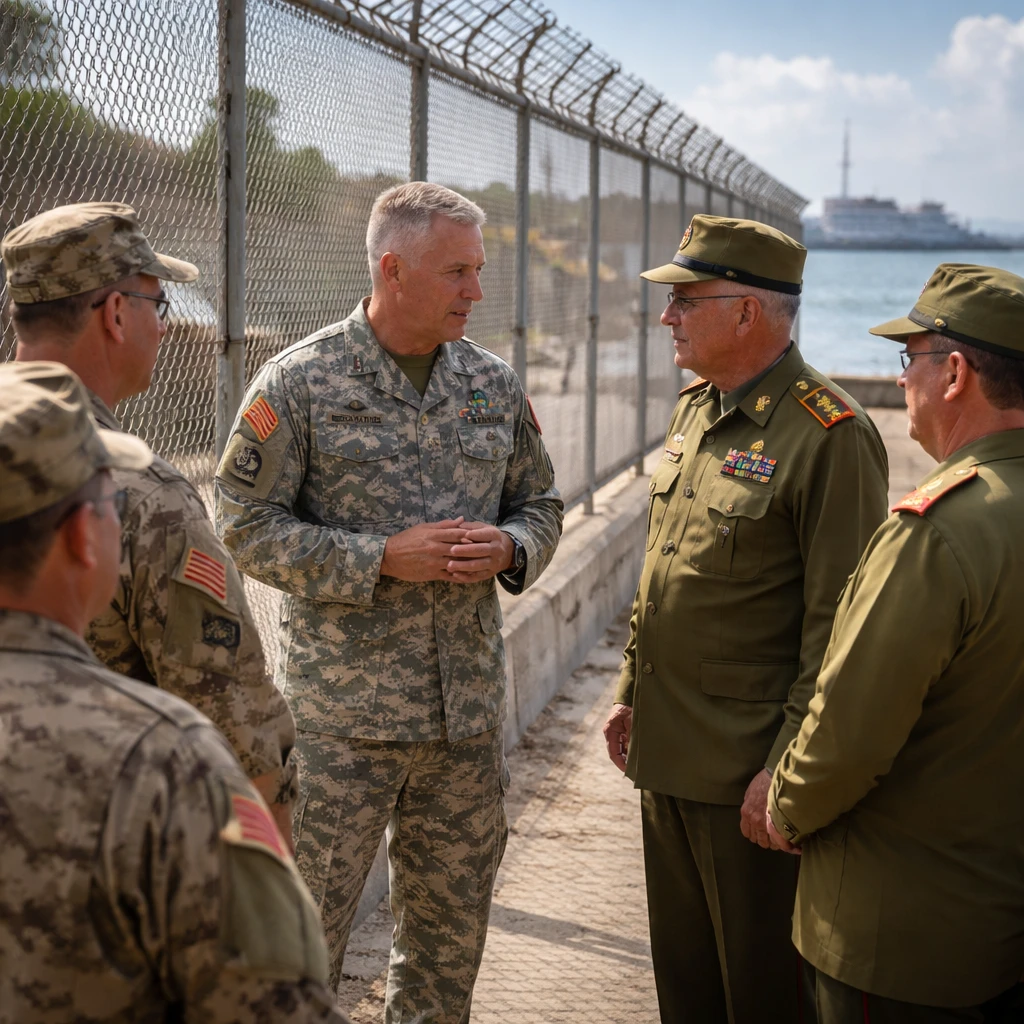
The top U.S. military officer responsible for operations in Latin America conducted a short, unusual rendezvous with senior Cuban military leaders on Friday at the edge of the U.S. naval installation at Guantanamo Bay, a U.S. official told Reuters.
U.S. General Francis Donovan, who leads U.S. Southern Command, met with a Cuban delegation that included General Roberto Legra Sotolongo, identified as first deputy minister of the chief of the General Staff. The official, speaking on condition of anonymity, said the talks were limited in scope and centered on operational security matters.
According to the official, Donovan’s appearance in Cuba marks the first time in recent memory that the head of Southern Command has conducted such a meeting on Cuban soil. The encounter comes as concerns have risen inside Cuba about the prospect of a U.S. military intervention on the Communist-run island.
The visit by the Southern Command chief follows another rare diplomatic move earlier in May, when CIA Director John Ratcliffe traveled to Havana, according to information in the public record. The sequence of these engagements has taken place amid a broader uptick in Washington’s posture in the Western Hemisphere.
President Donald Trump has repeatedly highlighted Cuba as a central foreign policy objective for a second term and has suggested that the island will receive increased focus once the conflict with Iran concludes, statements that officials and observers have noted in recent weeks.
Historical and political context cited by U.S. officials and Cuban authorities
The U.S. and Cuba have been antagonists for decades, a dynamic commonly traced back to the 1959 revolution. The Trump administration has been intensifying pressure on Havana, actions that supporters of tougher measures in the United States have long advocated.
Hardline Cuban Americans in Florida are described as a key domestic constituency backing more assertive U.S. policy aimed at regime change on the island, and the administration has pursued multiple measures to increase leverage over the Cuban government.
On May 20, the U.S. formally charged former President Raul Castro with four counts of murder in connection with the 1996 downing of civilian aircraft operated by Miami-based exile groups. U.S. officials framed that indictment as part of broader efforts to reinforce American influence across the hemisphere.
The administration’s posture in the region has also been illustrated by a high-profile military operation earlier in the year that aimed to seize Venezuelan President Nicolas Maduro on January 3 in Caracas and transport him to New York to face drug trafficking charges; Maduro has pleaded not guilty to those charges.
Public messaging and warnings
Prominent U.S. figures have been active in shaping the narrative surrounding Cuba. U.S. Secretary of State Marco Rubio, described in public profiles as the son of Cuban immigrants and viewed as a potential 2028 Republican presidential contender, has spoken of Cuba as a national security risk given its proximity to Florida. On May 5, Rubio and General Donovan posed for a photograph in front of a map of Cuba in a post on X by Donovan’s Southern Command; the accompanying statement said their discussions had concentrated on "U.S. efforts to counter threats that undermine security, stability and democracy in our hemisphere."
Cuban officials, in turn, have issued stark warnings. Cuba’s Foreign Minister Bruno Rodriguez has cautioned that any military action would produce a "bloodbath" that could claim thousands of Cuban and American lives.
Economic and humanitarian impacts noted
U.S. policy measures are also described as having immediate economic consequences for the island. The administration has effectively imposed a fuel blockade by threatening tariffs on countries that supply fuel to Cuba, actions credited with triggering prolonged power outages and further weakening an already fragile economy. Observers cited in reporting warn that instability in Cuba poses risks of a migration crisis.
The meeting at Guantanamo Bay, while brief, underscores an intensification of direct military and security engagement between Washington and Havana at a time of rising tensions and competing public messages about potential U.S. action and its likely costs.