
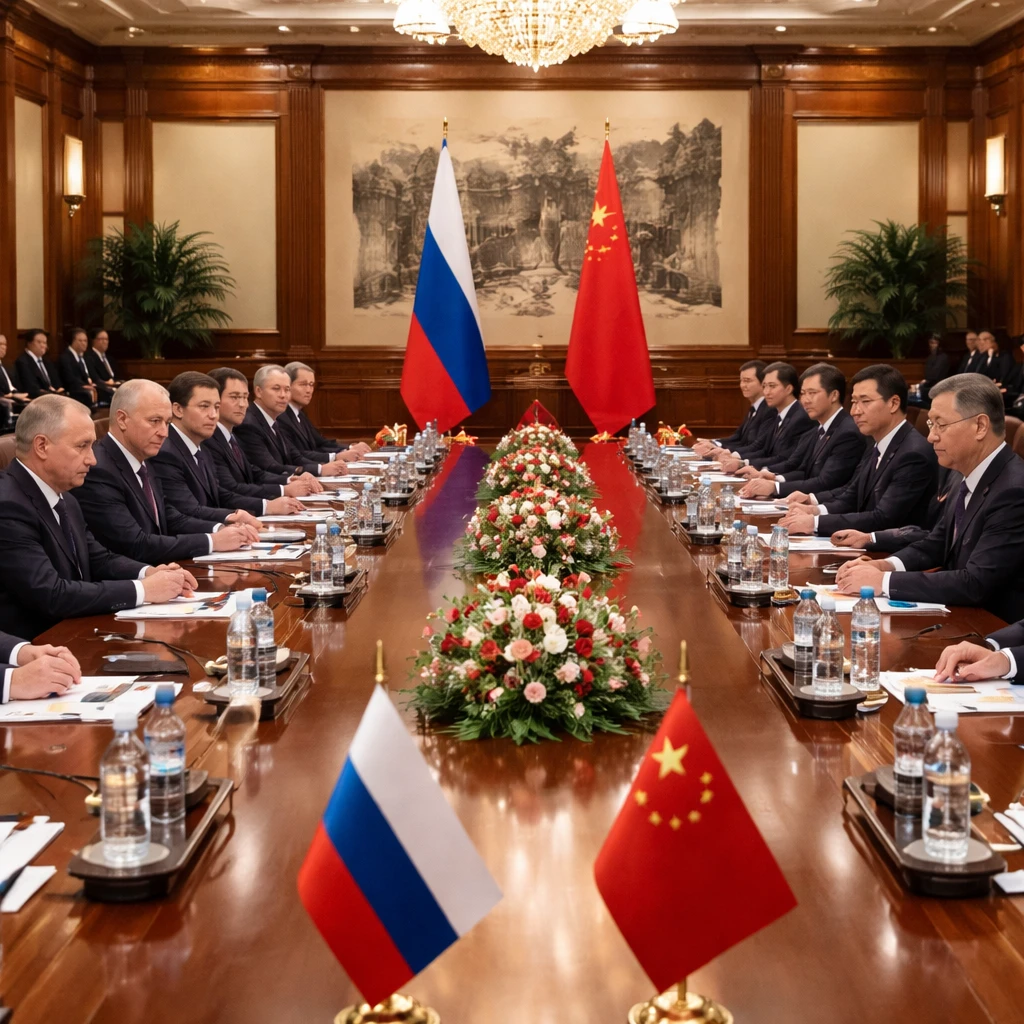
Russia and China jointly criticized the United States' proposed missile-defense initiative on Wednesday, asserting that the plan - known in U.S. political circles as the "Golden Dome" - poses a significant risk to global strategic balance. The remarks were made in a joint statement issued as Chinese President Xi Jinping hosted Russian President Vladimir Putin in Beijing.
The two governments said the U.S. project would broaden and deepen missile defenses by expanding ground-based capabilities such as interceptor missiles and command-and-control systems, while incorporating new space-based components. Those space elements were described as satellite networks intended to track, and potentially engage, threats from orbit.
In their joint text the countries set out a harsh assessment of the program's aims. "The parties believe that the U.S. 'Golden Dome' project, which aims to build an unlimited, multi-level, multi-sphere, and global missile defense system to destroy all types of missiles, including all types of 'peer adversaries' missiles, at all stages of their flight and before they are launched, poses an obvious threat to strategic stability," the statement said. The declaration added that such plans contradict what the two countries called the key principle of maintaining strategic stability - namely, the interconnectedness of strategic offensive and strategic defensive weapons.
Alongside its critique of the missile-defense program, the joint statement accused the United States of acting irresponsibly by allowing the 2010 New START nuclear arms reduction agreement between Washington and Moscow to lapse earlier this year without establishing a replacement treaty. The two governments labeled that decision an "irresponsible policy." The statement also noted that some U.S. critics who opposed extending New START had argued that extension was necessary to help Washington prepare to counter a rapid build-up in China's nuclear capabilities.
Finally, Russia and China raised concerns about moves by unnamed nuclear-capable states to forward deploy ground-based intermediate- and shorter-range missiles. Those deployments, the statement said, are "highly destabilizing and pose a strategic threat."
The joint declaration frames the two countries' position on recent U.S. defense initiatives and on the current state of nuclear arms control arrangements. It links the growth of layered defense systems - on the ground and in space - with a broader deterioration in the frameworks that the statement's authors say undergird strategic predictability.
Summary
- Russia and China issued a joint statement in Beijing criticizing the United States' "Golden Dome" missile-defense proposal as threatening to strategic stability.
- The statement outlined components of the program - expanded ground-based interceptors and command-and-control plus new space-based satellite networks aimed at tracking and potentially shooting down threats from orbit.
- The two countries also condemned the U.S. for not replacing the 2010 New START treaty after it expired, calling that decision "irresponsible policy," and warned that unnamed nuclear powers forward-deploying shorter- and intermediate-range ground missiles is destabilizing.
Key points
- Strategic criticism - Moscow and Beijing say the Golden Dome plan undermines the mutual relationship between offensive and defensive strategic systems, a link they characterize as essential for strategic stability.
- Arms control concern - the joint statement highlights the lapse of the New START treaty and the absence of a replacement as a contributing factor to heightened geopolitical uncertainty.
- Sectors affected - the dispute touches defense and aerospace sectors, including ground-based missile systems, satellite and space-based tracking networks, and broader defense procurement and policy decisions.
Risks and uncertainties
- Strategic stability risk - Russia and China assert the Golden Dome program could upset the balance between offensive and defensive capabilities, an assertion that highlights military and geopolitical risk for defense-sector stakeholders.
- Arms-control uncertainty - the expiration of New START without a replacement treaty introduces uncertainty in diplomatic and security frameworks that influence defense planning and international arms-control negotiations.
- Forward deployment concerns - allegations that unnamed nuclear-capable states are planning forward deployment of intermediate- and shorter-range ground-based missiles are described as "highly destabilizing," creating further uncertainty around regional and global security dynamics.