
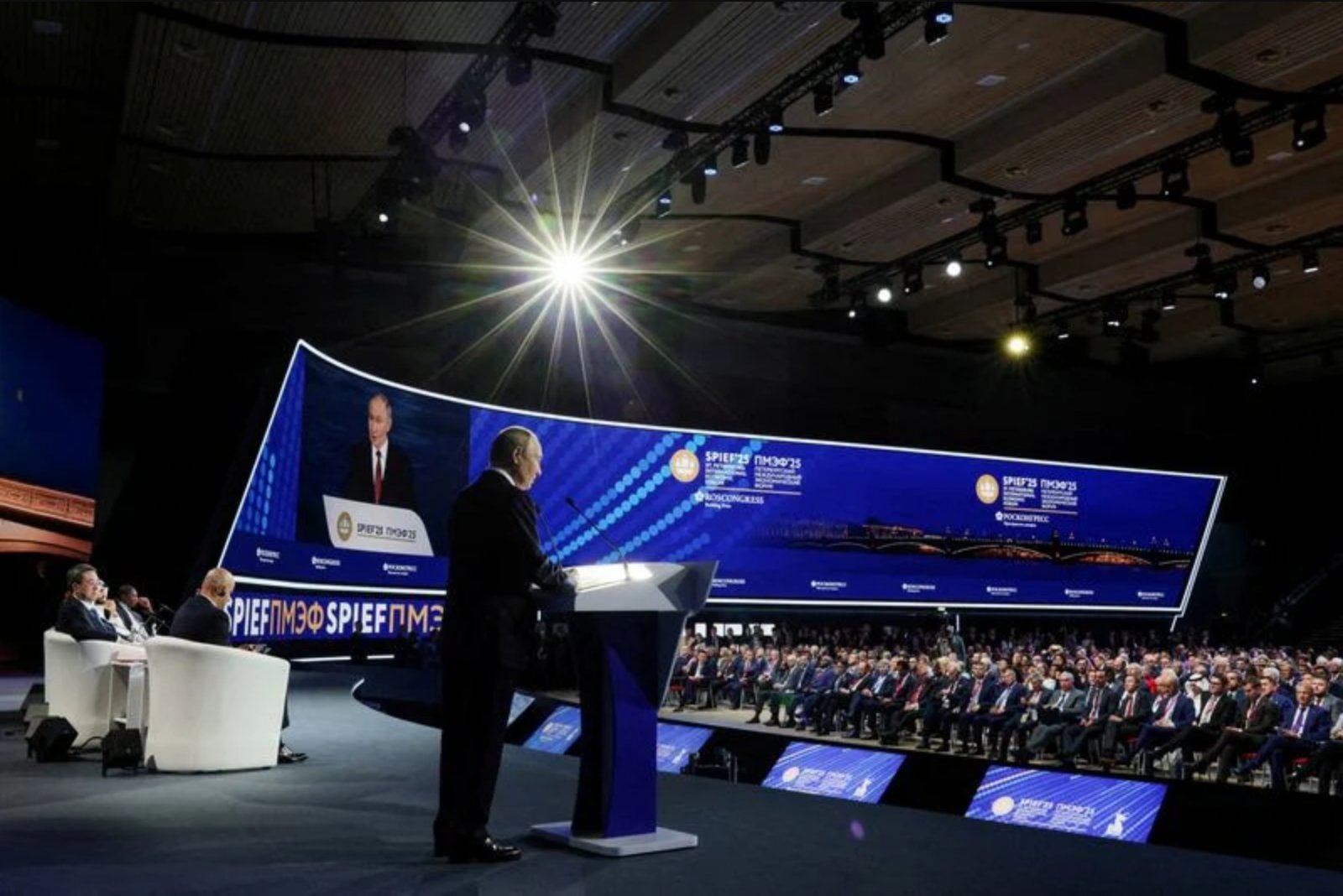
Russia’s flagship investment forum convenes this week amid acute economic and geopolitical pressures, bringing together an unlikely blend of international guests and domestic elites as the Kremlin confronts stalled growth and renewed confrontation with the West.
The event, the fifth such gathering since Moscow sent troops into Ukraine in 2022, opens just hours after a deadly drone and missile strike on Kyiv that Moscow said was a response to an attack on a dormitory in Russian-controlled Luhansk. Official programme materials make no mention of Ukraine, yet the conflict hangs over conversations and strategy sessions.
The forum’s organisers say it marks the first time since 2017-2018 that a serving U.S. official will attend. Among foreign participants listed are Rodney Mims Cook Jr., chairman of the U.S. Commission of Fine Arts who oversees a White House ballroom extension project; U.S. conservative commentator Candace Owens; and the possible presence of internet personality Andrew Tate. Also scheduled to take part in discussions is German retail billionaire Thomas Bruch, owner of Hyperglobus, who is listed for a session on German investment.
Attendees will gather at a heavily guarded conference centre outside the president’s hometown, where the programme - themed "Pragmatic Dialogue: the Path to a Stable Future" - sets out debates ranging from OPEC+ policy to the use of artificial intelligence in information operations. Russian billionaires will sit alongside former intelligence officers and overseas guests in sessions that reflect the Kremlin’s desire to project a veneer of international engagement despite broad Western boycott since 2022.
A Russian participant, speaking on condition of anonymity because of the sensitivity of the topic, put the tension succinctly:
"The question is: does this war end or do we stare into a much tougher future?"
Economic figures cited during the forum underscore how the conflict and associated policies have reshaped Russia’s growth trajectory. According to International Monetary Fund data referenced in official commentary, the economy grew roughly tenfold during the leader’s first 15 years in charge to about $2.3 trillion in 2013, the year before the annexation of Crimea. Since the 2014-2015 shift in geopolitics and the 2022 troop deployment, Russian state data put the economy at about $2.9 trillion this year - a fraction of the combined $45 trillion weight of NATO economies.
Recent growth has been weak. After reporting stronger-than-expected expansions in 2023 and 2024, the commodity-dependent economy slowed to roughly 1% growth last year, down from 4.9% in 2024, and contracted by 0.2% in the first quarter of 2026, according to the figures discussed at the forum. Officials cited high interest rates, Western sanctions and a strong rouble as key contributors to the weakness. Current forecasts presented at the event show modest growth of about 0.4% for the year.
That economic tension informs public debate at the forum. Oleg Vyugin, a former deputy chairman of the central bank, framed the trade-offs bluntly: Russia faces a choice between cutting military financing for what the Kremlin terms the Special Military Operation in Ukraine - a step that, he argued, could ease monetary policy by allowing a quicker reduction in the key interest rate, expand lending to the civilian sector, partially lift sanctions and help rebuild logistics chains - or maintaining military spending, which he said will require higher taxes and continued fiscal pressure that could push the economy deeper into recession and reduce real incomes.
Sessions will include a high-profile energy conversation featuring Saudi Energy Minister Prince Abdulaziz bin Salman, Russia’s energy minister Alexander Novak and OPEC Secretary General Haitham Al Ghais, focused on the implications of the war in the Middle East for energy markets and the future of OPEC+. Energy markets and commodity exporters remain central to Russia’s economic calculus and the stakes are evident in the guest list.
German economic ties to Russia are visible in the attendance list. The forum stated that 1,800 German companies continue to operate in Russia, and Mr. Bruch is listed for a panel on German investment. Hyperglobus did not respond to a request for comment that was sent in relation to the conference.
On social and cultural panels the organisers have also scheduled more unexpected foreign voices. Ms. Owens is listed to speak on a session described in the official programme as addressing "balancing parenthood in a large family with a successful career." Ahead of the trip, she commented that she had been "wanting to go to St Petersburg for a very, very long time just as a Christian in general just to see some of those cathedrals and churches."
Security is tight and the atmosphere is intended to project stability and normalcy, yet the forum nonetheless underscores unresolved questions about Russia’s economic future, the costs of continued military spending and the degree to which international commercial ties can be sustained or restored while sanctions and geopolitical tensions persist.
Key points
- Russia’s fifth post-2022 investment forum draws a mix of domestic elites and several notable foreign guests despite Western shunning; sectors impacted include energy, retail and finance.
- The economy faces weak growth - recent contraction and low forecasts - driven by high interest rates, sanctions and a strong currency, affecting lending and consumer incomes.
- High-level energy discussions with OPEC+ figures highlight the centrality of commodities and energy policy to Russia’s economic outlook and international engagement.
Risks and uncertainties
- Continued military spending on the Special Military Operation risks prolonging fiscal strain, higher taxes and further economic contraction - with consequences for government finances and consumer markets.
- Sanctions, elevated interest rates and a strong rouble threaten to constrain lending, slow civilian-sector investment and complicate the restoration of logistics chains and international trade relationships, impacting manufacturing, retail and transport sectors.
- Escalation of violence, as underscored by recent strikes and retaliatory claims, increases geopolitical risk that could dampen investor confidence and limit foreign participation in trade and investment discussions.
Tags: Russia, Economy, Energy, Sanctions, Investment