
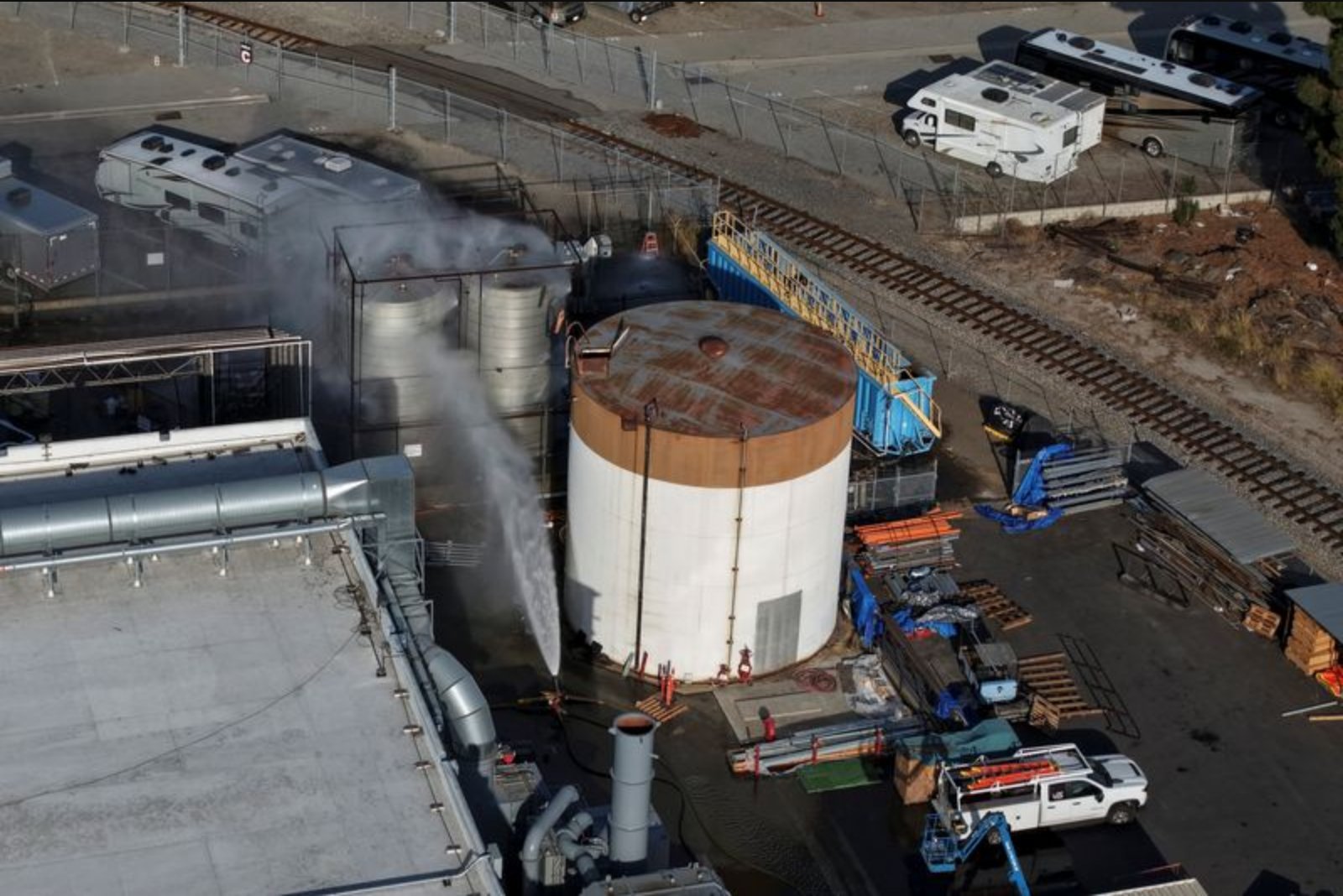
Emergency personnel and technical specialists responding to a hazardous materials incident in Southern California reported on Sunday that a team located what they described as a "potential crack" in a tank storing methyl methacrylate, a flammable chemical used in plastics and manufacturing.
Authorities have been working since Friday to prevent the tank from rupturing and releasing up to 7,000 gallons (26,500 liters) of material or exploding and threatening adjacent storage vessels on the GKN Aerospace site. Evacuation orders were issued on Friday for parts of Garden Grove, a suburb roughly 30 miles (48 kilometers) south of Los Angeles. Officials said the evacuation zone covers tens of thousands of residents.
TJ McGovern, interim fire chief of the Orange County Fire Authority, said in a social media video that specialists on Saturday night discovered the potential crack, and that it "could potentially be relieving some of the pressure in there." McGovern called the find "positive intel."
A spokesperson for the Orange County Fire Authority told Reuters that authorities are still investigating whether the possible crack has actually lowered the pressure inside the tank. The spokesperson said that a reduction in internal pressure could help avert an explosion. For now, officials are prioritizing pressure measurement while keeping other response options in reserve.
The spokesperson added that if the crack has indeed relieved pressure, it might eventually permit a controlled, gradual draining of the chemical from the tank under supervised conditions.
On Saturday, Craig Covey, division chief of the Orange County Fire Authority, said the internal temperature of the tank had been rising by about one degree Fahrenheit per hour and had reached as high as 90 degrees. Early on Sunday EPA Administrator Lee Zeldin told CNN’s "State of the Union" program that local officials were working to stabilize the tank by keeping its temperature under 85 degrees Fahrenheit.
Covey said crews were preparing containment measures to handle a potential release. Responders were exploring ways to dike, dam and divert any liquid into a holding area inside the commercial site so it would not reach storm drains, river channels or the ocean.
Health officials cautioned that vapor from methyl methacrylate could cause severe respiratory problems with prolonged exposure. However, the EPA reported on Sunday that air monitors deployed in Garden Grove were not detecting any chemicals or pollutants. Sensors positioned around the tank itself also had not registered air-borne chemical leaks, according to the fire authority spokesperson.
The Orange County Fire Authority and the Garden Grove mayor’s office did not respond to requests for comment on Sunday.
Separately, on Saturday firefighters were evaluating whether applying a heavy flow of cooling water could slow the chemical's curing process inside the tank sufficiently to reduce internal pressure and lower the risk of an explosion.
The incident began on Thursday at the GKN Aerospace facility, which the company describes on its website as specializing in the manufacture and testing of windows and canopies for commercial and military aircraft. In response to the incident, California Governor Gavin Newsom declared a state of emergency for Orange County on Saturday.
Summary
Specialists believe a potential crack in a methyl methacrylate storage tank at a GKN Aerospace site in Garden Grove may be relieving pressure, which could reduce the immediate risk of an explosion. Evacuations remain in effect while officials continue to monitor pressure, temperature and air quality and prepare containment measures to prevent a spill from reaching waterways or storm drains.
Key points
- Evacuation orders affect tens of thousands of residents around the GKN Aerospace facility in Garden Grove; the tank holds up to 7,000 gallons (26,500 liters) of methyl methacrylate.
- Responders located a "potential crack" that might be lowering pressure inside the tank; authorities are measuring pressure and temperature and considering controlled draining if conditions permit.
- Air monitors in the surrounding community and sensors around the tank were not detecting chemical releases on Sunday; containment measures including diking and diversion to on-site holding areas are being prepared.
Risks and uncertainties
- Possibility of a spill or explosion if pressure is not sufficiently reduced or if the tank structure fails - this risk impacts local public safety and the industrial sectors operating at the site, including aerospace and chemical handling.
- Potential for severe respiratory harm from vapor exposure with prolonged contact - a health risk that affects residents and first responders and could strain local healthcare and emergency services.
- Environmental contamination risk if any released chemical reaches storm drains, river channels or the ocean - this would affect local water quality and environmental remediation costs for municipal and environmental management sectors.