
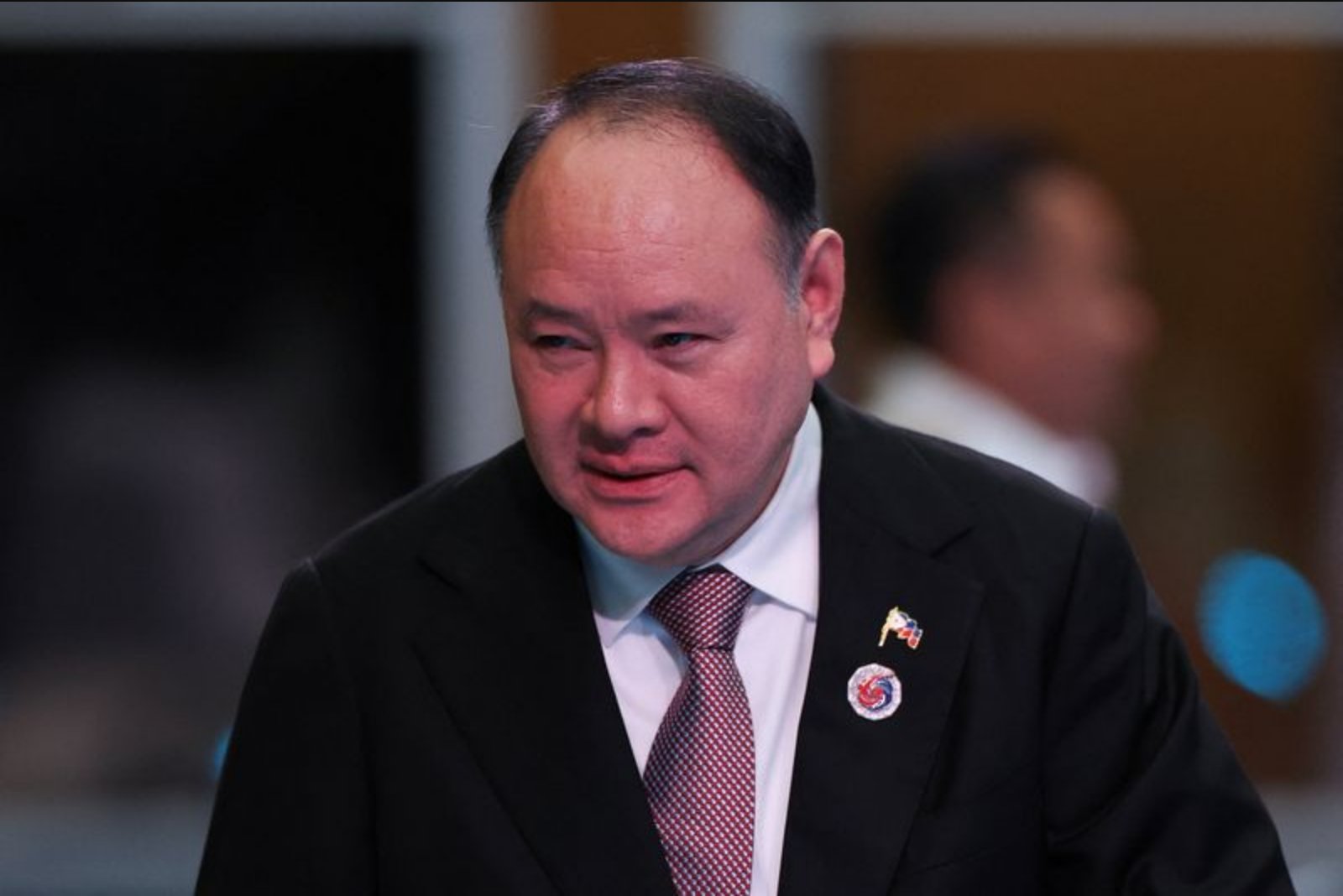
SINGAPORE, May 30 - The Philippines continues to face a "severe threat" from China, its defence minister said on Saturday at the Shangri-La Dialogue in Singapore, even after a recent softening of tensions between the United States and China following their leaders' summit earlier this month.
Speaking on the sidelines of Asia’s premier defence forum, Defence Secretary Gilberto Teodoro framed the recent easing between Washington and Beijing as a natural development between two powers he described as more equal in military capability. "When they are at parity defence-wise, then there is respect and the capability to adjust because of the depth that both countries have," he said.
But Teodoro drew a clear distinction between that dynamic and the Philippines’ position. "For countries like the Philippines, though, which is under severe threat territory-wise and politically too by China, we have no choice but really to be resilient and to stand up against Chinese aggression," he said.
The Philippines and China have repeatedly clashed in recent years in maritime confrontations in the South China Sea, where Beijing asserts broad claims over waters that overlap with those of Vietnam, Malaysia, Brunei and Taiwan. Teodoro reiterated Manila’s concerns about Beijing’s expansive claims, which have been the source of multiple standoffs at sea.
On the matter of U.S. security guarantees, Teodoro said there was no sign that U.S. obligations to the Philippines under their mutual defence treaty were being weakened either by the recent U.S.-China summit or by developments in the Middle East. He emphasized that Manila’s defence posture is supported by relationships with other partners as well.
"The commitment of the United States becomes more solid when more actors, at least in the deterrence phase, come in, because there is a common threat," Teodoro said, adding that ties with nations including Japan, Canada, Australia and New Zealand buttress Manila’s security.
Outlining Manila’s approach to China, Teodoro said the policy is to build resilience through resisting pressure, strengthening alliances where necessary, and accelerating upgrades to defence infrastructure "in a very realistic and rapid way."
Teodoro also addressed media reports that China had offered the Philippines fertiliser and fuel during shortages triggered by the conflict in the Middle East. He dismissed such gestures as insufficient and questioned their sincerity. "No matter how they sugarcoat their assistance to us, it doesn’t cut the mustard," he said, and described the offers as lacking long-term good faith. "It’s actually guileful," he added.
Separately, Teodoro responded to media speculation that he might consider a presidential run in 2028, when President Ferdinand Marcos Jr.’s term ends. He said he had no plans to run and preferred to focus on his current duties. "It’s best to let things evolve as they are. So, it’s best for me, for my duty to my country, to stick with what I’m doing," he said.
Contextual notes: Teodoro’s remarks at the Shangri-La Dialogue underscore Manila’s emphasis on deterrence, alliance diversification and rapid enhancement of defence capabilities in response to ongoing maritime disputes and diplomatic offers from China.