
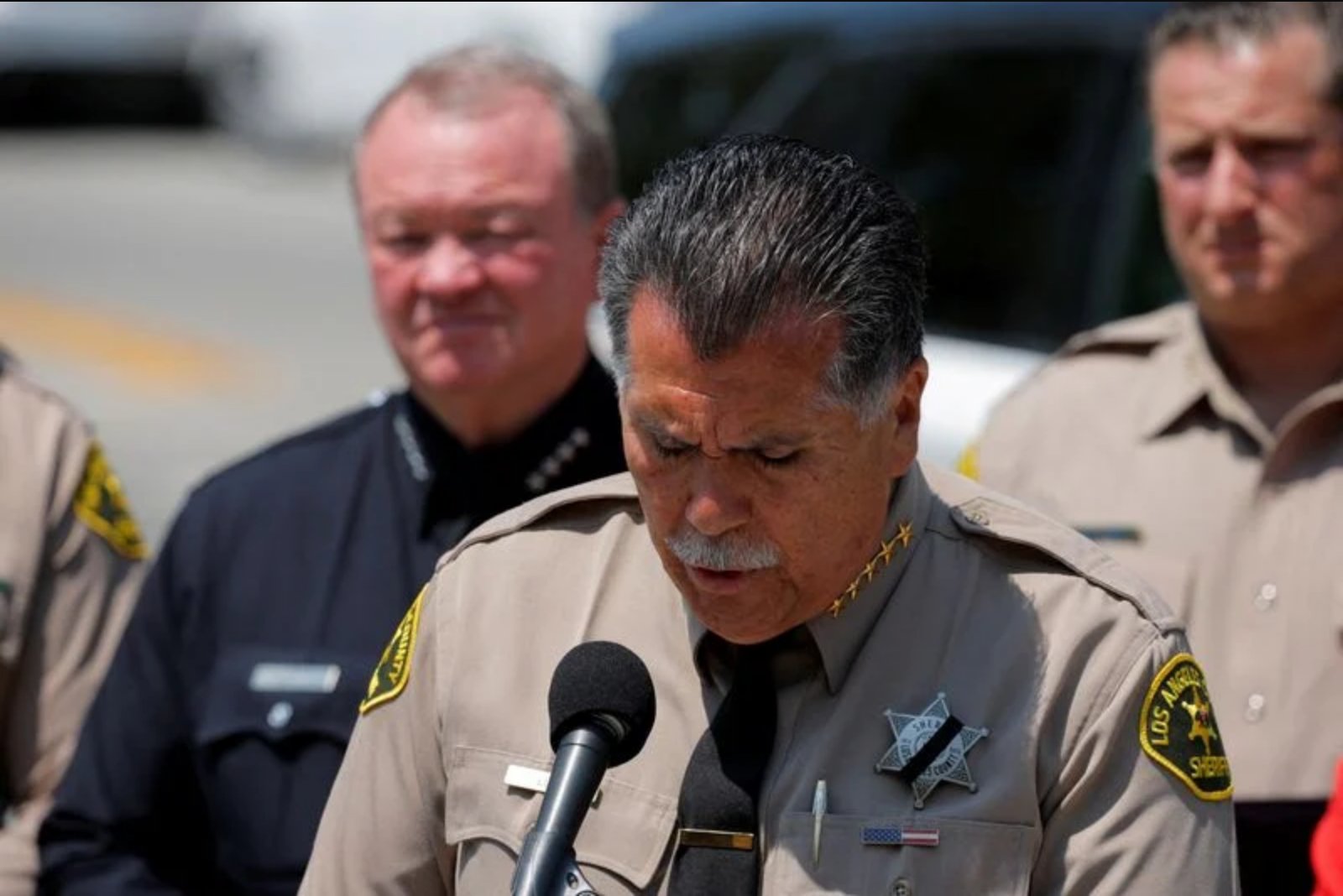
Federal authorities have communicated to Los Angeles County Sheriff Robert Luna that civil immigration enforcement actions by U.S. Immigration and Customs Enforcement (ICE) will not be carried out at FIFA World Cup matches or related events in Los Angeles, Luna said on Monday as multiple agencies presented security plans for eight games set to start on June 12.
Speaking at a joint news conference involving local, state and federal law enforcement representatives, Luna addressed recent reports and rumors suggesting ICE presence at the games. He said he contacted the head of the Department of Homeland Security for the Los Angeles region, who indicated federal agents will participate in security operations around venues and ancillary events, but that civil immigration enforcement would not be undertaken at any of the matches.
Luna underscored that the current assurances could change, but expressed confidence in the information provided by federal counterparts. He warned that if civil immigration enforcement were to occur at the games, it would create a new set of complications for organizers and authorities.
Heightened staffing for Iran matches
Officials said law enforcement will augment staffing and monitoring around the two Iran fixtures scheduled to be played in Los Angeles, citing the potential for protests or related activity in and around the stadium and fan zones. Iran is slated to play its first match of the tournament on June 15 at SoFi Stadium, located near Los Angeles, a metropolitan area noted in the briefing for hosting the largest concentration of Iranians outside Iran.
Authorities noted that Iran brings a distinct set of considerations to the security planning because of ongoing global events. The briefing reiterated that Iran and the United States are in negotiations to end their three-month-old war, and said that additional personnel will be allocated to some of the games involving Iran.
Drone restrictions and enforcement
Officials warned of a strict enforcement posture regarding unauthorized drones near World Cup venues, with temporary flight restrictions expected to be in place around the facilities. Patrick Grandy, the FBI assistant director in charge, explained that the capability exists to bring down a drone that violates a temporary flight restriction, and stressed that operations would repeatedly monitor areas around the venues for such violations.
"If a drone’s violating a temporary flight restriction, the capability exists to bring that drone down into a safe location away from the crowds," Grandy said, adding there would be "a zero tolerance policy" for deliberate breaches.
Large law enforcement presence and prosecution posture
Los Angeles District Attorney Nathan Hochman described the security operation as bringing an unusually large law enforcement footprint to the region for the duration of the tournament. He framed the period from June 11 through July 19 as a time when criminal activity will be met with active prosecution.
"Between the dates of June 11th, all the way through July 19th, if you are a criminal, this is a terrible time to commit a crime," Hochman said. "The district attorney’s office will prosecute you, and you will be punished."
Context and public response considerations
Law enforcement officials recalled that immigration raids conducted by masked ICE agents in Los Angeles last year prompted widespread demonstrations in the region. That history factored into the sensitivity around operational planning and the federal assurance that civil immigration enforcement would not be carried out at the matches, at least under the current guidance.
Officials reiterated that federal agents will nonetheless be part of an integrated security posture to ensure safety at both the primary venues and the various scoped and unscoped events related to the tournament. The precise composition and roles of those federal personnel were described as necessary to secure the events but with the caveat that policies could be altered in the future.
As authorities move toward the opening fixtures on June 12, the emphasis in public statements was on visible preparations: increased staffing around select matches, active monitoring for drone incursions, and an elevated prosecutorial stance designed to deter criminal activity during the event window.