
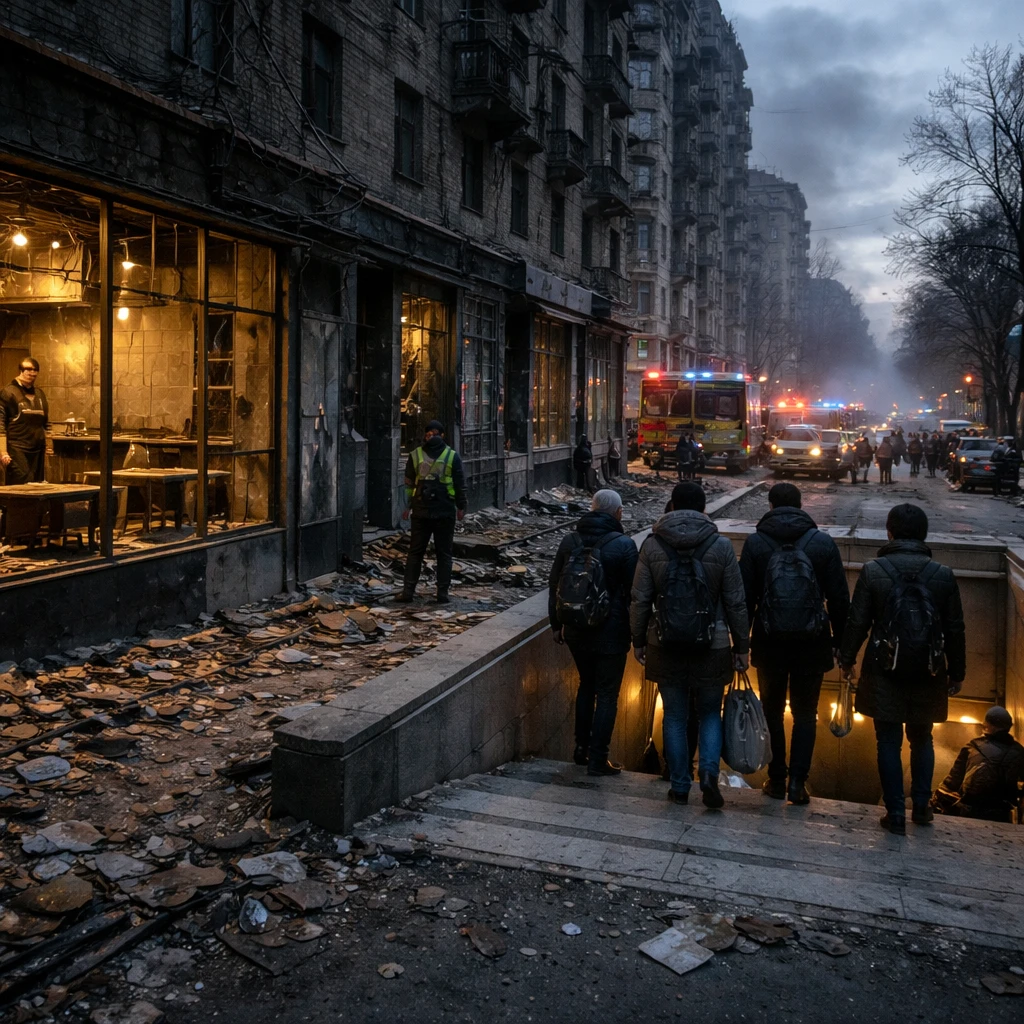
KYIV, May 26 - After years of war and repeated attacks, many Kyiv residents reacted to Moscow's statement that it planned "systematic strikes" on the capital with fatigue and defiance rather than panic. The Russian government urged foreigners and diplomats to leave, but locals interviewed in the city said they intended to stay and carry on.
Russia claimed the Monday announcement followed what it called a retaliatory operation, saying Sunday’s barrage was in response to a Ukrainian drone strike on a student dorm in the Russian-occupied Luhansk region. Ukrainian forces described their action as a strike on a Russian drone unit. Kyiv, for its part, has carried out long-range drone attacks into Russia targeting oil and gas facilities and has attacked military logistics and command-and-control centres inside territory it says is occupied by Russia.
The latest heavy missile and drone bombardment on Sunday resulted in significant harm across the city. Ukrainian authorities reported three people killed, more than 90 injured and around 300 sites damaged. A separate strike on May 14 killed 24 civilians in Kyiv, underscoring the recent intensity of attacks on the capital.
Locals expressed a mixture of exhaustion and steady resolve. "I think that those threats are manipulation: more aimed at sowing panic among the public," said Oleksandr Korzh, a 43-year-old former serviceman in Kyiv. "I will stay in Ukraine, and I will stay in Kyiv." Viktoriia Paramonova, 21, a barista who works in a cafe hit during Sunday’s strikes, said: "Honestly, our people are tired of this, and I am also tired of this war."
Despite the toll, many residents emphasized an acceptance of the reality and routines that have developed since the invasion. "We take them (Russian threats) seriously because, basically, they are constantly bombing us. They bombed us all winter and they are still bombing us now," said Kateryna Kozechenko, 38. "Nothing new, everything’s as usual - we are ready. We always go to the shelter."
Analysts questioned whether Moscow could significantly increase the tempo and scale of air assaults. Mykola Bielieskov of Ukraine’s National Institute For Strategic Studies said combined attacks at the scale seen on 13-14 May or 23-24 May would require Russia to accumulate missiles because, he said, there is no spare capacity in people, money or production to raise missile output substantially above current rates attained in 2024-25. Bielieskov characterised the threats as "bluster," suggesting they may be intended to distract from setbacks on the battlefield and disruptions to energy production caused by Ukrainian strikes on infrastructure.
On the ground, residents and businesses are adapting to the ongoing danger while continuing daily life when possible. The recent rounds of strikes have left parts of the city damaged and many people coping with loss, injury and the disruption of services. At the same time, public statements from authorities on both sides described the attacks in terms of retribution and countermeasures, illustrating the tit-for-tat dynamic that has marked operations over recent months.
Context and implications
The immediate public response in Kyiv has been a blend of wariness, routine preparedness and determined refusal to be driven from homes and workplaces. While residents noted exhaustion, they also described clear shelter procedures and a willingness to remain in place despite official warnings and recent civilian casualties and damage.