
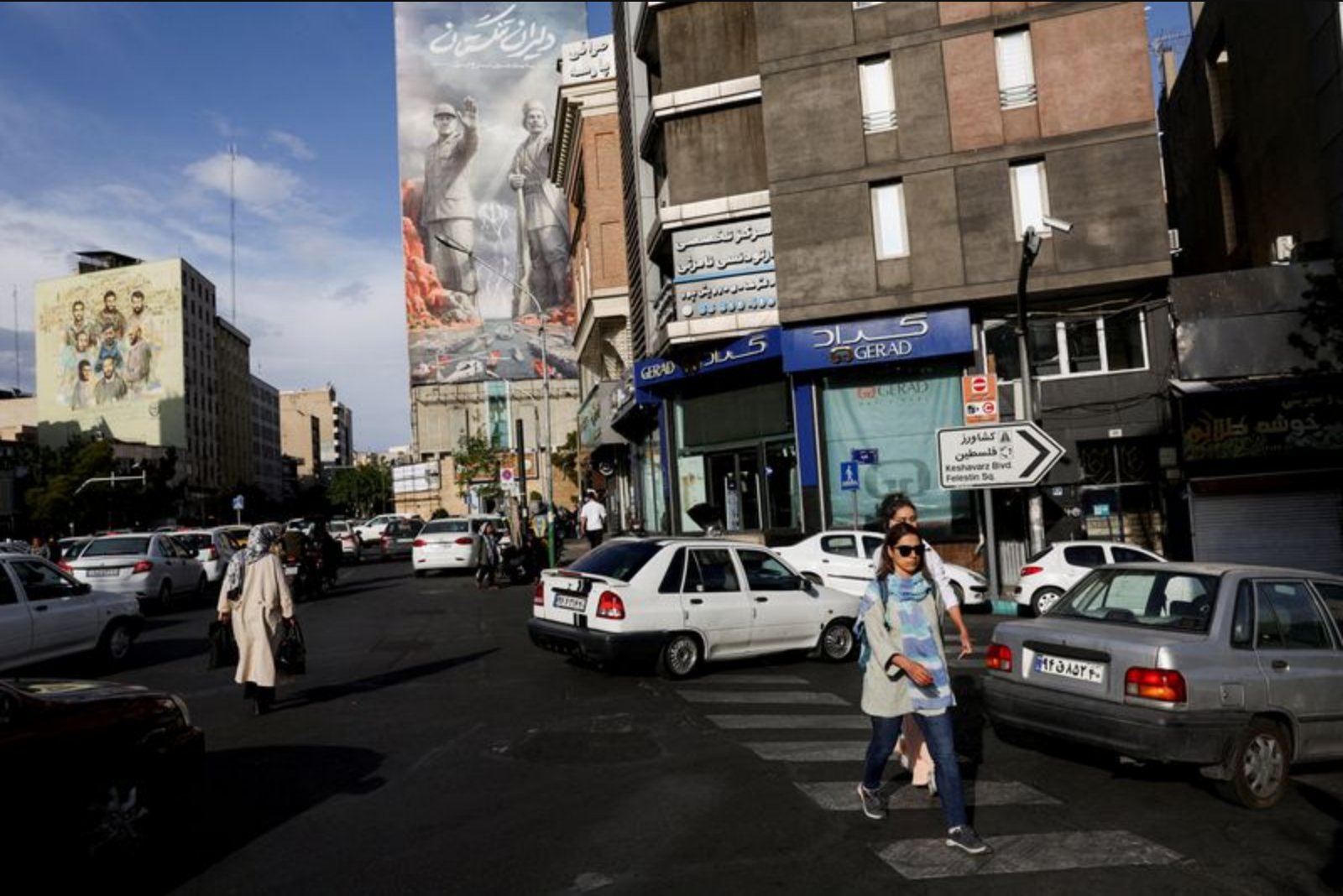
Iranian authorities have rolled out an extensive public relations push that replaces some long-standing revolutionary religious symbols with a more nationalist narrative aimed at portraying a united front at home and projecting strength abroad. Posters, televised footage and staged public events have proliferated in Tehran, alongside displays that link the Revolutionary Guards with the successful closure of the Strait of Hormuz to foreign vessels - an action authorities frame as forcing outside powers back to the negotiating table.
The visual and public messaging program includes murals and billboards depicting Guardsmen and the strait, televised segments of rallies and interviews with women shown without headscarves, and large-scale public spectacles such as military-themed mass weddings and weapons drills in mosques. Organizers have used these events to emphasize a theme of national resistance rather than the explicitly religious revolutionary rhetoric that dominated previous decades.
Analysts and some Iranian citizens say the shift toward nationalist imagery is a deliberate effort to broaden appeal beyond the core hardline base. "The old ideology of the Islamic Republic no longer really had much traction within the society. And therefore there was a need to draw on other elements of Iranian identity that could mobilize masses," said Ali Vaez, Iran project director at the International Crisis Group.
Despite that intention, Vaez and others caution that the campaign's effectiveness is uncertain among a population described in interviews and commentary as deeply disillusioned. Authorities face a difficult domestic situation: an economy already in poor condition before the conflict now risks further disintegration, and a continuing campaign of repression signals official fear of renewed internal unrest.
State messaging leans on traditional themes of resistance to Western influence and vilification of external adversaries while downplaying some religious iconography long associated with the Islamic Republic. Shi'ite motifs of martyrdom that were a mainstay for decades have in part been sidelined in favor of Persian national and historical figures that previously were viewed with suspicion by the clerical establishment for their connections to a pre-revolutionary past.
Visuals that would have been rare on state television until recently - such as interviews with women without headscarves - are now incorporated into coverage of public gatherings. Prominent analysts disagree on how persuasive these images will be overall. "It\'s an attempt to show that everything is normal in Iran, we\'re all united and we don\'t butcher our own people," said Ali Ansari, professor of modern history at the University of St Andrews in Scotland. "It\'ll work to some extent with waverers in the middle but most Iranians don\'t believe it really."
The authorities have also foregrounded the closure of the Strait of Hormuz - a vital global oil supply route - in their domestic and international messaging. Posters and online material depict Revolutionary Guardsmen in triumphant or mocking stances toward U.S. forces, including one image showing Guardsmen holding a fishing net laden with captured U.S. ships and aircraft. Another large poster represents a cloth stapled over the face of the U.S. president in the shape of the strait.
These images build on a long tradition of portraying Iranian heroism and casting the United States as an adversary. Yet the government has gone further by elevating national heroes from Persian history. One prominent poster places Rais Ali Delvari - a guerrilla leader who resisted British encroachment on Iran\'s Gulf coast a century ago - alongside a Revolutionary Guards commander, both shown standing resolutely as if to block the strait.
Some Iranians view the wartime-oriented banners and pageantry with suspicion. "These banners showing national heroes are for wartime purposes. After that they will come back against us and the repression will begin," said Narges, 67, a retired government employee in Shiraz who asked not to give her family name.
Observers inside Iran say the conflict has accelerated a transfer of influence from the clergy to Revolutionary Guards commanders, reflecting a broader reorientation of power that had been underway for years. "The direction of travel when it gets to the narratives that the regime is putting out there is actually indicative of the transformation that the regime is undergoing. It is moving from a theocratic system into a military one," Vaez said.
State imagery also emphasizes patriotic symbols beyond military figures. Photographs of the national football team saluting, and displays of the new Supreme Leader Mojtaba Khamenei accompanied by a large Iranian flag, further the message of national unity and state resilience.
Authorities have sought to use the impact of external strikes and inflammatory rhetoric from foreign leaders to recast the conflict as a broader attack on the Iranian state rather than a specific campaign against the Islamic Republic. "These have all helped the Iranian regime to portray this war, not as a war against the Islamic Republic, but a war against Iran as a state," Vaez said.
To ensure visible public support, the authorities have staged near-nightly rallies during the conflict, but sentiment among participants and observers is mixed. Some participants tell journalists and analysts that the events are performative - aimed at presenting unity rather than addressing pressing problems such as economic distress. "It\'s all a game, a performance meant to show the world that people are with the system. Instead of these displays they should fix the economic situation," said Arshia, 23, a recent French-language graduate from Yazd.
Views among supporters of the system are not uniform either. Mohammed, 26, a hardline student in Tabriz, said the patriotism on display felt genuine, but he expressed discomfort at seeing unveiled women interacting with unrelated men in the crowds. "This is not what the revolution was for," he said.
Some staged events have combined celebratory elements with overt military symbolism. A recent mass wedding involved couples being paraded in Revolutionary Guards vehicles decorated with balloons and machineguns, alongside models of ballistic missiles painted an incongruous flamingo pink. State television also aired footage of weapons training sessions held in mosques, where instructors demonstrated how to strip and fire assault rifles to men and women.
That mix of spectacle and force may serve a dual purpose: bolstering the appearance of popular backing while reminding dissidents that the authorities can rely on heavily armed support. "It goes to the heart of the fact that the regime is not as secure as it\'s pretending to be. They\'re presenting to their own people that this is a regime that is tough," Ansari said.
Summary
Iranian state authorities have intensified a campaign of nationalist propaganda that substitutes some long-standing religious revolutionary symbols with Persian national imagery and military pageantry. Events and visuals - including posters about the Strait of Hormuz, mass weddings with military trappings, and weapons training in mosques - aim to convey unity and resistance even as analysts and citizens question the campaign's ability to counter deep economic problems and domestic discontent.