
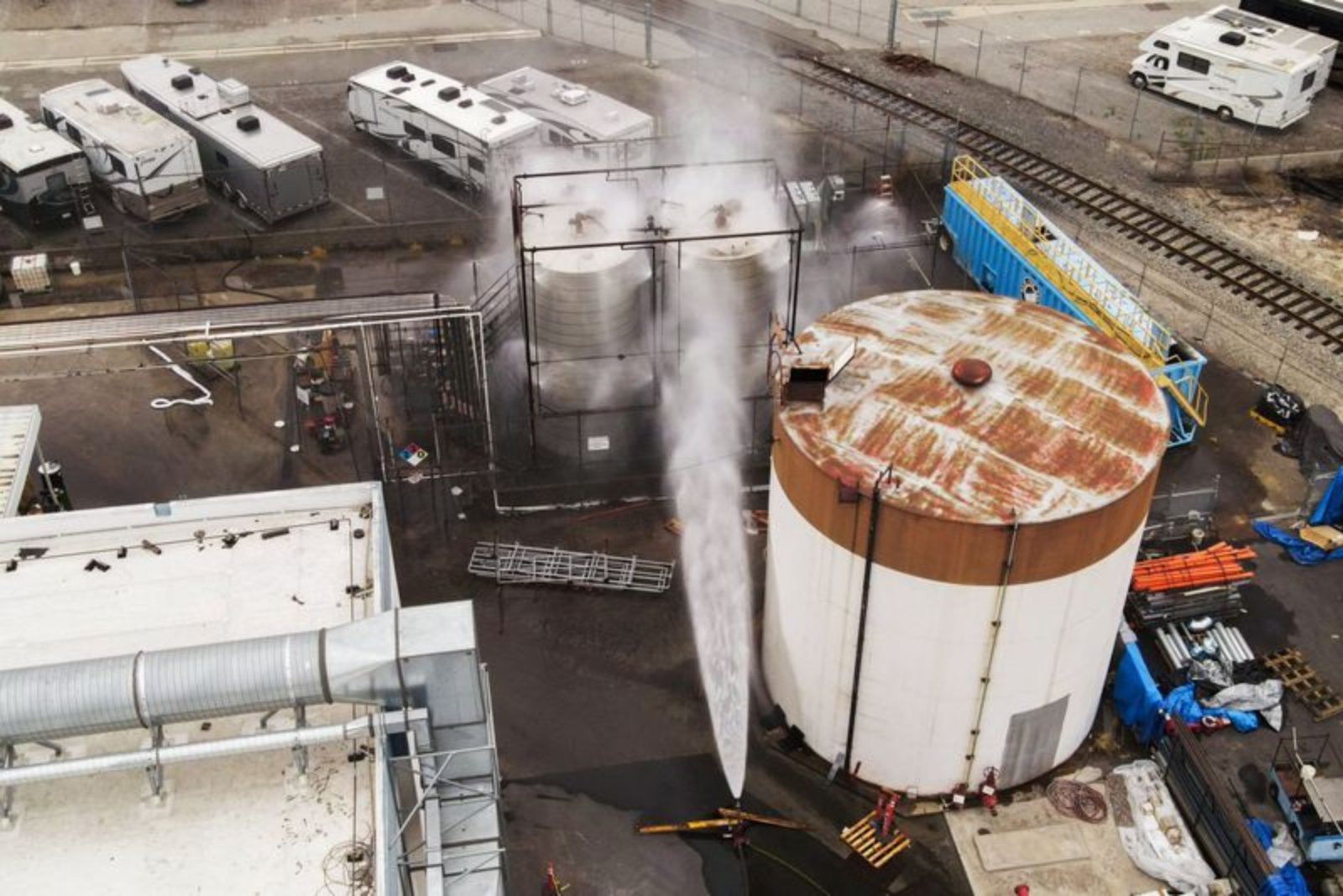
Firefighters working to avert a catastrophic failure at a chemical storage tank in southern California discovered overnight that the vessel was warming from the inside even though crews had been applying cooling water to its exterior, the incident commander said.
The discovery has kept evacuation orders active for an area that covers tens of thousands of residents in Garden Grove, a suburb south of Los Angeles, and prompted California's governor to declare a state of emergency for Orange County. Officials urged residents to comply with the evacuation so emergency teams can continue their work without additional complications.
Drone readings and on-site gauge tell different stories
Crew members had returned to the hazard zone after drone observations on Friday indicated that water being sprayed on the tanks was stabilizing conditions. However, those drone sensors measured the exterior of the vessel and did not capture the temperature of the chemical held inside, Orange County Fire Authority Division Chief Craig Covey said in an update posted to social media.
When responders reached the tank's gauge, they found the internal temperature had risen to 90 degrees Fahrenheit (32 degrees Celsius), up from 77 degrees (25 degrees Celsius) when crews previously withdrew from the area. Covey said the internal temperature was climbing at about one degree per hour. "That’s the bad news," he said.
The tank contains methyl methacrylate, a flammable chemical used in plastics and manufacturing. Officials have warned the vessel could rupture, spilling up to 7,000 gallons (26,500 liters) of the material, or possibly explode and imperil adjacent tanks.
Operational adjustments and response options
Firefighters said they were evaluating whether a heavy flow of cooling water directed at the tank might slow the curing process inside the vessel, reduce internal pressure and lessen the chance of an explosion. "Letting this thing just fail and blow up is unacceptable to us," Covey said. "Our goal is to find something and not allow that to happen."
Overnight operations moved from a protective, "defensive" posture to a more active, "offensive" approach with assistance from chemists assigned to the manufacturer's emergency response team. One objective of the offensive efforts was to neutralize a nearby 15,000-gallon tank to lower its explosive potential if the smaller vessel failed. "We did put people in harm’s way last night," Covey said.
Crews also prepared for the possibility of a liquid release by planning dikes, dams and diversion strategies to capture spilled material within a holding area on site, rather than allowing it to flow into storm drains, river channels or the ocean. "We are not giving up," Covey added.
Incident origin and the company response
The event began on Thursday at the GKN Aerospace facility in Garden Grove. The company, which notes that the site specializes in manufacturing and testing windows and canopies for commercial and military aircraft, said it is collaborating with "all relevant experts" to resolve the problem.
In a statement on Saturday, a GKN spokesperson apologized for the disruption to local residents and businesses forced to evacuate. Officials expanded evacuation orders on Friday after the assessed risk of an explosion increased.
Evacuations, shelters and public health monitoring
Authorities have set up evacuation shelters in Garden Grove and the nearby cities of Anaheim and Cypress. Garden Grove Police Chief Amir El-Farra said roughly 15 percent of people in the evacuation zone were refusing to leave, according to the Orange County Register.
Health officials cautioned that vapor from methyl methacrylate could cause severe respiratory problems if people experience prolonged exposure. As of the most recent health agency update cited by officials, air-quality monitors had not detected vapor from the chemical at detectable levels.
"You are safe as long as you are out of the zone that was determined to be an evacuation zone," Dr. Regina Chinsio-Kwong of the Orange County Health Care Agency said on Friday.
In addition to cooling and neutralization efforts, fire crews continued to monitor and test air quality while preparing containment measures in case of a spill. The combination of internal heating, the flammable nature of the chemical, and the proximity of other storage tanks has driven planners to consider multiple response paths and to keep evacuation orders in force.
Outlook
Officials continue to weigh technical options intended to reduce internal pressure within the affected tank and to limit any downstream contamination from a potential spill. On-site teams are coordinating with chemists and the facility's emergency response personnel as they pursue cooling, neutralization, and containment tactics. Public safety measures, including evacuation and sheltering, remain central to the ongoing response.