
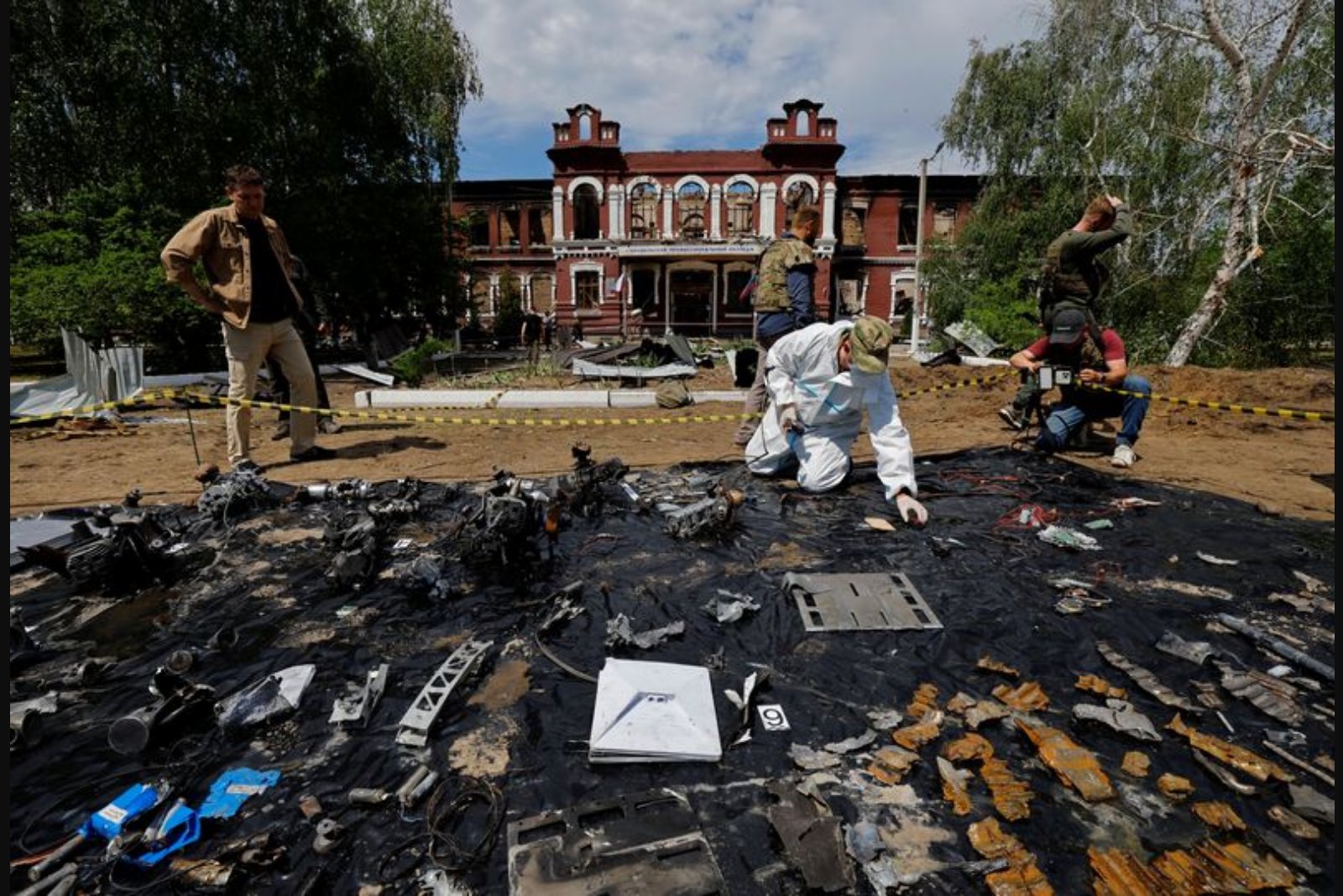
Forensic teams on Sunday moved through the ruined remains of a dormitory that Russian authorities say was largely destroyed in a drone strike on a teacher training college in the Luhansk region. The area has been under Russian control since early in the conflict.
Russian officials said search operations finished late on Saturday and that the attack left 21 people dead, many of them young women. The facade of the building bore large, gaping holes and dozens of windows were blown out. Outside, piles of twisted metal and fractured concrete lay where a courtyard once opened; inside, wrecked desks and cupboards were heaped among the debris.
On Friday, workers in protective gear laid pieces of metal and assorted fragments on a tarpaulin while personnel from Russia's Investigative Committee collected data related to the incident. The facility displayed official Russian state insignia and posters, one of which offered instructions on how to act against "the threat of terrorism." A group of people gathered outside the damaged building, holding up photographs of those killed.
Russian authorities described the strike as occurring in three waves of unmanned aerial vehicles, each wave separated by 10-15 minutes. Yana Lantrova, identified by officials as Russia's Human Rights Commissioner, told journalists that 16 UAVs were involved in total and said the attackers had waited for children to run out before firing directly at them.
Ukraine's military rejected responsibility for the attack on the dormitory. Ukrainian officials said their forces had struck what they described as an elite drone command unit in the area and said that their operations complied with international humanitarian law.
Reporting from Starobilsk took place during a media facility trip organized by the Ministry of Foreign Affairs of the Russian Federation on May 24, 2026. Independent verification of the sequence of events described by Russian authorities was not possible.
Following the dormitory attack, Russian President Vladimir Putin instructed the military to prepare options for retaliation. Within a little more than 24 hours, Russian forces struck Kyiv and surrounding areas with hundreds of drones and missiles in what officials described as one of the heaviest bombardments of the city since the start of the conflict. Russian statements said the overnight barrage killed four people and included the firing of an Oreshnik hypersonic missile south of Kyiv.
Damage at the teacher training college was visible and extensive. Photographs taken at the scene and descriptions from officials detailed a building with its exterior ripped open and interiors strewn with the remnants of daily life for students and staff. Investigative workers photographed and cataloged fragments taken from the wreckage as part of efforts to determine the nature of the munitions used and the sequence of the incident.
Both sides presented starkly different accounts of who was responsible and what was targeted. Russian authorities attributed the destruction to a Ukrainian drone attack on the dormitory, while Ukrainian officials said their strike targeted a military drone command element in the area and denied intentionally striking civilian accommodation. The available information did not allow for independent confirmation of either version.
The events in Luhansk and the subsequent large-scale strikes on Kyiv and surrounding areas underscore the immediate human toll and the challenges of independently verifying competing claims in an active conflict zone. Forensic teams continue their work amid damage that has left a teacher training facility in ruins and dozens of people dead or injured.