
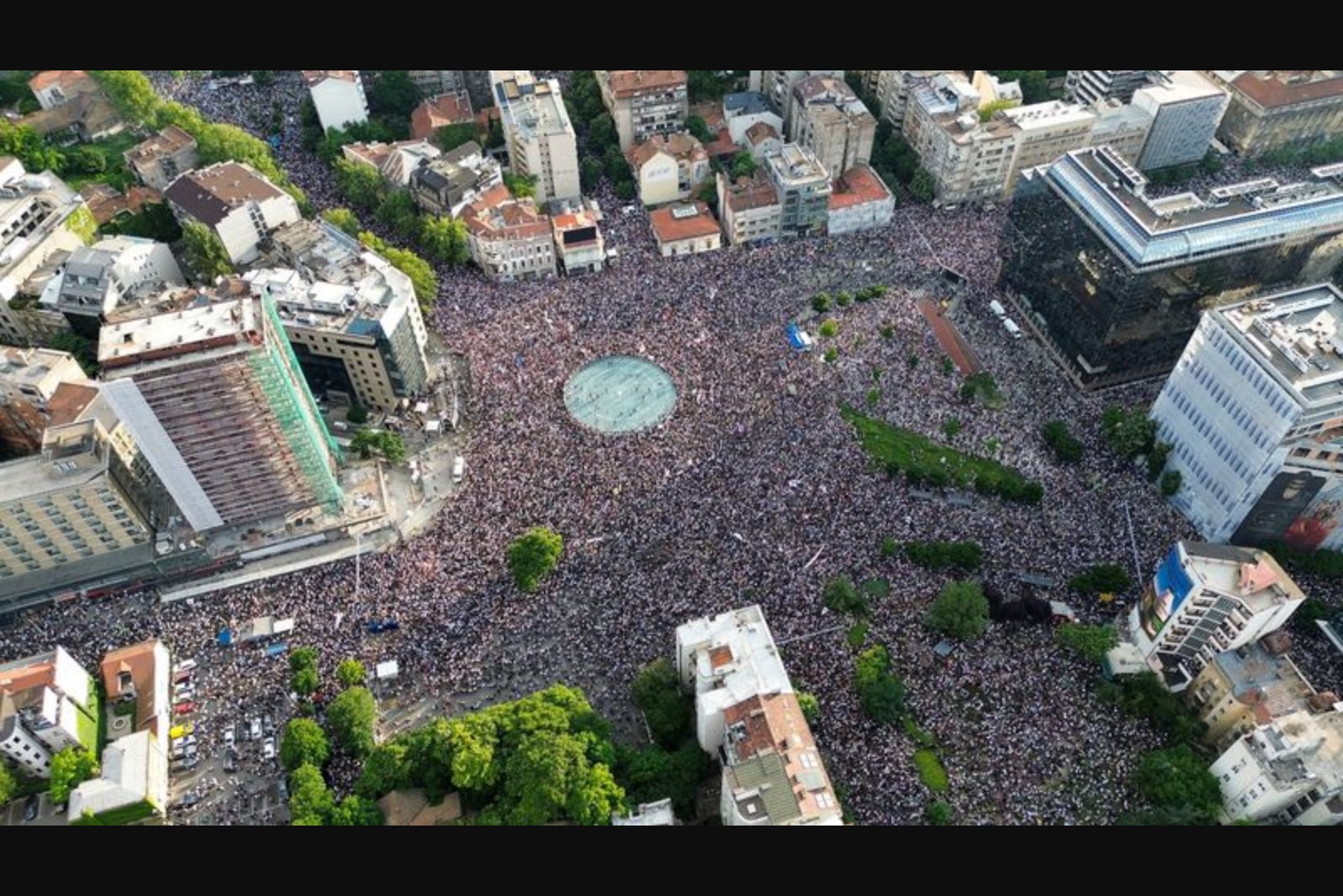
Police in central Belgrade deployed teargas and engaged in skirmishes with demonstrators on Saturday after large crowds assembled to press for early elections and an end to the long-running rule of President Aleksandar Vucic. The gathering swelled around Slavija Square, one of the city’s principal junctions, in the latest wave of demonstrations that began roughly a year and a half ago following a deadly roof collapse that catalysed a youth-led movement protesting alleged corruption and mismanagement.
Officers in riot gear established a cordon around Belgrade city hall, located about a kilometre from the square, before sporadic clashes occurred near the presidential office and outside a park where Vucic’s supporters have been camped since March of last year. Police actions included firing teargas and using stun grenades as they pushed some protesters further down the street.
Scenes at the demonstration included bins filled with rubbish set alight by some in the crowd. Many protesters wore badges bearing a red hand and the slogan "Your hands are bloody," while banners proclaiming "The students are winning" were visible among the assembled crowds.
The origins of the anti-government protests are noted in two related incidents cited by organisers and observers: the deadly roof collapse that sparked the initial youth-led movement about a year and a half ago, and a separate awning collapse at a railway station in Novi Sad on November 1, 2024. Protesters, opposition figures and rights monitors have described those incidents as indicators of wider mismanagement.
President Vucic and his close political allies reject allegations of corruption and suppressing critics. They assert that measures have been taken to hold accountable those responsible for the roof collapse. Ahead of the confrontation with police on Saturday, Mirjana Nikolic, rector of Belgrade’s University of Arts, addressed the crowd and said: "This government is ... afraid of those who are defending their dignity and their rights." Her words were met with cheers from the assembled demonstrators.
Estimates of the size of the demonstration varied. Police placed the number of people in the square and surrounding streets at 34,300, while the Archive of Public Gatherings, an organisation that monitors public events, estimated the crowd at around 100,000.
Participants described their reasons for attending. Dragan Djuric, a 55-year-old farmer from the town of Sabac, told the rally: "I came here to show how many of us there are, how many unhappy citizens are and that it is a high time to organise election to make things better."
The events on Saturday underscore the persistence of public discontent that began following the construction-related incidents and have continued into prolonged demonstrations and counter-presence by supporters of the president. The situation included moments of confrontation between police and protesters as authorities sought to control movement near key government buildings.