
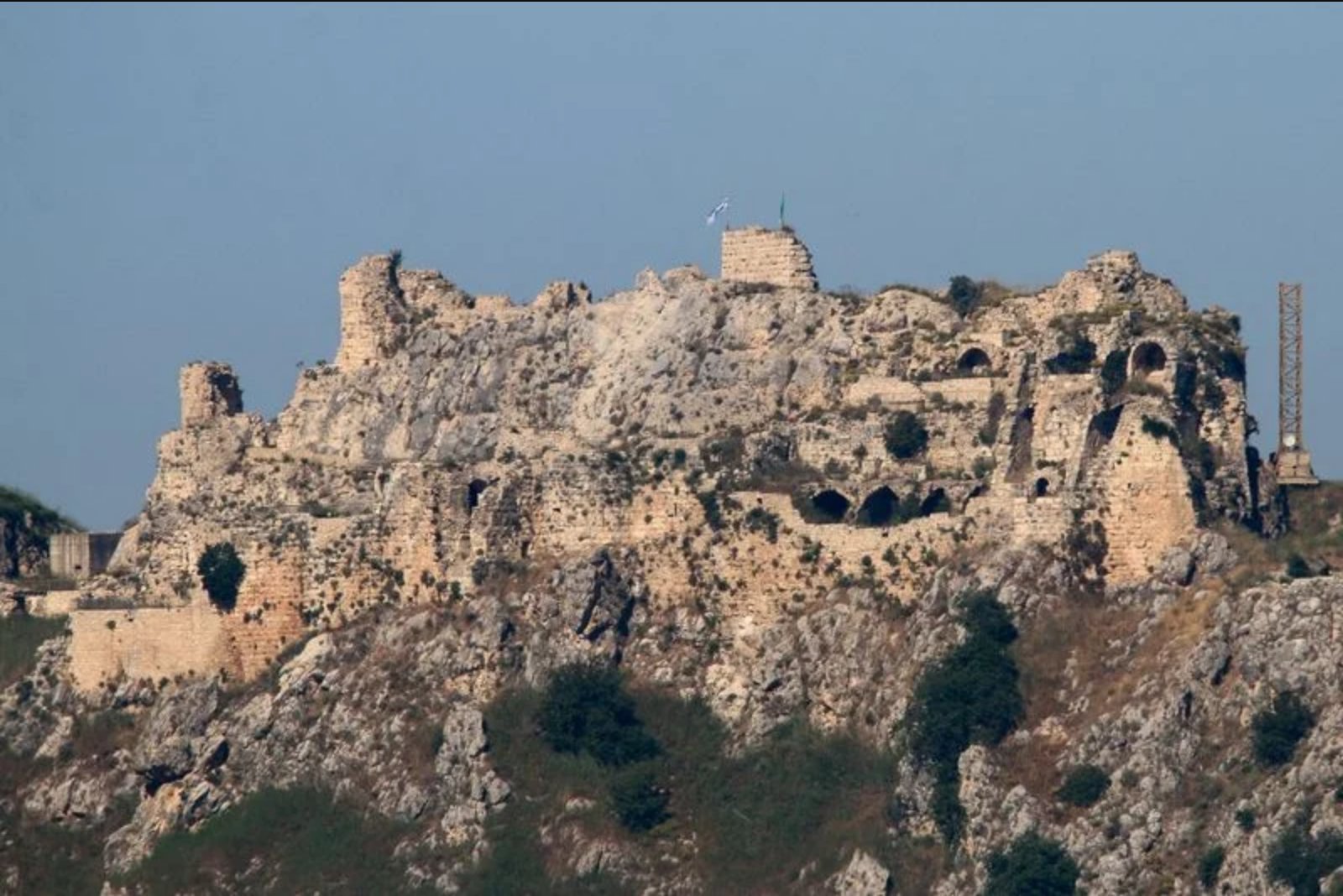
The stone ramparts of the Beaufort Castle rise sharply above southern Lebanon, offering commanding views of the surrounding valleys and coasts and making the site a potent military symbol as well as a historical landmark. Israeli forces entered the Crusader-era fortress on Saturday, returning to a position they held during their 1982-2000 presence in southern Lebanon.
The capture of the 900-year-old stronghold was hailed by Israeli Prime Minister Benjamin Netanyahu, who has faced criticism at home over his handling of conflicts with Lebanon and Iran. "I remind you that, 44 years ago, this place was a symbol of a heroic battle by our fighters, but it was also a symbol of deep division among us," he said. "Today, we returned to Beaufort differently. We returned united, determined, and stronger than ever."
Hezbollah, the Iran-backed Shi'ite group currently at the center of the new war with Israel, said it did not have a military presence within the castle at the time Israeli troops entered. The group added that combat in nearby areas was ongoing.
Geography underpins Beaufort’s strategic value. Perched above the Litani River, the fortress commands views eastward to the Israeli-occupied Golan Heights, roughly 10 km away, and westward to the Mediterranean Sea, about 25 km distant. Those vantage points made the site a prized position for successive military actors across centuries.
Built in the 12th century by a Crusader ruler atop earlier fortifications, Beaufort passed through the hands of the great Muslim leader Saladin and later the crusading Knights Templar, before coming under the control of Egypt’s Mamluk dynasty. Despite the technological evolution of warfare that includes drones and other modern systems, independent Middle East security analyst Riad Kahwaji said the castle’s positional value endures. "The site for the castle was chosen because of its significant strategic location. The significance has not declined with time. It’s still important, especially in ground operations," he said.
By recent decades Beaufort had become a picturesque ruin, known more for its historical character than as an active military installation. But Lebanon’s descent into civil war after 1975 saw the Palestine Liberation Organisation use the site as a base for operations against Israel. When Israel mounted its 1982 invasion, reaching as far north as Beirut, its forces took control of the castle and established it as a center of operations in the south, where the local population is majority Shi'ite Muslim.
The physical fabric of the castle still carries scars from those years. Shelling and strikes left visible marks on the walls during clashes in the 1970s when Israel targeted PLO positions and later during repeated Hezbollah attacks on the Israeli garrison across the 1980s and 1990s. For many Lebanese, Beaufort came to embody the reality of occupation, with Israeli flags flying from one of the region’s most prominent hills and soldiers looking down on nearby communities.
"The fact that they’re back now in Beaufort I think is reminiscent of that era and that level of control over people’s lives," said Mohanad Hage Ali, deputy director for research at the Carnegie Middle East Center. "It’s an occupation that you can see."
The Israeli withdrawal from Lebanon in 2000, driven in part by persistent Hezbollah attacks, turned the site into a symbol of triumph for the group. When the yellow Hezbollah flag flew from the battlements, it served as a visible focus for the movement’s narrative of victory. That symbolism produced mixed reactions inside Israel, where the castle had been seen both as a marker of military heroism and, for some, as a reminder of the futility of prolonged involvement in Lebanon.
Danny Orbach, a military historian at Hebrew University of Jerusalem, said Beaufort carried those dual meanings. "It was a symbol for heroism," he said. "But it was also a symbol in the eyes of many of the futility of war; the narrative that Israel has nothing to do with Lebanon." Orbach added that recent military gains against Hezbollah in 2024 and the seizure of territory in Lebanon this year may be reshaping that perception. "Israel occupying Beaufort is actually telling Hezbollah and the world: we overcame the trauma. We’re not afraid anymore," he said.
Although Israel and Hezbollah fought another brief war in 2006, Beaufort largely ceased to function as an active military site in the years afterwards and underwent careful restoration as a tourist attraction. UNESCO, the U.N. cultural agency, describes Beaufort as among the best-preserved medieval castles in the Middle East and this year placed it on a special list for enhanced protection amid the conflict. Israel is not a member of UNESCO.
The current fighting has exacted a heavy toll on Lebanon at large. Military operations in the campaign have devastated areas surrounding the fortress and driven hundreds of thousands of people from their homes. That displacement and the physical damage to cultural sites and civilian infrastructure are part of the broader humanitarian and material consequences of the renewed war between Israel and Hezbollah.
Context and implications
Beaufort’s capture is simultaneously tactical and symbolic: tactical because of its commanding position on the landscape and symbolic because of its long association with occupation, resistance and national narratives on both sides. The fortress’s history as a Crusader stronghold later contested by Saladin, used by the PLO, occupied by Israeli forces and claimed by Hezbollah illustrates the layers of conflict embedded in the site.
As the conflict continues, the castle’s role as both heritage site and contested military position highlights the intersection of cultural preservation concerns and active hostilities in the region.