
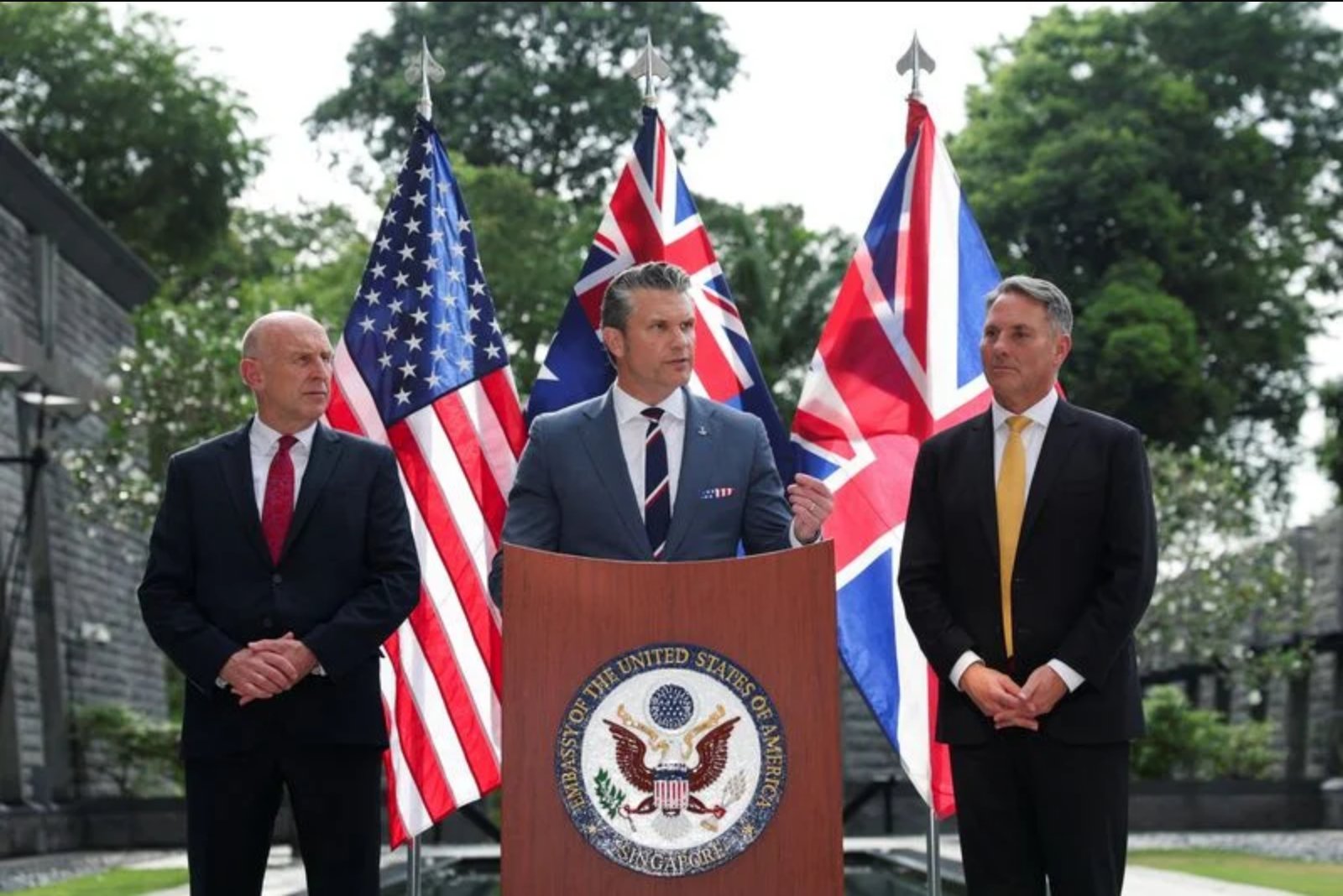
The United States, Britain and Australia have launched a collaborative programme to develop unmanned undersea vehicles (UUVs) as part of their trilateral AUKUS defence pact, U.S. Secretary of Defense Pete Hegseth told reporters on Saturday.
AUKUS said in a joint statement that delivery of the vehicles will begin in 2027. The partners described the programme as a means to strengthen their reconnaissance and strike capabilities and to "bolster superiority in anti-submarine and anti-surface warfare, mine countermeasures, electronic warfare, and contested littoral manoeuvre," the statement said.
The initiative is being pursued under AUKUS’s so-called "Pillar Two," the strand of the partnership focused on developing advanced defence technology such as quantum computing, undersea systems, hypersonic capabilities, artificial intelligence and cyber technology.
Hegseth characterised the UUV effort as a signature project of Pillar Two, saying: "The signature project will deliver a suite of highly adaptable multi-mission UUV payloads designed to support undersea operations and maintain our collective advantage in the maritime domain."
At the Shangri-La Dialogue in Singapore, Britain’s Defence Secretary John Healey said the programme will quickly equip the three nations with advanced battlefield technologies. "This will rapidly give our forces the very most advanced battlefield technologies as together we produce a range of cutting-edge sensors and weapons systems for undersea drones," he said.
Healey also noted that the unmanned undersea vehicles will enhance the partners’ ability to respond to a range of threats, explicitly including those aimed at underwater cables and pipelines. He added a pointed critique of past work under AUKUS, saying: "For too long in AUKUS, we talked too much and delivered too little." Healey made those remarks alongside Hegseth and Australia’s defence minister on the sidelines of the conference.
Formed in 2021, AUKUS has been framed by the three countries as an instrument to counter growing Chinese influence in the Indo-Pacific region. China has described the pact as dangerous and warned it could spur a regional arms race.
Programme officials emphasise that the UUV project will focus on adaptable, multi-role payloads capable of supporting a broad array of undersea missions. According to the partners’ statement and the officials present at the Singapore dialogue, the programme will contribute to anti-submarine and anti-surface warfare, mine countermeasures, electronic warfare and contested littoral manoeuvre while dovetailing with other advanced technology efforts under Pillar Two.
Delivery timing, operational employment and industrial participation are matters the partners will continue to define as the programme progresses toward its stated 2027 delivery start. Public comments at the Singapore meeting outlined the scope and intent of the project but did not provide additional technical or contractual specifics.