
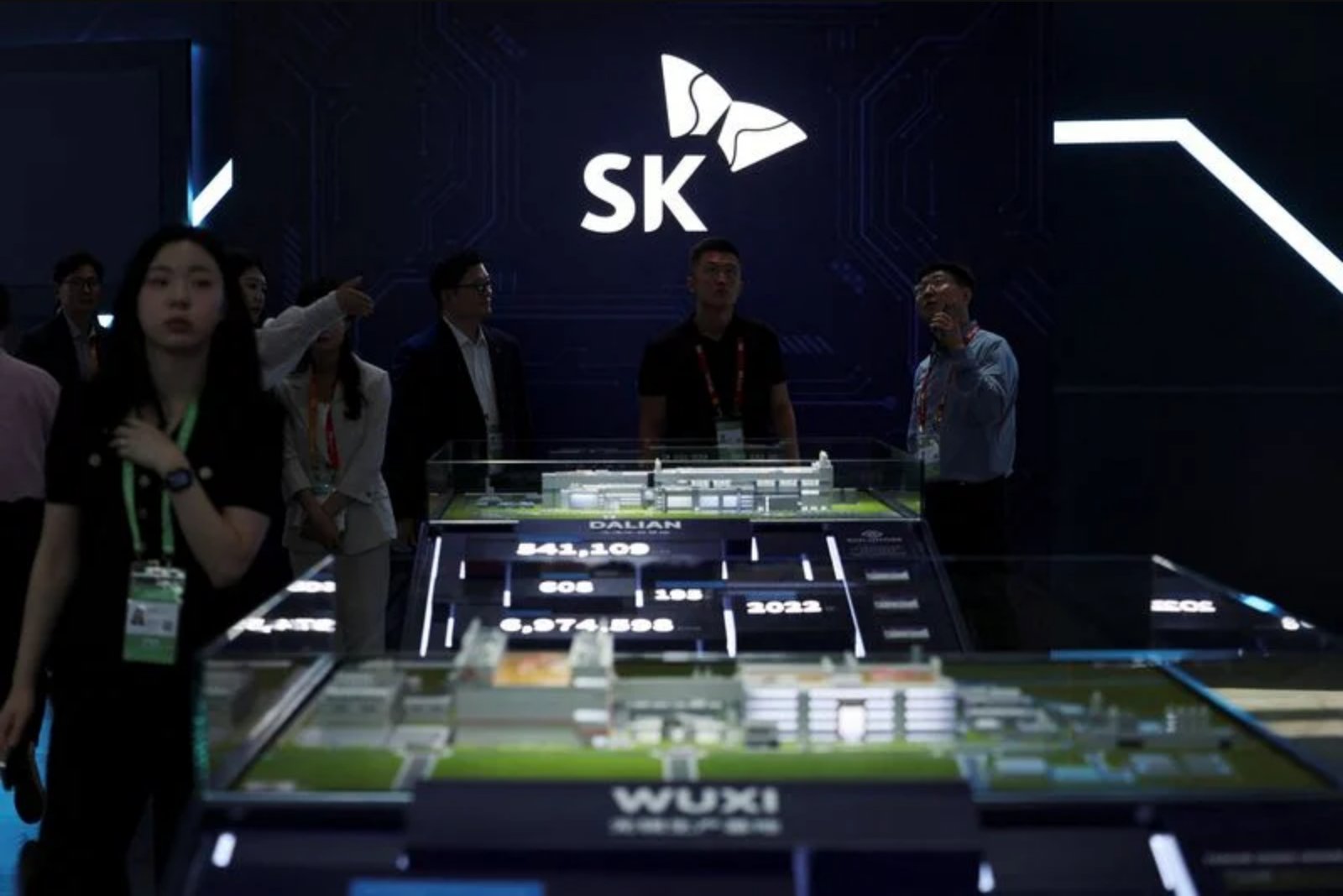
When SK Hynix steps onto the Nasdaq with a $26.5 billion listing, the ceremony will represent the culmination of a contentious corporate wager: the 2012 purchase of a money-losing memory chipmaker by SK Group that many inside and outside the conglomerate once regarded as a risky move.
At the time of the takeover, Hynix was not only unprofitable but also lagging Samsung Electronics in both market share and technology in the volatile, capital-intensive memory sector. Over the subsequent decade, however, Chairman Chey Tae-won directed the company toward a focused, high-stakes strategy - especially around high-bandwidth memory, or HBM - a technology that was niche then but which later became essential to AI hardware.
Company and industry leaders have credited that strategic focus for SK Hynix’s rise. Nvidia’s chief executive publicly acknowledged SK Hynix’s role, saying the chipmaker was the company’s largest memory partner and that without the partnership, the AI industry would not have developed as it has. Nvidia’s CEO made the remarks during a Seoul appearance in June, standing beside Chey as he listened.
Observers who followed SK Hynix’s internal shifts point to management choices that reinforced the technological bet. Kim Dae-il, a former board member at SK Hynix and an economics professor, highlighted Chairman Chey’s preference for elevating executives from within Hynix rather than installing managers from the broader SK Group. Kim credited Park Sung-wook, a longtime engineer chosen as CEO in 2013, with maintaining commitment to HBM despite boardroom skepticism.
"There was enormous investment behind SK Hynix’s rise to that position," Kim said, noting that Chey’s contribution was both strategic - making the right technological bets - and organizational - putting the right people in charge.
Concerns over sustainability of memory pricing and demand
Even as SK Hynix benefits from the AI-driven surge in demand for memory, Chairman Chey has cautioned that the current market dynamics may not be permanent. Chey, who studied physics at Korea University and pursued postgraduate work in economics at the University of Chicago, said in an April speech that the industry was facing a memory supply shortage. He added that while the shortage can be profitable, it was not a durable situation.
Those remarks come amid broader capacity moves in South Korea. Earlier this month, both SK Hynix and Samsung announced pledges to invest hundreds of billions of dollars in new domestic chip plants, a response framed in part by President Lee Jae Myung’s call for measures to reduce regional economic disparities. While the investments aim to meet surging demand, they also raise the prospect of oversupply in a business known for heavy cyclicality.
Ownership structure and personal profile
Chey is not a direct owner of SK Hynix, but he occupies a pivotal ownership position in the group’s corporate web. He is the largest shareholder of SK Inc, which in turn holds a 32% stake in SK Square - the top shareholder of SK Hynix. Forbes estimates Chey’s personal wealth at $5.4 billion.
Chey’s public profile departs from the often-private posture of many South Korean conglomerate leaders. His career has included public controversies and setbacks that have drawn attention alongside his corporate accomplishments. In 2015 he wrote a candid letter to a local newspaper acknowledging a personal family matter that split public opinion in a society where such issues are sensitive. He is currently involved in an acrimonious divorce settlement lawsuit with hundreds of millions of dollars at stake, a legal battle that could affect control of the conglomerate.
Chey also served more than two years in prison after being convicted of embezzling corporate funds, before receiving a presidential pardon in 2015. At the time of the pardon, the government said the decision was intended to give business leaders an opportunity to contribute to national economic development.
Where the industry stands
SK Hynix’s transformation from a struggling memory maker to a leading supplier of HBM has reshaped how some industry participants view memory suppliers in the AI ecosystem. The company’s emergence as a primary HBM producer has been linked explicitly to Nvidia’s AI accelerators, underscoring the interplay between memory vendors and AI hardware manufacturers.
But the memory market’s historic volatility, the scale of announced capacity investments, and the uncertainty over how long elevated memory prices will persist mean that the company and its peers face continuing demand and price risks. The industry’s next phase will be shaped by whether sustained AI spending absorbs new capacity or whether the sector re-enters a period of oversupply and tighter margins.
Currency note
The article used the following exchange rate for reference where needed: $1 = 1,503.7700 won.