
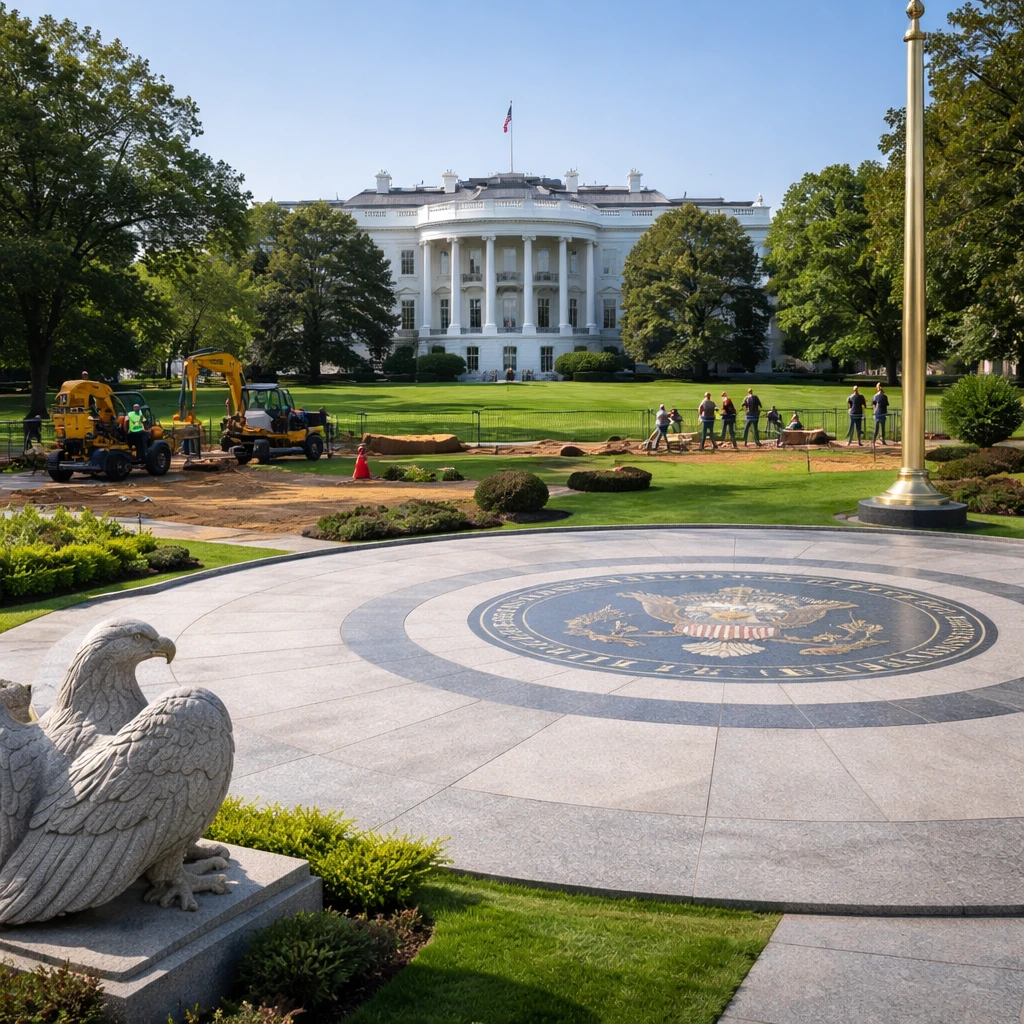
WASHINGTON, Aug 19 - Confronted by stalled Iran diplomacy, unease in financial markets and an approval rating at a historically low level, President Donald Trump returned to terrain familiar to him on Wednesday: construction and renovation. For roughly 30 minutes he escorted reporters across the South Lawn, positioning a series of White House projects as the centerpiece of the legacy he wants to leave.
Trump highlighted a newly laid granite driveway, a circular helipad carved from thick California stone, and a planned $400 million ballroom among a slate of renovations he said will both modernize and preserve the historic complex for future generations. "This building was falling apart. It’s falling apart - like buying a building in New York City that’s in bad shape and putting it back together. That’s what I used to do. I did it better than anybody, I think," he said as workers and equipment clanged in the background.
Throughout his second term the president has devoted significant attention to reshaping the executive branch's physical footprint in Washington. His Reuters/Ipsos approval rating now stands at 33%, tied for its lowest point ever, and yet he has shown no sign of slowing the effort to remake the White House, which he says had been allowed to deteriorate for decades.
Not all of the projects have been universally embraced. The ballroom in particular has attracted criticism and legal challenges. An appeals court recently ruled that any further construction would require congressional approval, and on Friday the president took the dispute to the U.S. Supreme Court, asking it to permit the work to continue.
On the tour, Trump began on a stretch of the driveway that had been asphalt for decades and is now faced with granite. He led reporters through a gap in a fence to the site of the new circular helipad, which he said is being donated by Sikorsky, the company that makes the Marine One helicopters that fly presidents.
Trump said the helipad was needed because exhaust from new helicopters had scorched the grass. He added that Scotts Miracle-Gro Company was donating new sod for the lawn and noted, "They actually contributed to my campaign." Pointing to a flagpole installed as part of the broader makeover, he said, "It’s a tapered pole. I’m very good at flagpoles."
At the helipad site, Trump used his trademark Sharpie pen to sign a granite eagle that will be embedded in the circular landing area. He said the stone will be installed with his signature not visible, and quipped that perhaps his name should be seen. The helipad itself is composed of 4-inch-thick (10-cm-thick) granite quarried in California and is engraved in large letters with: "The Seal of the United States of America."
"This will be here long after we’re gone," Trump said of the granite installation. "No matter what happens with the world, this is not moving. This will take any kind of shot." The president described the helipad as an improvement for state arrivals and as a practical surface for events, saying attendees could use it "almost like a table," host cocktails there, and then proceed to the ballroom once it is finished.
As the tour concluded, Trump briefly took questions about North Korea and Iran but returned repeatedly to the subject that dominated the outing: how the White House will look and function for visitors in the years to come. He emphasized how the changes - from the granite driveway to the helipad and the ballroom - fit into a broader vision of restoring and enhancing the grounds and interior spaces.
Legal and political pushback has not deterred the administration from pressing forward. Despite criticism and the appeals court direction that further construction required congressional sign-off, the president has asked the Supreme Court to allow the projects to proceed, signaling an intention to continue construction while the disputes play out.
Context and implications
The White House renovations have become a visible symbol of the president's second-term priorities, even as foreign policy challenges and market volatility occupy other parts of the administration's agenda. The combination of private donations for elements of the project, legal contestation over approvals, and the president's personal involvement have kept the renovation effort in the spotlight.