
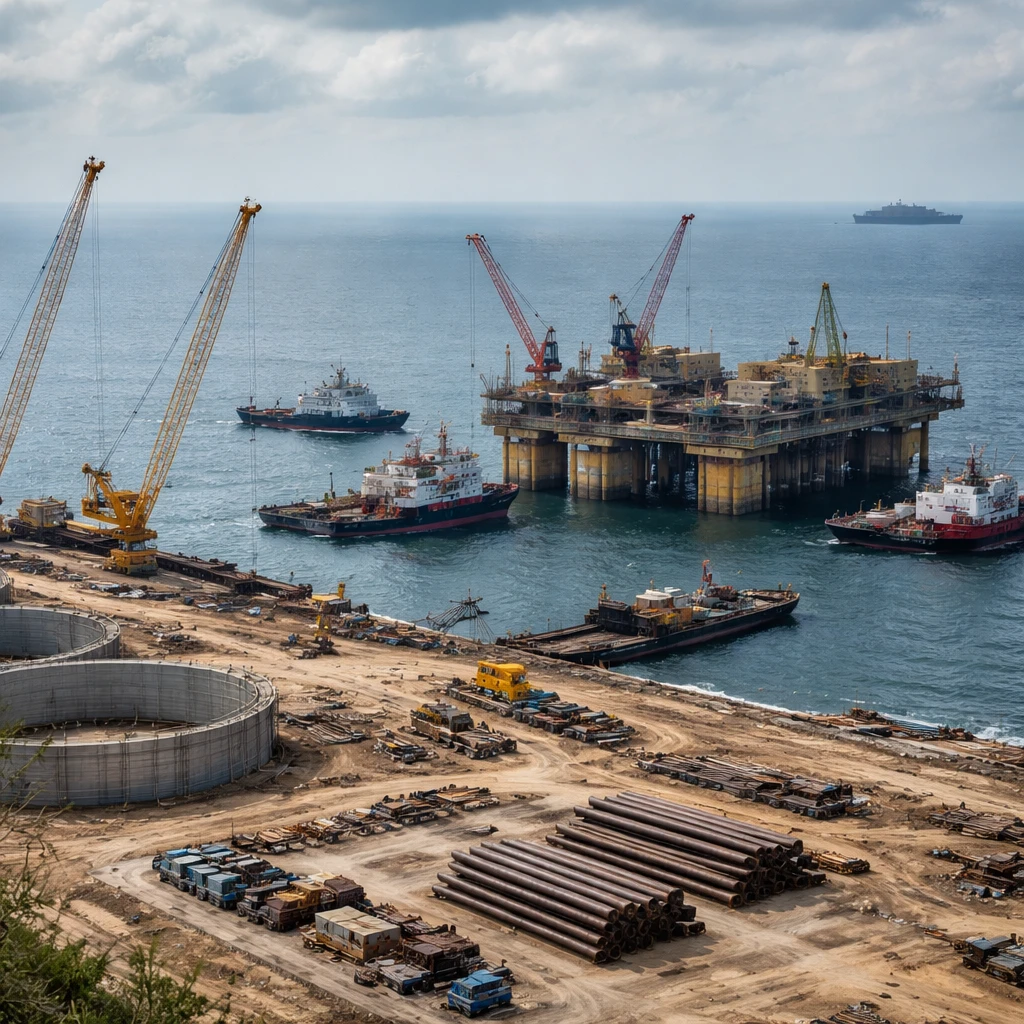
A recent decision by the 5th U.S. Circuit Court of Appeals has cast doubt on the federal approval that formed the basis of Sentinel Midstream’s license for its Texas GulfLink deepwater crude oil export project, an outcome that could pause or delay offshore elements of the $2.1 billion development off the Texas coast.
The court ruling, which took effect on October 30, voided the Maritime Administration’s (MARAD) record of decision (ROD) approving Texas GulfLink and concluded that the ROD violated the Deepwater Port Act by allowing an application area that overlapped with an existing or proposed deepwater port site. The panel said that, under the statute, an application area must cover the whole proposed deepwater port site, including pipelines, and that when properly designated Texas GulfLink’s application area would have intersected with Enterprise Products Partners’ Sea Port Oil Terminal (SPOT) project.
Petitioners who brought the challenge have argued the legal result is straightforward. Michael Brown, counsel for the petitioners, said the court’s decision vacated the ROD that formed the core of GulfLink’s license and that MARAD now must revoke or suspend that license.
Environmental group Better Brazoria Clean Air and Water reiterated the practical consequence in a press release this week, saying construction cannot continue without a federal deepwater port license.
Legal outcome and immediate implications
The Fifth Circuit’s ruling specifically found MARAD’s ROD to be inconsistent with the Deepwater Port Act requirement that only one deepwater port be approved within a given application area. Because the designated application area for Texas GulfLink, as described in the ROD, would have overlapped with Enterprise’s SPOT project, the court determined the ROD could not stand.
The decision vacated the ROD that MARAD used to justify issuing a license to Sentinel, which had received the license in January 2026 following MARAD’s ROD last year that approved Texas GulfLink with conditions.
Positions from Sentinel, MARAD and petitioners
Sentinel has previously described progress on the project as "business as usual," and the company told reporters this week that its license has not been suspended or terminated. A senior vice president at Sentinel, Bruce Heine, told stakeholders that the project remains on track for a fourth-quarter 2028 operational date and characterized the issue as narrow in scope, saying there are multiple potential paths to address the statutory concern without disrupting construction activities or the overall schedule.
Heine also said site development and improvement work continues at the Jones Creek onshore terminal facility in preparation for tank construction, and that major long-lead equipment and pipe have been purchased and key construction contracts executed.
At the same time, a source familiar with the matter told reporters the company could not continue with the offshore project on the current license and that Sentinel is working with MARAD to discuss options for moving forward. In its motion last month to stay the court mandate, the company warned that because the license expressly incorporates the ROD as a compliance standard, voiding the ROD exposed the license to suspension or revocation and prevents construction of offshore components.
MARAD said it was disappointed with the outcome and that it continues to pursue all avenues to achieve the President’s stated objective of American energy leadership.
Project status, timeline and investment decisions
Sentinel made a final investment decision for Texas GulfLink in May and began construction thereafter. The company received its license in January 2026 after MARAD issued a ROD with conditions the previous year. Sentinel has been developing onshore work at Jones Creek while preparing for offshore components about 30 miles off Freeport, Texas.
The company and the administration have cited an expedited timeline for deepwater approvals under the current presidency; MARAD said it recently issued a deepwater project application license in just 410 days, which the administration has contrasted with the historical average that previously took nearly 3.7 years longer.
Texas GulfLink is designed to handle very large crude oil export loadings - the project aims to fully load a supertanker with roughly 2 million barrels per day - and Sentinel has said it purchased major equipment and pipe and executed important construction contracts to support the build-out. The company is targeting fourth-quarter 2028 for operations to begin.
Legal remedies, next steps and potential ripple effects
Sentinel has indicated in filings it plans to seek relief at the Supreme Court, and in its motion to stay the mandate it warned of marketplace harm if the cloud over its ROD and license is not resolved. The company also noted that two other pending deepwater port applications have application areas similar to Texas GulfLink’s and may require redesignation as a result of the appeals court panel’s decision, which could produce consequential impacts to those projects as well.
If Sentinel is required to resubmit its application, the company would have to await a new ROD and a new license. The article notes that while it took nearly seven years for Sentinel to secure approvals previously, MARAD has been moving more quickly under the present administration.
What this means for stakeholders
The immediate legal finding vacates the administrative decision that underpinned Sentinel’s license. Petitioners and environmental advocates say that absent a valid federal deepwater port license, offshore construction cannot proceed, while the company and MARAD emphasize continued progress on onshore work and the possibility of addressing the statutory defect without derailing the schedule.
Sentinel’s filings also warned that the regulatory uncertainty could harm the project’s commercial position in the marketplace and that, at a minimum, the company will not commence offshore construction of the deepwater port under the current posture even if a stay of the mandate is granted.
Bottom line
The Fifth Circuit’s ruling removes the ROD that served as the legal foundation for the Texas GulfLink license and places the company and regulators at a crossroads - either seek rapid judicial relief, pursue a reissued ROD and license with corrected application-area designations, or face a period in which offshore components cannot move forward under the present license. The decision also signals potential procedural consequences for other deepwater port applicants whose application areas may overlap in ways that run afoul of the Deepwater Port Act’s single-port-per-application-area requirement.