
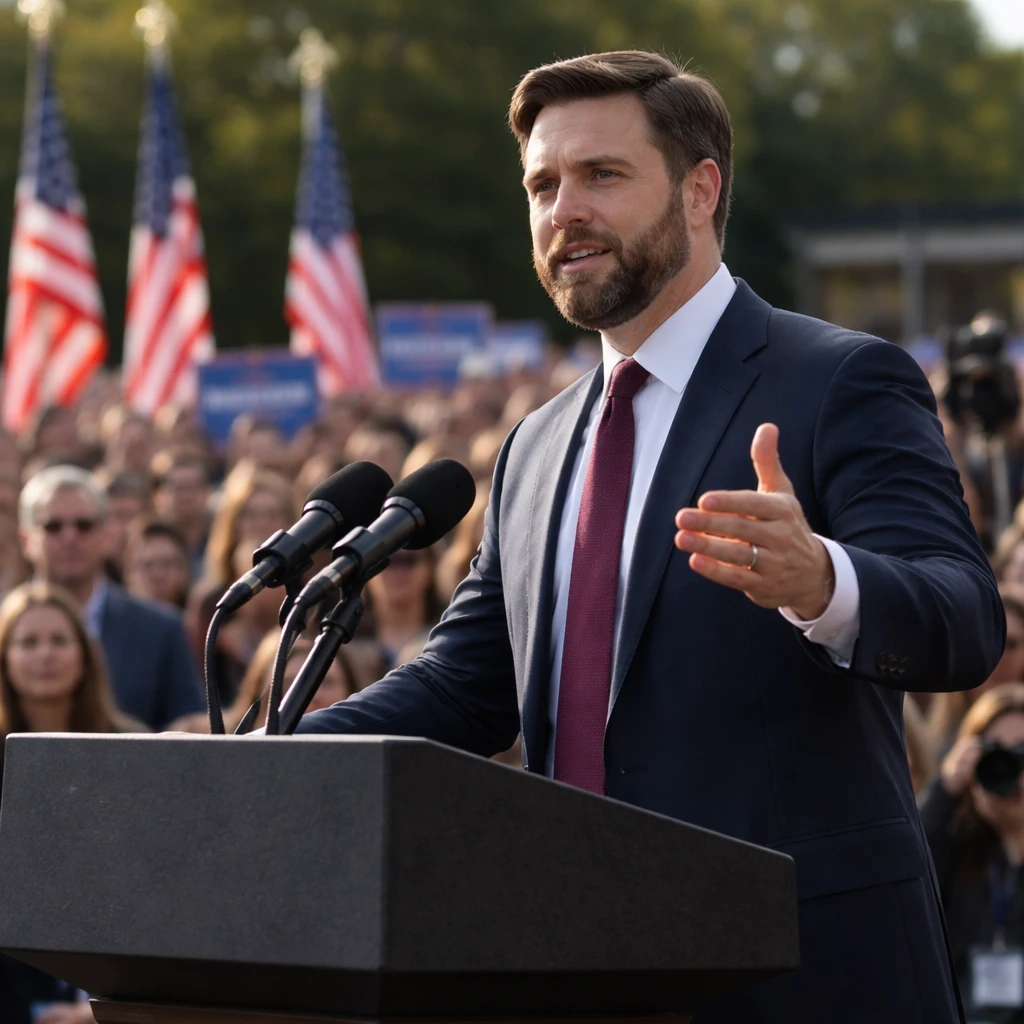
In the closing stretch of Republican efforts to limit losses in the midterm elections, Vice President JD Vance adjusted his public approach. Rather than foregrounding President Donald Trump’s signature positions, Vance shifted to emphasize a distinct set of policy priorities that he presented as his own political identity. According to a review of roughly half a dozen speeches he delivered since the Republican convention in September, this pivot meant discussing Republican prospects almost entirely through the lens of his policy portfolio.
The change in tactic was intended to respond to polling that showed Trump’s sagging popularity was weighing on Republican candidates. Two people familiar with Vance’s strategy said the vice president and his advisers believed there were topics he could credibly champion - economic nationalism, foreign policy restraint, and public safety - that might resonate without relying on Trump’s branding. While those themes overlap with the broader MAGA movement, Vance emerged during the campaign as an outspoken proponent who could press them with his own voice.
That recalibration offered an early view of how the 42-year-old vice president might begin to chart an independent path as Republican leaders and voters start to contemplate a post-Trump era. Vance has not declared whether he will run for president in 2028, and the president has not publicly endorsed him or any other prospective candidate. Still, some Republican officials treat him as a leading possible contender who would have to keep large swaths of Trump’s base while also finding ways to separate himself from Trump’s liabilities.
A pointed post-election critique
On Wednesday, Vance made a notably forthright intervention aimed at reshaping the postmortem debate. In a social media post he blamed the Iran war for contributing to Republican losses in the midterms and set out a program for recovery. He urged a quick end to the conflict, placed renewed emphasis on affordability, called for a reassessment of foreign relations, and recommended an overhaul of the U.S. relationship with Israel.
The public statement was the clearest indication to date that Vance would openly press for ending the Iran war. Three people familiar with communications in the White House and Vance’s team told Reuters that the vice president was not attempting to break with the president, and that White House chief of staff Susie Wiles was aware of Vance’s post before it went up. Separately, the president has acknowledged that the Iran war factored into the Republican midterm losses by raising gas prices, though he has continued to defend the intervention. He has said he would have acted the same way.
Following the midterms, the president reorganized senior White House staff, replacing Susie Wiles with Stephen Miller - a move observers say signals an intent to double down on some of the administration’s harder-line positions. Reuters was unable to determine whether the president himself saw Vance’s social post before publication. Outside the White House, the president’s eldest son publicly endorsed Vance’s statement, and several conservative allies amplified it on social platforms.
Using the vice presidency to shape debate
Republican strategist Michael Ricci, a former aide to past House speakers, said Vance’s intervention compelled conservatives to debate the merits of the Iran war and, more broadly, what policy commitments will define Republican presidential candidates in 2028. Ricci argued that Vance was using the platform of the vice presidency to set the terms of the internal debate rather than merely seeking to distinguish himself for distinction’s sake.
Representatives for the vice president declined to comment when asked about the strategy. White House spokespeople directed inquiries to the president’s public remarks, in which he said he understood Vance’s view on the election results. Democrats, for their part, are expected to emphasize any future Republican nominee’s ties to the president, particularly if the president maintains influence over candidate selection.
Igor Volsky, a Democratic strategist, summarized the tension for Republicans: how does a candidate position themselves to be competitive in a general election while also succeeding in a primary environment in which loyalty to the president can be a prerequisite?
Political costs and campaign choices
Vance’s attempt to mold a distinct brand did not leave him free of political costs. Republicans lost in multiple states where the vice president had campaigned, and some tactics associated with candidates he supported came under scrutiny for potentially harming electoral prospects. The article referenced one such example: an advertisement used by an Ohio gubernatorial candidate that cast doubt on the sexual abuse allegations of the victorious Democratic candidate, Amy Acton. Some strategists say that approach may have backfired and cost races that might otherwise have been more competitive.
Other high-profile Republicans offered differing diagnoses of the midterm setbacks. Senator Ted Cruz suggested Republicans had underperformed on affordability issues. Florida Governor Ron DeSantis argued that some losing campaigns had concentrated excessively on transgender issues while failing to address voter concerns about data centers and the impact of artificial intelligence. Secretary of State Marco Rubio has not publicly weighed in.
In his late-stage stops, Vance urged voters to back Republican candidates by promising investigations into alleged fraud in federal health care and antipoverty programs, tying those efforts to the administration’s immigration agenda and to broader cost-of-living concerns. During many of these rallies, he rarely invoked the Iran war or rising gas prices and seldom mentioned the president by name. In one of his final public appearances in North Carolina he said, “I want my kids to raise a family in a country that is vibrant and thriving and free and prosperous. I want the simple things. And because I want that for me, I want it for you too.”
Market and sector considerations
The rhetorical and policy shifts Vance has emphasized prompt several questions for investors and market participants. Which sectors might be most affected if the policy priorities he has foregrounded - including a call to end the Iran war - gain traction? How will investors price the political risk associated with a potential 2028 nomination fight that leans heavily on continuity with, or distance from, the president? The article noted such market-oriented queries without asserting specific market moves.
Energy markets, particularly gasoline and broader oil benchmarks, are among the most directly linked to discussion of foreign conflicts that influence supply and price. Defense-related industries could also see sensitivity to debates about military engagement overseas. Meanwhile, Vance and other Republicans referenced concerns tied to federal healthcare and antipoverty programs, which touch on sectors that provide government-contracted services and benefits administration. Other commentary at the time called out voter attention to data centers and artificial intelligence, suggesting potential investor interest in technology infrastructure and related power demand.
Outlook
Vance’s post-election posture has heightened his profile among conservatives interested in a post-Trump Republican identity. At the same time, his role in a midterm season that produced losses for his party complicates his standing. Some Republican officials and strategists view him as a credible future standard-bearer if he can carry much of the existing coalition while also distinguishing himself from the president’s controversies. Opponents and Democratic strategists, however, are likely to underscore any linkage between Vance and the president should he seek higher office.
For now, Vance’s approach underscores a broader question for Republican politics and for investors watching political risk: whether a vice presidential platform can successfully convert campaign megaphone into durable positions that reshape both the party’s direction and attendant market expectations.