
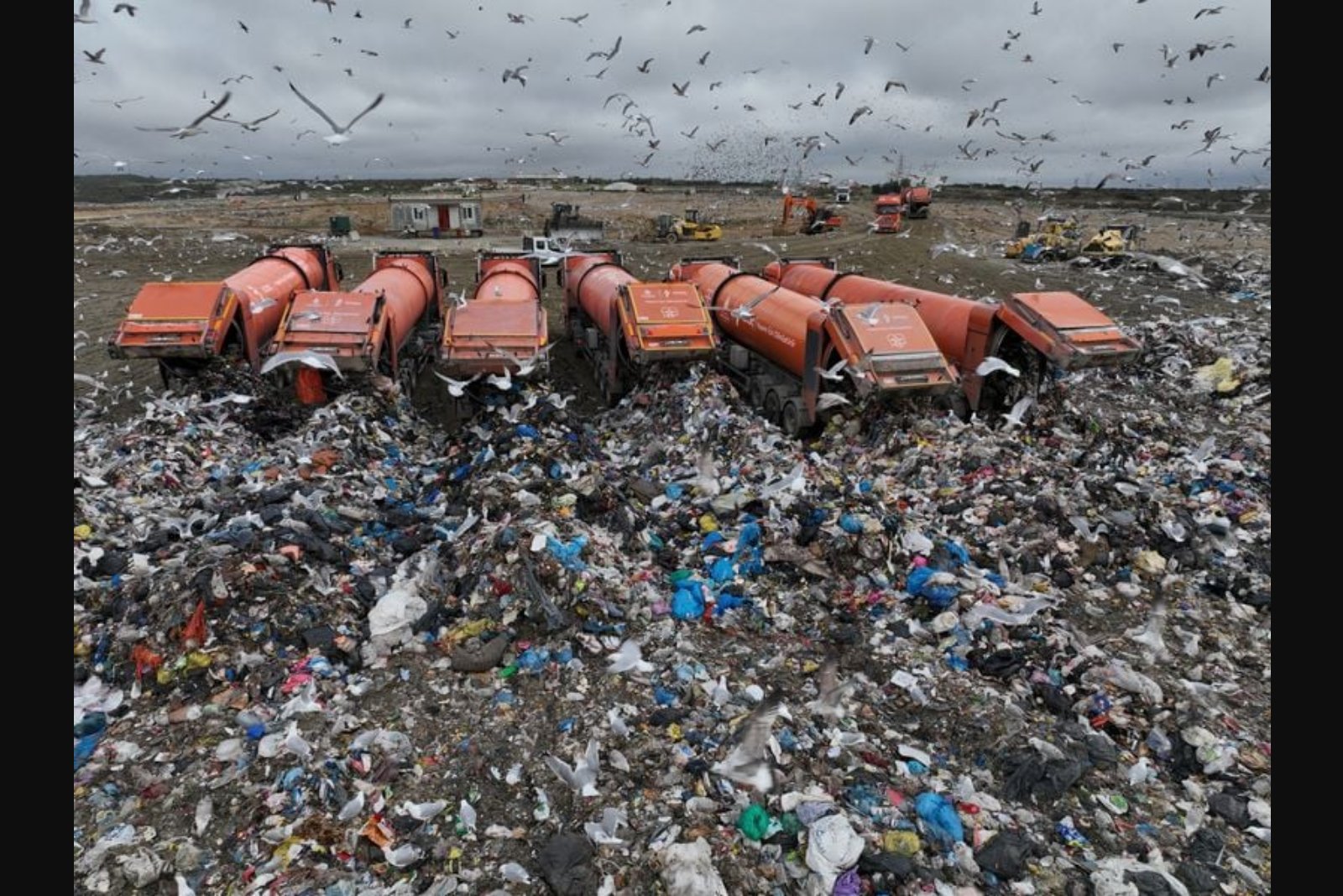
In agricultural land west of Istanbul, a municipal dump receives thousands of tonnes of mixed household refuse each day. Trucks queue to unload. Nearby, seagulls wheel over the mounds of decomposing waste and an on-site power plant burns collected landfill gas to produce electricity.
High above that scene, however, satellites have detected sizeable methane emissions that the local gas capture operation has not contained. Analysis of satellite data places the landfill west of Istanbul among the world’s most significant single-site landfill methane emitters recorded in recent years.
Satellite evidence and the scale of detected emissions
Researchers at the University of California, Los Angeles (UCLA) examined public data from Carbon Mapper gathered by the Tanager-1 satellite between January 2025 and the end of May 2026. That analysis identified 70 methane plumes across Turkey’s 10 highest-emitting waste sites, with the average rates detected spanning from 841 kg an hour up to 7.4 metric tons an hour.
Three of the high-emitting landfills identified are in the greater Istanbul area; other detected sites are located near Ankara, Izmir and Antalya, the host city for COP31. The landfill west of Istanbul, commonly referred to as the Seymen site in local reporting, showed an average detected rate of about 7.4 tons an hour in the UCLA analysis - a level that puts it just below the top-ranked landfill on a 2025 global list of large emitters.
Emissions-monitoring non-profit Carbon Mapper and its waste sector lead, Tia Scarpelli, said the concentration of the largest detected emissions at a limited number of sites means targeted action could yield sizable reductions at the national level. "There is this huge mitigation potential by just addressing the largest landfills to reduce their national emissions," she said, recommending both diversion of organic material before it reaches dumps and improvements to capture systems, including fixes to cracked covers or faulty gas wells.
On-site gas capture and differing measurements
At Seymen, municipal operator ISTAC collects gas that forms as buried organic matter decomposes. An energy company on-site burns that gas to generate electricity; a 2025 report by the energy news site Enerji Gunlugu noted the plant produces about 22,000 megawatt-hours of electricity per month. The Environment Ministry has said ISTAC benefits economically from efficient methane capture tied to electricity generation.
Despite the presence of gas-to-power infrastructure, the satellite record indicates substantial fugitive emissions. ISTAC officials disputed whether satellite snapshots accurately represent the landfill’s typical emission rates. ISTAC official Aysen Erdincler said the site's emissions typically ranged between 4 and 6 tons per hour and that a single satellite reading of 12 tons per hour on one day had lifted the average reported by UCLA.
ISTAC head Fatih Ugur offered context for that higher reading, saying about 30 hectares of the landfill had been left uncovered on the day of the measurement while maintenance work was performed on methane-collection pipes. He also cited low atmospheric pressure as a factor that increased observed methane concentrations. Separately, Erdincler estimated that methane leaks at the site were usually around 25%, although researchers say it remains unclear how much of the landfill’s total methane the collection system actually captures.
National context, trends and policy signals
Turkey has elevated methane reduction as a priority for COP31, which runs from November 9 to 20 in Antalya. Methane is the largest driver of climate warming after carbon dioxide and is more than 80 times as potent as CO2 over the first 20 years after emission, meaning sharp reductions can slow warming relatively quickly.
Yet Turkey is a major source of methane from solid waste. According to emissions tracking by Climate TRACE, Turkey is the world's fifth-largest emitter of methane from solid waste, behind China, the United States, Russia and Brazil. World Bank data based on the European Commission’s EDGAR database show methane emissions from Turkey’s waste sector increased nearly 25% in the decade to 2024, compared with a global rise of 6.5% over the same period. Turkey’s waste emissions have remained at about 21 million tons of CO2 equivalent annually since 2020.
The Turkish government’s Environment Ministry noted that the satellite-derived plumes do not come from continuous measurements and therefore cannot be used to calculate annual emissions at the Seymen landfill directly. The ministry pointed to the national Zero Waste Initiative as a policy mechanism designed to reduce the volume of waste sent to landfills and thus lower methane emissions; it said the national recovery rate for waste increased to 37.53% in 2025 from 13% in 2017.
Turkey is not currently listed among participants in the Global Methane Pledge, which was launched at COP26 in 2021 with an initial aim of cutting methane emissions by 30% from 2020 levels by 2030. More than 30 countries have since adopted national targets under that pledge. Analysts and policy researchers caution that joining the pledge does not automatically translate to action unless implementation and regulation ensure operators capture and reuse methane.
Selim Yildirim, chief climate policy researcher at Ankara-based D84, described Turkey as having more developed waste disposal infrastructure than poorer countries but less effective management, recycling and value recovery compared with much of Europe. He suggested that while Turkey could declare participation in the Global Methane Pledge during COP31, doing so would not guarantee practical results without regulatory pressure to enforce methane capture and reuse.
Local impacts and community experience
Residents near the Seymen landfill report issues related to the decomposition of organic material, notably strong odors that can permeate homes. Methane itself is odorless, but the mix of gases and other compounds released as organic waste breaks down can create a pungent smell that affects nearby neighborhoods. Soner Duz, a 46-year-old barber who lives about 5 km from the landfill, described how the smell arrives at specific times: "Around four or five in the morning, the smell suddenly comes," he said. "It wakes you up."
Implications for waste management and energy sectors
The Turkish case underlines a structural challenge: the existence of gas capture and electricity production at large landfills does not automatically equate to containment of fugitive methane emissions. Carbon Mapper’s Scarpelli emphasized two main pathways for mitigation: diverting organics before they reach landfills and improving capture systems at the sites that contribute most to national totals. Because detected emissions were concentrated at a limited number of locations, resolving problems at those sites could deliver a disproportionate share of national reductions.
Local operators such as ISTAC have economic incentives to capture methane for power generation, but the divergence between plant output and satellite-detected plumes shows operational and maintenance gaps can still allow significant leaks. The issue has implications for municipal governments, waste contractors, energy firms operating landfill-gas plants and regulators tasked with ensuring environmental controls are effective.
Where the data leave questions open
Satellite overpasses provide snapshots of emissions that reveal large plumes and patterns, but the Turkish Environment Ministry noted those snapshots are not continuous measurements and should not be used to estimate annual emissions without caution. ISTAC officials also questioned whether single-day high readings were representative of typical conditions at Seymen, pointing to operational factors and atmospheric conditions that can temporarily influence measured concentrations.
Nonetheless, the persistence and scale of the plumes identified in the UCLA analysis, combined with the concentration of the highest-detected emissions at a few sites, indicate substantial potential to reduce national methane emissions by targeting maintenance, improved capture and pre-landfill organic waste diversion at those key locations.
Conclusion
As COP31 convenes in Antalya and methane reduction sits on the agenda, satellite-enabled monitoring has brought the scale of landfill emissions into clearer view in Turkey. The evidence points to both significant mitigation potential and practical hurdles: large, sometimes well-equipped landfills can still emit substantial methane, and converting detection into durable reductions will require repairs, system upgrades, regulation and policies that divert organic waste from landfills in the first place.