
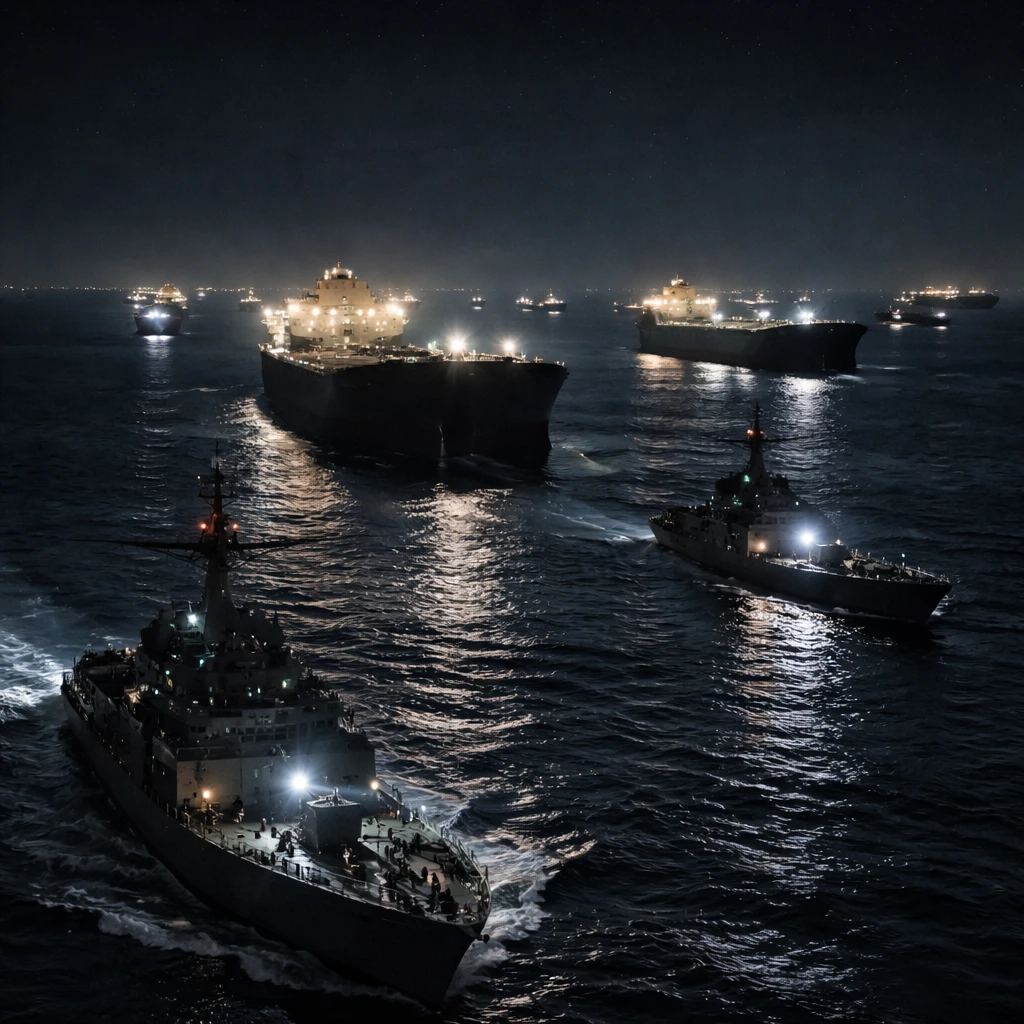
U.S. forces are conducting nighttime escort operations to move oil tankers and other commercial vessels through the Strait of Hormuz, Interior Secretary Doug Burgum said on Friday. He told CNBC that, following the removal of sea mines, the effort has enabled "some nights, more than 20 ships coming out."
Burgum highlighted the scale of individual ultra-large carriers, noting that some can hold 2 million barrels of crude and that "substantial amounts of oil that have come out of the strait." He also linked the increased transit activity to a softening in oil prices, saying: "I think the markets figured that out before some of the tabloid press did, because you're starting to see a softening of oil prices."
The operation is intended to free tankers and commercial ships that have been unable to transit since U.S. and Israeli attacks on Iran in late February, Burgum said. President Donald Trump added on Wednesday that the effort has helped restrain crude costs, asserting in a social media post that more than 200 commercial ships and 100 million barrels of oil had safely exited Hormuz under what he called a "secret mission."
Trump told reporters that U.S. forces had taken 22 ships out of the strait "late at night, with no lights" to avoid detection. The claim was presented as part of the broader description of the nighttime operations assisting vessel movements through the waterway.
The Strait of Hormuz previously accounted for roughly a fifth of global crude flows. Its effective closure earlier had prevented millions of barrels from reaching world markets each day and contributed to a global increase in oil and fuel prices, the article said.
Market data cited in the reporting showed West Texas Intermediate futures trading at about $85.5 per barrel on Friday. Separately, private tracking firm Vortexa Ltd reported that at least 1.8 million barrels exited the Persian Gulf on each of the first 10 days of June.
The reporting noted that non-Iranian oil flows through the strait have surged by about 50% so far this month, while the U.S. maintains its blockade of Iranian shipments.
Context and implications
The described operation is focused on restoring movement for vessels trapped after the escalation of military action in the region. Officials have framed the effort as reducing upward pressure on crude prices by increasing the flow of commercial oil through the waterway.
Public statements from senior officials and a private analytics firm provide the primary factual basis for the account: Burgum's comments on CNBC; President Trump's public remarks and social media post; and Vortexa's estimate of Persian Gulf outflows in early June.
The reporting does not provide operational details beyond the statements quoted, and it does not offer independent verification of the specific counts of ships or exact volumes beyond the figures attributed to the officials and Vortexa.