
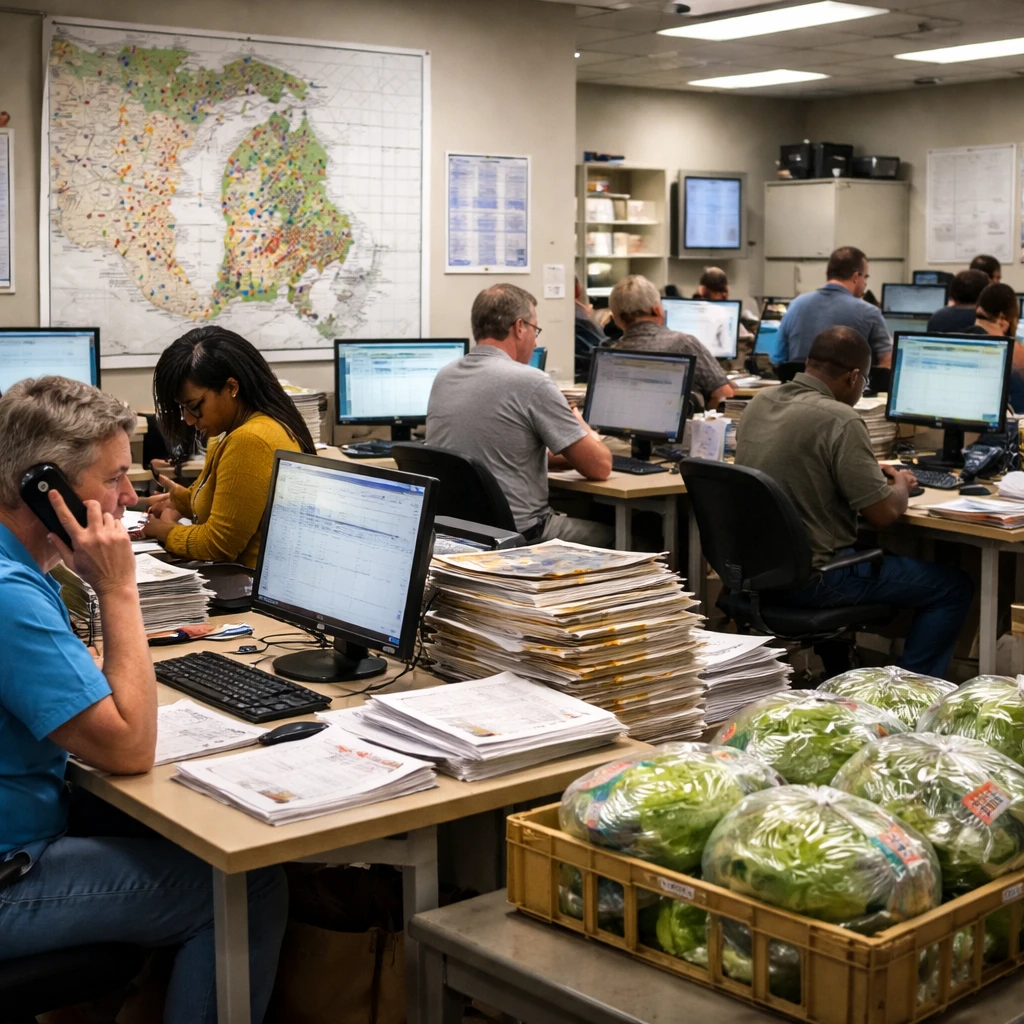
Michigan is confronting an unusually large outbreak of cyclosporiasis that investigators say has produced explosive diarrhea and continues to spread across nine states. State officials report more than 8,100 cases in Michigan alone, making it the hardest hit among affected states. New infections are still being recorded as public health teams at the state and local level race to trace exposures and identify more definitive sources.
State and county officials describe their response as being stretched thin. They point to cuts in federal funding and what representatives from two counties and another source familiar with Michigan’s handling of the outbreak described as intermittent or limited communication from federal agencies. Those constraints have led health departments to redeploy staff from other programs and recruit volunteers in an effort to keep up with investigations.
Federal funding and staffing shortfalls
Michigan officials say the state’s infectious disease workforce and county public health staff are reduced compared with recent years. According to state figures, Michigan now has 23 fewer infectious disease workers and 123 fewer county health staff after the federal government canceled roughly $12 billion in COVID-era grants to states in 2025. The cancellations and subsequent staffing reductions have contributed to the need to borrow personnel from other public health programs and rely on volunteers for case investigations.
"We have had to pull in dozens of staff from other areas, from hepatitis C and interns who are working on gun violence prevention," said Dr. Natasha Bagdasarian, Michigan’s chief medical executive, describing how the state has reshaped its workforce to respond to the outbreak.
Former federal officials and food safety experts told state and local officials that reductions at federal agencies have also complicated the response. In particular, a cut to funding administered through the U.S. Agency for International Development removed $40 million that had supported a CDC laboratory handling parasitic disease work, while resignations and other staffing changes at agencies have further reduced capacity, according to a former senior CDC official.
Tracing cases is labor-intensive and time-consuming
Cyclospora infections cannot be tracked with highly automated laboratory testing methods, so investigators depend on detailed interviews with ill people. Those interviews can take up to 45 minutes each, and the cumulative workload is substantial when thousands of illnesses are under investigation.
In Oakland County, which serves nearly 1.3 million residents, a core team of four communicable disease nurses and three epidemiologists has been conducting interviews and compiling case data. As of July 24, county officials had reported 710 cases. During the COVID pandemic the county had additional outreach staff that have since been let go; officials said 12 extra staff had supported pandemic response activities, and four nurses were removed from the workforce this past spring.
In Ingham County, which encompasses most of Lansing and has a population of about 290,000, there have been roughly 700 reported illnesses. The county’s health department, however, has just five nurses assigned to investigate cases and has chosen to focus investigations on more recent illnesses, dropping some older cases from active follow-up. "That way we can try to help the state and the feds understand what is still causing people to get cyclospora," said Anne Barna, deputy health officer for Ingham County.
Washtenaw County health officials are handling more than 770 cases, and the additional workload has reduced the department’s capacity to provide other services such as clinics and routine care. In rural Shiawassee County, where the population is roughly 68,000, the local health department has brought in qualified volunteers to help investigate about 450 cases. "This really just hit us so fast," the county health director said. "It was like, ’Boom, here it is.’"
Federal, state and industry actions
The U.S. Centers for Disease Control and Prevention posted a health warning about cyclosporiasis on July 14. On July 17 the U.S. Food and Drug Administration said it had linked part of the outbreak to iceberg lettuce served at Taco Bell restaurants that was supplied by Taylor Farms operations in central Mexico, while continuing to investigate other possible sources.
Taco Bell, a brand owned by Yum Brands Inc., has stopped using iceberg lettuce sourced from Taylor Farms nationwide. Taylor Farms said it had removed lettuce grown in central Mexico from retailer and foodservice channels while investigations continue.
The CDC has reported 4,173 laboratory-confirmed domestic cases of cyclosporiasis and indicated there are more than 7,400 additional unconfirmed cases nationwide. Michigan’s own investigation has not singled out a single fast-food chain as the sole source of illnesses in the state, and officials note that about 12% of patients have no clear link to having eaten lettuce or patronized a fast-food chain.
Coordination and communication challenges
Officials involved in outbreak responses said the CDC has historically taken a coordinating role among states. In large outbreaks, states typically have regular meetings with federal investigators to share findings and shape the response. Some Michigan local officials said they learned of developments through news reports before receiving details through official channels.
One former CDC food safety expert said that states involved in major multi-state outbreaks would usually convene at least weekly with CDC staff. Michigan officials said they received timely answers to technical questions from the CDC and FDA but did not have regular formal meetings with federal partners, according to a source familiar with the state response who was not authorized to speak publicly.
The U.S. Department of Health and Human Services disputed that assessment, saying the CDC was holding daily meetings with FDA and state officials across the country to exchange updates and collect information about the outbreak. HHS also noted the CDC had deployed a team of epidemic intelligence specialists to Ohio starting July 22 for a three-week assignment.
Remaining uncertainties in the investigation
Local and state investigators acknowledged that the outbreak remains partially unexplained. Michigan’s public health leaders said they have not identified a single fast-food chain as the definitive driver of all cases within the state. Roughly 12% of people who have fallen ill cannot be linked to lettuce consumption or to visits to fast-food restaurants according to state officials.
The lack of a single, clear exposure pathway and the substantial number of unconfirmed nationwide cases have contributed to a sense of mystery among health workers on the ground. "We’ve got this huge volume (of cases) and so many people working on it and it’s not getting clearer," a county health department spokesperson said.
Meanwhile, federal and industry actions have sought to remove implicated product from supply chains while testing and interviews continue. Investigations remain active and health departments at all levels are reallocating personnel and tapping volunteers to keep pace with the labor-intensive work of case interviews and exposure tracing.
Key points
- Michigan is the epicenter of a nine-state cyclosporiasis outbreak, with more than 8,100 cases reported in the state and new infections still being recorded.
- Federal funding cuts and staffing losses have reduced infectious disease and county health personnel, forcing state and local health departments to redeploy staff from other programs and recruit volunteers to handle case investigations.
- The U.S. FDA linked part of the outbreak to iceberg lettuce served at Taco Bell sourced from Taylor Farms in central Mexico; Taco Bell halted use of that lettuce nationwide and Taylor Farms pulled the implicated product from channels while investigations continue.
Risks and uncertainties
- Incomplete links between illnesses and specific exposures - about 12% of Michigan patients have no clear connection to lettuce consumption or fast-food visits, leaving gaps in the investigation and complicating source control efforts. This affects the foodservice and retail produce sectors.
- Reduced public health capacity - cuts to federal COVID-era grants and staffing reductions at both federal and local levels limit investigative bandwidth and could delay containment and public guidance. This has implications for public health services and local government budgets.
- Communication and coordination inconsistencies - some local officials reported learning updates from media reports rather than formal federal briefings, illustrating potential friction in multi-jurisdictional outbreak coordination that could hamper timely interventions across state and industry partners.
Tags: publichealth, outbreak, produce, Yum, Michigan