
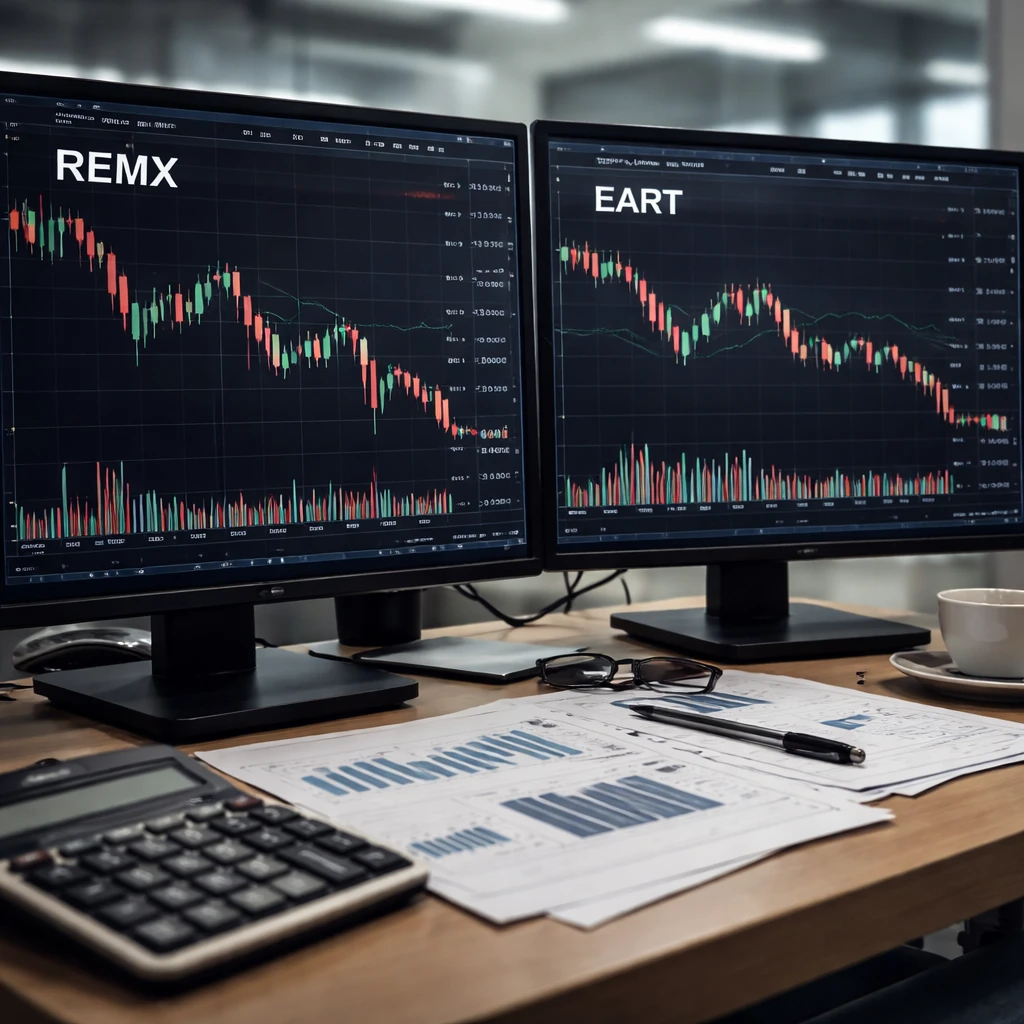
Investors seeking concentrated exposure to critical minerals have a small set of ETFs to consider, and within that group VanEck Rare Earth and Strategic Metals ETF (REMX) emerges as the liquidity leader. With $1.99 billion in assets under management and a 0.60% expense ratio, REMX is by far the largest fund in this niche and provides the tightest trading conditions of the listed alternatives.
REMX also posts a positive one-year performance of +25.2%, outperforming many peers on a one-year basis among the liquid funds. That said, the fund has not been immune to recent weakness: REMX shows a -33.1% return over the last three months, reflecting a sharp short-term drawdown in the sector.
The critical minerals ETF landscape
Below is the set of ETFs that match the critical minerals theme across the examined exchanges. The data reflect assets under management, one-year return, three-month return, year-to-date performance, and expense ratio when available.
- VanEck Rare Earth & Strategic Metals (REMX) - NYSE Arca - $1.99B AUM - 1Y Return +25.2% - 3M Return -33.1% - YTD -8.7% - Expense Ratio 0.60%
- Global X Rare Earth & Critical Materials (EART) - Nasdaq - $37.8M AUM - 1Y Return +38.2% - 3M Return -17.0% - YTD -4.3% - Expense Ratio N/A
- Global X Rare Earth & Critical Metals ASX (GMTL) - ASX - $7.5M AUM - 1Y Return +41.6% - 3M Return -14.2% - YTD -6.0% - Expense Ratio N/A
- Dynamic Active Mining Opportunities (DXMO) - TSX - $56.8M AUM - 1Y Return +42.9% - 3M Return -10.9% - YTD -1.1% - Expense Ratio N/A
- Nicholas Defense & Rare Earth Income (WEPN) - NYSE Arca - $7.0M AUM - 1Y Return -14.2% - 3M Return -8.3% - YTD -14.2% - Expense Ratio N/A
- WisdomTree Efficient Rare Earth Plus (WDIG) - BATS - $4.9M AUM - 1Y Return -24.7% - 3M Return -24.7% - YTD -24.7% - Expense Ratio N/A
Why REMX stands out
Liquidity is a key consideration in niche thematic ETFs. REMX's $1.99 billion in assets is 53x larger than the next US-listed option, EART, which has $37.8 million. That scale typically translates into narrower bid/ask spreads and reduced market impact when establishing or closing positions. Technical indicators show REMX with a relative strength index of 28.4, which the data indicate is in oversold territory. That reading can be interpreted in different ways: it may point to a valuation entry opportunity for some investors or signal further downside risk if sector pressure continues.
EART and the smaller challengers
Global X's EART has produced a stronger one-year return of +38.2% compared with REMX's +25.2%, and it has experienced a smaller three-month decline (-17% versus REMX's -33.1%). EART's $37.8 million size implies lower liquidity than REMX, but for investors with smaller allocations and higher risk tolerance the return differential is notable.
The three-month caution
Every ETF in this review is down over the past three months, with declines ranging from -8.3% to -33.1%. The materials indicate a sector-level reset tied to softer rare earth prices and concentrated supply dynamics. The same data show ongoing structural demand drivers from sectors such as electric vehicles, defense, and semiconductors, yet the near-term price volatility remains a material consideration for portfolio positioning.
Quick verdict
| Investor Profile | Best Fit |
|---|---|
| Liquidity-first, lower cost | REMX |
| Max returns, smaller size | EART |
| Canadian investor, active management | DXMO |
| Defense and rare earth exposure | WEPN |
Investors should weigh liquidity, expense structure, and short-term volatility when choosing among these funds. The listed metrics provide a snapshot of relative scale and recent returns to inform those decisions.