
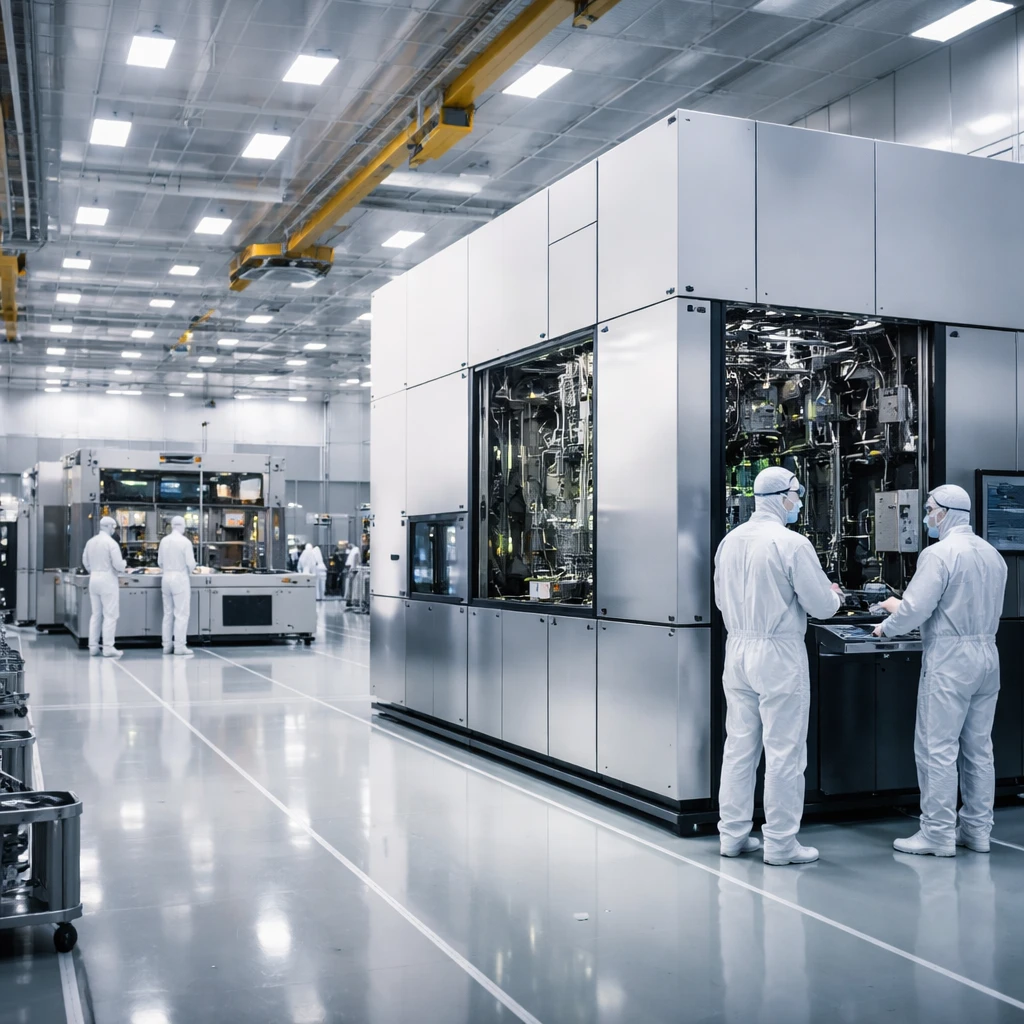
ASML ADR slid -7.37% intraday to $1,627.64 amid market reaction to reports that a Shanghai firm backed by the state has reached limited production of immersion DUV lithography machines. The reported plan calls for roughly 5 units targeted for 2026 and about 20 for 2027 to be supplied to existing Chinese customers: SMIC, Hua Hong, and CXMT.
On the surface, the sell-off is comprehensible - China is expected to contribute about 20% of ASML’s 2026 revenue, and DUV equipment represents a significant share of those sales. Yet the broader context gives a different texture to the development: the reported Chinese machines target a technology segment ASML has been steadily moving beyond.
The immediate trigger, explained
The Information reported that the Shanghai entity has initiated limited production of immersion DUV tools with a modest unit cadence planned for 2026 and 2027. The market’s reaction extended to ASML’s ADR listing, producing the steepest single-day drop the stock has seen in months. The linkage is straightforward: DUV revenues to Chinese customers are meaningful, and any credible alternative supplier could compress renewal cycles and reduce future DUV spend in China.
Where ASML’s real defensive moat sits
ASML’s primary strategic advantage is EUV - Extreme Ultraviolet lithography - and the company’s continued progress into High NA EUV. EUV remains subject to export controls that prevent China from importing production-grade machines, and Chinese EUV efforts remain at a prototype stage. Meanwhile, ASML has advanced to High NA EUV, a next-generation tool that carries an approximate per-unit price of $400 million and has recently arrived at the Albany NanoTech Complex in New York this month.
In short, the technology China has reportedly started producing is DUV - an older generation that ASML has been phasing out of the center of its product roadmap. That distinction is central to assessing the long-term competitive picture: mastery of DUV does not equate to parity in EUV or High NA EUV.
Operational and financial snapshot
ASML’s financial profile in the report remains robust. The ADR was trading at $1,627.64 with a market capitalization of $684.31 billion. Key performance metrics cited include a trailing P/E of 51.6x and a forward P/E of 40.1x. Return on invested capital stood at 46.6%, net margin at 29.4%, and a one-year return of +148.7%.
| Metric | Value | Take |
|---|---|---|
| Revenue (Latest FY) | $38.38B | Up from $21.18B four years ago - an ~81% increase |
| FY+1 Revenue Forecast | $50.16B | +30.7% projected growth |
| EPS (Latest FY) | $29.03 | Versus $16.32 four years ago |
| FY+1 EPS Forecast | $44.46 | +53% projected increase |
| Gross Margin | 52.8% | Indicates pricing power |
| ROE | 53.9% | High capital efficiency |
| Debt / Equity | 9.1% | Near-debt-free balance sheet |
| Fair Value (InvestingPro model) | $1,595 | Roughly fairly valued (-2.1%) |
| Analyst Target Upside | +30.1% | Consensus sees recovery runway |
Bookings, pricing, and near-term outlook
The company is reported to be nearly fully booked for 2027 EUV deliveries and has already collected a meaningful number of orders for 2028 EUV, including demand tied to a planned Terafab facility. ASML announced price increases on its equipment weeks ago, a move presented as evidence of limited near-term competitive pressure in the EUV segment.
Bank of America is cited as viewing the market sell-off as a buying opportunity, retaining a Buy rating and modeling 2027-2028 EPS that are 6-7% above Street consensus.
Arguments for caution and arguments for confidence
The sober bear case acknowledges several tangible vulnerabilities:
- China’s approximate 20% revenue contribution is material - if domestic DUV scales faster than expected, renewal cycles tied to legacy DUV in China could shrink and potentially affect $5-8 billion of annual revenue.
- Chinese EUV remains at prototype stage today - the timeline to production-grade, reliable systems is uncertain and not defined in the report.
- At a trailing P/E of 51.6x, the valuation leaves little margin for execution missteps; premium multiples require premium delivery.
The bull case presented in the report rests on counterpoints the market should weigh:
- The reported Chinese units - roughly 5 then 20 - contrast sharply with ASML’s annual shipments in the hundreds, leaving a substantial volume gap.
- EUV technology remains both legally restricted and technically difficult for China to replicate at scale in the foreseeable future.
- High NA EUV establishes an additional layer of technological leadership ahead of potential Chinese progress in legacy segments.
- The FY+1 EPS projection of $44.46 would reduce the forward P/E to about 40.1x, which the consensus views as still rich but supported by growth expectations.
Management signals
Management’s retention program - a reported €20,000 per employee through 2030 - is noted as an internal signal of confidence in the multi-year business trajectory. The company’s willingness to lock in talent through 2030 is presented as a vote of confidence in the durability of its roadmap.
Conclusion
The market’s steep one-day decline reflects a rational response to a concrete development: a domestic Chinese program targeting immersion DUV. But conflating that threat with ASML’s core strategic advantage in EUV and the emergent High NA platform misses a crucial distinction. The reported Chinese effort addresses an older generation of lithography that ASML is moving beyond, while ASML remains heavily booked for EUV years forward and retains what the report frames as a legally and technically protected lead at the technology frontier.