
Samsung faces a potentially disruptive labor action that crystallizes a fundamental internal question: who should benefit from the profits tied to the global AI-driven demand for memory chips?
Starting May 21, over 45,000 workers have threatened an 18-day strike that, if carried out, would be the largest in the conglomerate’s history and would reduce output of memory chips that power AI data centers, smartphones and laptops. The standoff centers on how performance bonuses, generated amid a worldwide memory shortage, should be allocated across Samsung Electronics’ contrasting semiconductor businesses.
Company negotiators have proposed substantial bonuses for memory employees, reflecting the division’s outsized profitability during the AI-led demand surge. Under the proposal reviewed in internal wage negotiation transcripts, the 27,000 workers in Samsung’s memory operations could receive awards that are at least six times larger than those planned for staff in the logic chip design and manufacturing lines.
Workers in the Device Solutions Division’s system LSI and foundry businesses - about 23,000 people who work on logic chips and related processes - argue they should not be left behind. These teams manufacture components that feed AI chips developed by customers such as Nvidia and Tesla, and many of them are stationed in the same facilities as their memory-focused colleagues despite the logic and foundry units having suffered multibillion-won losses in recent years.
Internal friction and workforce departures
Review of hundreds of pages of transcripts from internal wage talks, along with interviews with more than 10 employees and sources familiar with the discussions, show deep tensions between Samsung’s semiconductor units. The material reveals how these tensions have already contributed to employee departures and how they endanger Samsung’s ambition to offer an integrated, end-to-end semiconductor service - a so-called "one-stop" model that combines memory, system LSI and foundry capabilities under a single corporate umbrella.
Analysts and company insiders say the profitability gap between memory and the rest of the Device Solutions Division has widened significantly. Samsung remains the global leader in memory chip sales, a position that attracted exceptional profits during the shortage. By contrast, Samsung’s foundry business and other logic-focused operations have struggled to generate consistent profits, leaving divisions unequal at the most critical moment for chip demand.
JPMorgan has estimated the strike could shave between 21 trillion won and 31 trillion won from Samsung’s operating profits - roughly $14.08 billion to $20.79 billion - while sales losses could total about 4.5 trillion won, according to the transcripts and financial commentary cited in the discussions.
Bonus proposals and union demands
Conversations documented in the transcripts show Samsung floated a proposal in March that would deliver bonuses to memory employees that could exceed those at a key rival, SK Hynix, reaching as high as 607% of annual salary for some memory staff. Historically, memory and logic workers had followed a shared bonus structure, but the new proposal would create a sizable divergence.
Under details provided in the negotiation records, workers primarily engaged in logic chip production - including processes such as "base die," which are essential elements of AI chip assembly - would be eligible only for bonuses in the range of 50% to 100% of salary. Union leaders counter that such a gap would incentivize talent to migrate to the memory division or to competing firms, potentially crippling Samsung’s efforts to scale logic and foundry operations.
Union negotiators have urged Samsung to remove a 50% cap on bonuses and to establish a bonus pool that would allocate 15% of annual operating profit to employees. Company negotiators have maintained that performance-based awards must reflect merit and financial performance, noting that the logic and foundry businesses have incurred losses amounting to trillions of won in recent years.
In the negotiation transcripts, Samsung executive Kim Hyung-ro argued the company had backed the logic chip business financially despite its recent losses: "They, the logic chip business, posted losses in the trillions of won and honestly, if it had not been for our company, they probably would have gone out of business or closed down. So how can you justify giving performance bonuses?" He added that investments in the logic business were being funded by profits earned in memory.
The company said in a statement that the logic chip business is strategically important and that it has continued consistent investment aligned with a long-term vision. It also said its latest compensation proposal would offer industry-leading pay should the plan be adopted. Samsung warned that a strike would erode customer trust and disrupt deliveries.
Talent flight and competitive dynamics
Discontent intensified after rival SK Hynix removed its bonus cap for a 10-year period, leading to payouts that have been more than three times higher than Samsung’s in some cases. That shift prompted some Samsung employees to accept offers from SK Hynix or to transfer within Samsung to the memory division.
Several employees who spoke on condition of anonymity said they have seen colleagues apply for roles at SK Hynix and elsewhere. One foundry engineer in Pyeongtaek, who used the surname Lee, said his team had shrunk markedly over the past years as members moved to the memory division and to competitor firms. He said many of his peers had already sought outside opportunities because of the pay disparities.
Union leader Choi Seung-ho pointed to the morale effects during talks, asking rhetorically: "If the memory division gets 500 million won while the foundry division only gets 80 million won, what motivation would those employees have to keep working?" The transcripts include such appeals as the union sought to make the case that bonus structures should reflect the contributions of all semiconductor workers.
Strategic implications for Samsung’s integrated model
Observers quoted in the transcripts cautioned that the dispute and ensuing departures have the potential to undermine Samsung’s stated strategy of being a vertically integrated semiconductor provider. Namuh Rhee, a Yonsei University professor and chairman of a Korean corporate governance group, wrote on social media that some of the current challenges are "partly self-inflicted by the company" and that combining disparate businesses under a single conglomerate created a complex structure that can produce valuation discounts, conflicts of interest and limited business opportunities. He urged that foundry operations be enabled to operate with more independence.
Company leaders, including Chairman Jay Y. Lee, have publicly expressed the ambition to become the clear number one in the logic chip market by 2030. Union negotiators and many foundry employees fear that unequal compensation could derail that plan by accelerating outflows of experienced technicians and engineers who are critical to advancing Samsung’s logic and foundry capabilities.
Wider economic and market concerns
Top executives at Samsung, government officials in Seoul and investors have all signaled alarm at the potential macroeconomic and market-side consequences of a large-scale strike. A company internal memo cited in the discussions warned that labor action could lead to capital outflows, lower tax revenue and a weakening of the Korean won in addition to operational disruptions. The American Chamber of Commerce in Korea cautioned that prolonged labor uncertainty could damage perceptions of South Korea as a reliable manufacturing partner in global supply chains.
Political commentary has been part of the wider discourse. In late April, President Lee Jae Myung said some unions were making excessive demands - remarks widely viewed as aimed at Samsung’s labor movement. Legal scholars and corporate observers have noted that other firms are watching the outcome as a potential precedent for labor-management relations across Korea. Korea University law professor Park Ji-soon warned that if unions achieve their demands through strikes, future bargaining positions for companies could become more challenging.
Voices from the workforce
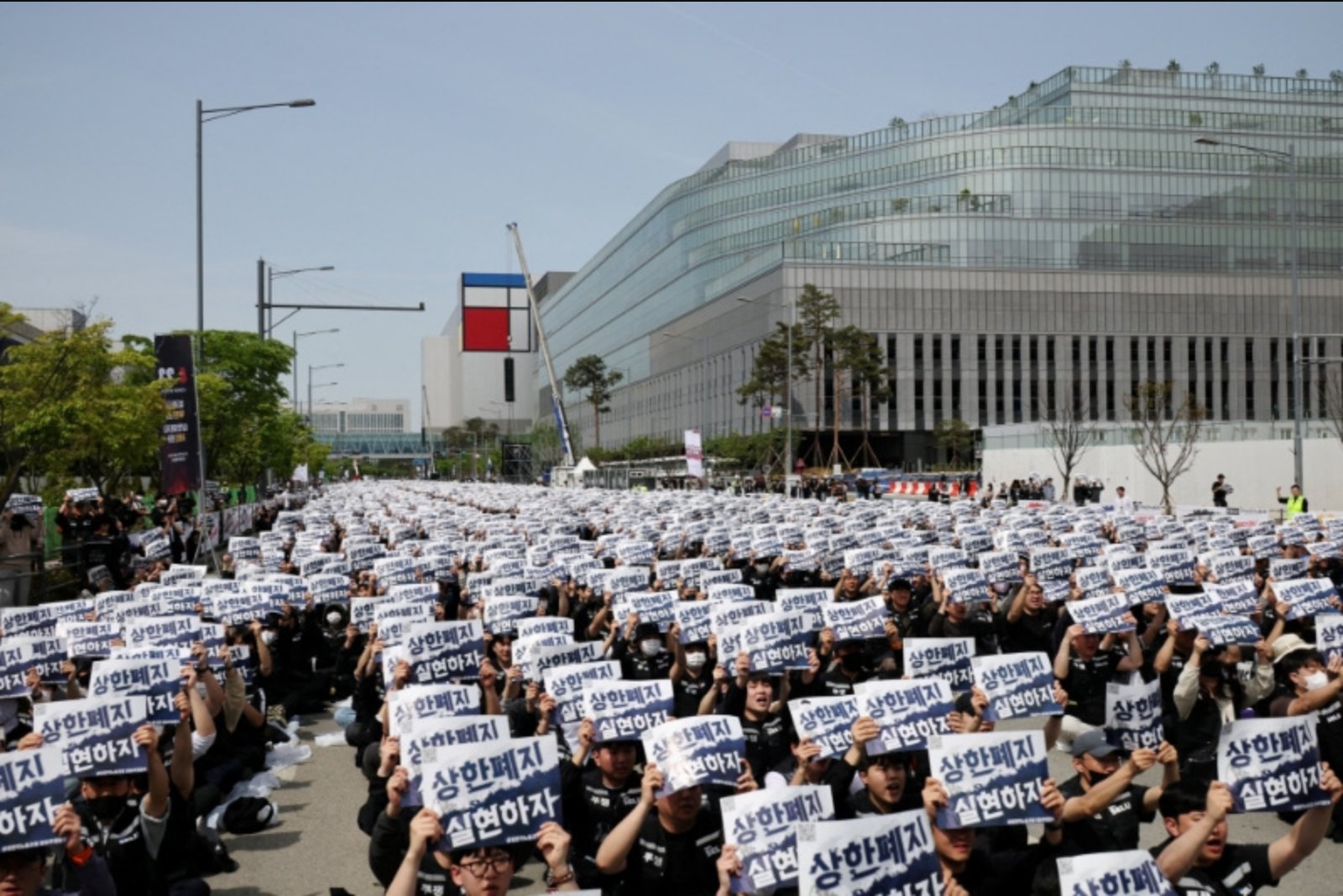
Workers participating in rallies and discussions said they felt their contributions to Samsung’s global standing were being overlooked. At a rally of roughly 40,000 workers in late April, one chip researcher named Lee, who has worked in the industry for three decades, told attendees he had applied to work for another firm and attended the demonstration out of anger and loss of pride in Samsung.
"I attended the rally because I am infuriated. I can’t just sit in the office and work," he said. "I no longer have pride in Samsung." Other workers interviewed expressed similar sentiments about morale and a sense that compensation did not reflect the risks and efforts that sustained Samsung’s market position.
What remains uncertain
Negotiations continue, but the core question - how to distribute the financial gains that have accrued to Samsung from the AI-driven memory shortage - has not been resolved. The scale of the projected impact on operating profit and sales has been quantified in internal and external analysis, yet the outcome of the bargaining and whether a strike will proceed remain uncertain.
The dispute lays bare tensions over how an integrated semiconductor strategy should manage cross-subsidization between profitable and unprofitable businesses, how to retain technical talent across divisions, and how to preserve customer trust in a company that supplies critical components to global technology supply chains.
For now, Samsung is publicly defending its investment strategy and compensation offer, while union leaders press for a more equitable approach that recognizes the roles of logic and foundry staff. The resolution of these talks will affect not only Samsung’s internal structure and employees, but also the broader semiconductor supply chain and investor confidence in Korea’s largest technology exporters.