
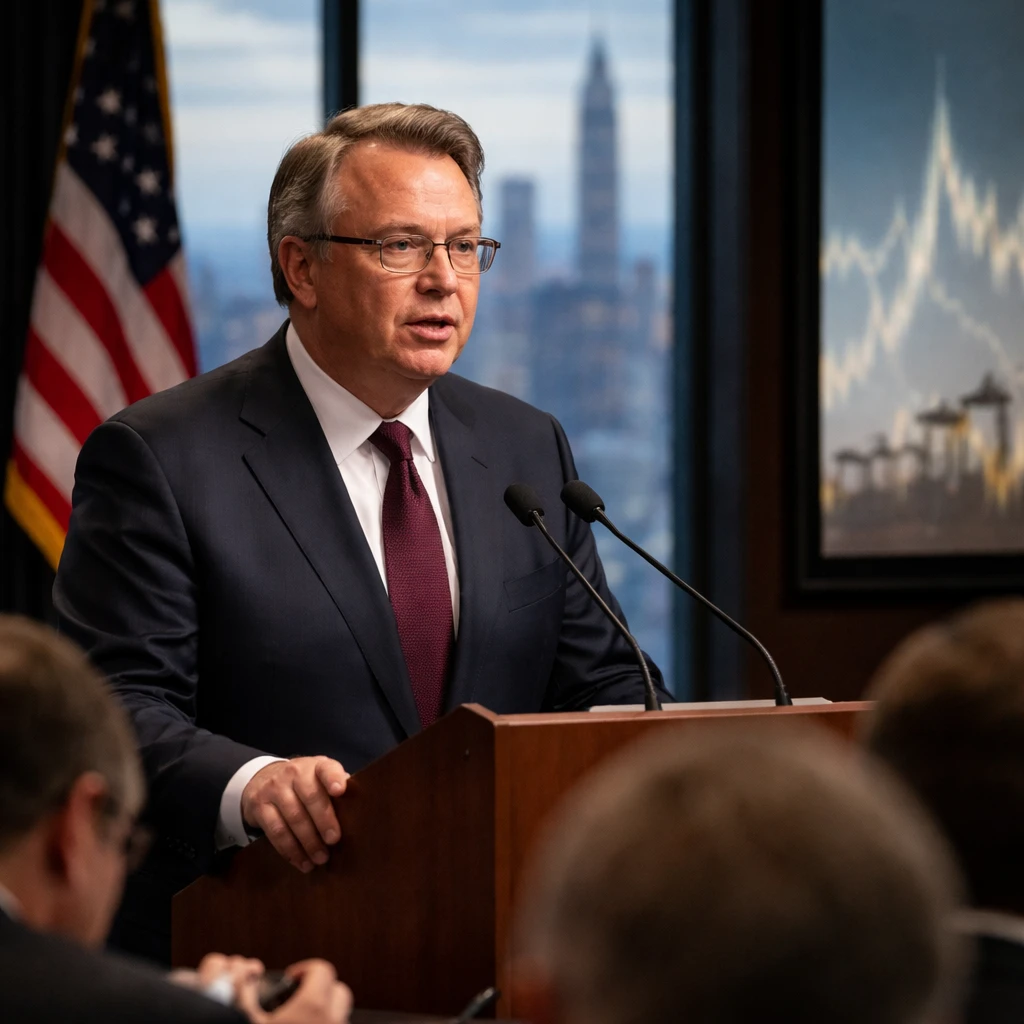
New York Federal Reserve President John Williams told an audience in New York City that U.S. monetary policy is well placed to respond to the economic uncertainty created by the conflict in the Middle East, but he warned that the balance of risks around the Fed's dual mandate has widened.
"The future is difficult to see, and the risks to both sides of our mandate have increased," Williams said in prepared remarks delivered at a Cynosure Group event.
He highlighted supply disruptions and higher energy costs stemming from the Middle East war as central influences on the global growth outlook, describing the combination as an unusual challenge for Fed policymakers.
Williams offered a set of near-term projections for the U.S. economy. He estimated real GDP growth this year in a range between 2% and 2.25%, with the unemployment rate remaining between 4.25% and 4.50%.
On inflation, Williams said he expects price growth to be about 3% this year, before easing back to the Fed's 2% objective in 2027. He cited tariffs and energy costs as primary drivers of the elevated inflation profile.
While noting that inflation expectations have been largely stable, Williams urged caution on the potential for larger-than-expected moves in energy prices. "Market expectations of the future path of oil prices are fairly benign, but several plausible scenarios entail more severe dislocations in both prices and quantities," he said.
Williams also warned that an intensification of the Iran conflict could trigger a larger supply shock, with more significant implications for both inflation and economic activity.
These remarks were the first Williams has made publicly since the Federal Reserve left its policy rate unchanged last week in the 3.50% to 3.75% range. He did not provide explicit guidance about the future path of the policy rate during his remarks.
Williams' statements came amid internal Fed debate over forward guidance. Three regional Fed bank presidents who supported last week's decision objected to language in the policy statement that suggested the next move would be a rate cut, arguing instead that both rate hikes and rate cuts remain possibilities. The dissenting presidents were from Cleveland, Dallas and Minneapolis.
Implications at a glance
- Energy price and supply volatility are central to the risk outlook.
- Monetary policy is judged to be appropriately positioned, but the Fed faces heightened uncertainty.
- Internal Fed views differ on whether the next policy action is more likely to be a cut or could be either a hike or a cut.