
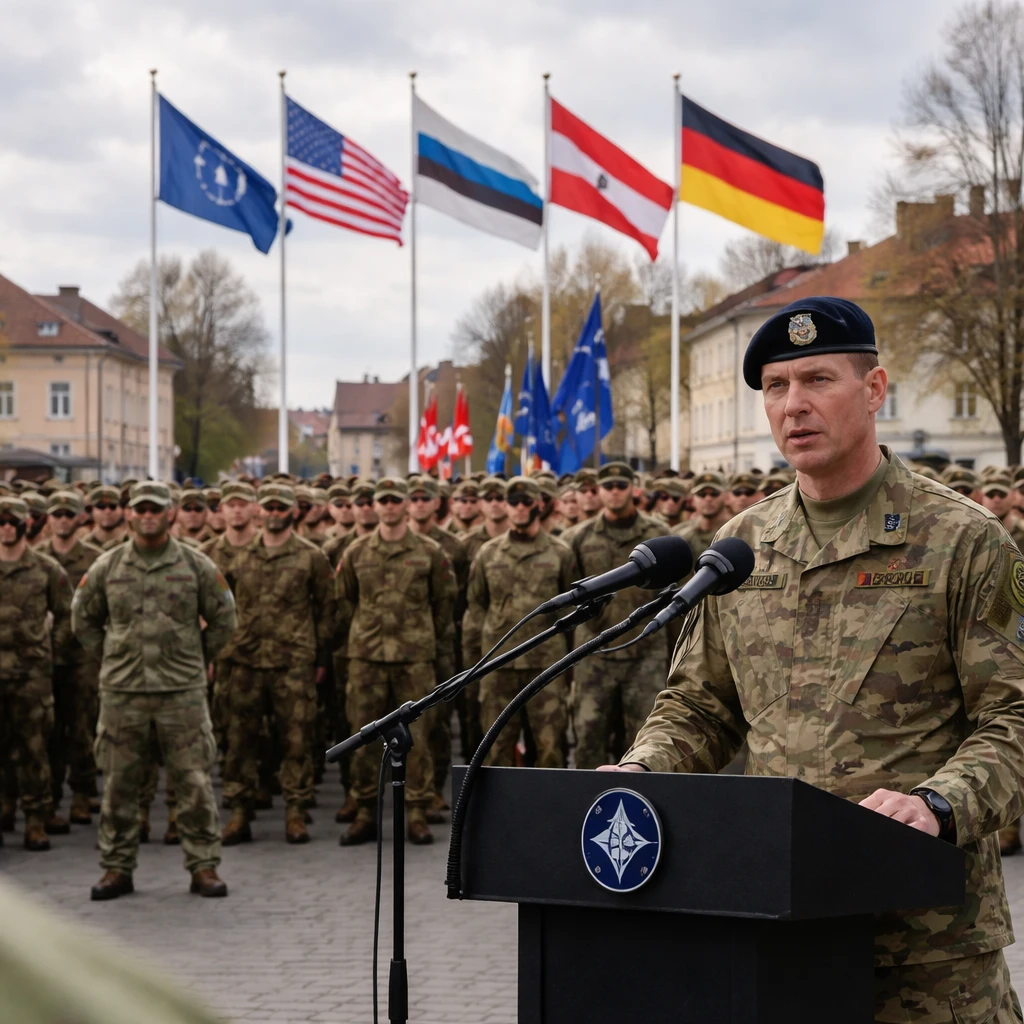
The United States will stand with its European allies in defending the Baltic states, the senior American commander of NATO land forces in Europe said on Tuesday as the alliance assigned an additional headquarters to the region.
Speaking in the border town of Valga, Estonia, U.S. General Chris Donahue told assembled officials and troops: "You’re ready to do more and following words with action, and the United States will be there alongside you." He added: "That is how deterrence is built: Not with words from a podium, but with boots in the mud." Donahue, who is due to relinquish his post on Thursday, also serves as chief of the U.S. Army in Europe and Africa.
Until now, NATO forces stationed in the Baltic states - Lithuania, Latvia and Estonia - together with units in northern Poland, have reported to a single multinational headquarters located in Szczecin in northwestern Poland. The alliance’s decision to create a second command zone is intended to allow NATO to allocate more troops and command capacity specifically to the Baltics.
Initially, two multinational divisions stationed in Estonia and Latvia will be placed under the command of the German Netherlands Corps, which is based in Muenster in Germany. NATO officials describe this shift as a means to improve the alliance’s ability to mass forces rapidly in the region when required.
NATO has warned that Russia - which invaded Ukraine in 2022 - could be capable of mounting a large-scale assault on allied territory as early as 2029 if current levels of arming continue, a forecast the Kremlin has denied. That assessment has contributed to growing pressure within Europe to bolster defensive capabilities.
U.S. President Donald Trump has publicly criticised European allies for what he says is insufficient burden-sharing on defence, a line of pressure that has increased calls for enhanced preparations across NATO.
German Defence Minister Boris Pistorius described the change in NATO’s posture as tangible proof of the alliance’s resolve. "It is a visible and strong demonstration of NATO’s unity, readiness, and of our collective determination to defend every inch of Allied territory," he said in Valga.
Military planning details underline the scale of what is being contemplated. When fully operational, an army corps normally commands three divisions, a formation that typically encompasses between 40,000 and 60,000 troops. In peacetime a corps often exists as a skeleton command - maintaining specialised functions such as artillery, air defence and medical units - so it can rapidly receive and deploy forces when needed.
The Multi-National Corps Northeast in Szczecin has overseen the region since its establishment in 2017. Adding a second corps-level command focused on the Baltics, NATO officials say, would permit the alliance to generate "mass at speed," according to a military official who spoke on condition of anonymity.
Summary
NATO has added a second multinational command for the Baltic region to increase troop and command capacity. U.S. General Chris Donahue reiterated American commitment to allied defence at a ceremony in Valga, Estonia, while Germany’s defence minister framed the move as proof of NATO unity and readiness. The reorganisation shifts two divisions to the German Netherlands Corps in Muenster and is intended to improve rapid massing of forces in the Baltics.
Key points
- The U.S. pledged continued presence and support for Baltic defence, emphasising on-the-ground deterrence.
- NATO created a second command zone, placing two multinational divisions in Estonia and Latvia under the German Netherlands Corps in Muenster to enhance responsiveness.
- Sectors likely affected include defence and defence procurement, national government budgets, and regional security planning.
Risks and uncertainties
- NATO’s assessment that Russia could mount a large-scale assault by 2029 if current arming trends continue - an outcome Moscow denies - creates a persistent security risk for the region; defence and defence manufacturing sectors are directly implicated.
- Political pressure from the United States for European allies to increase defence contributions introduces uncertainty in defence spending decisions across NATO governments, affecting fiscal planning and defence contractors.
- The time required to bring a corps to full operational capability - from peacetime skeleton structures to a fully manned formation - creates uncertainty in readiness timelines, with implications for troop deployments and logistics.