
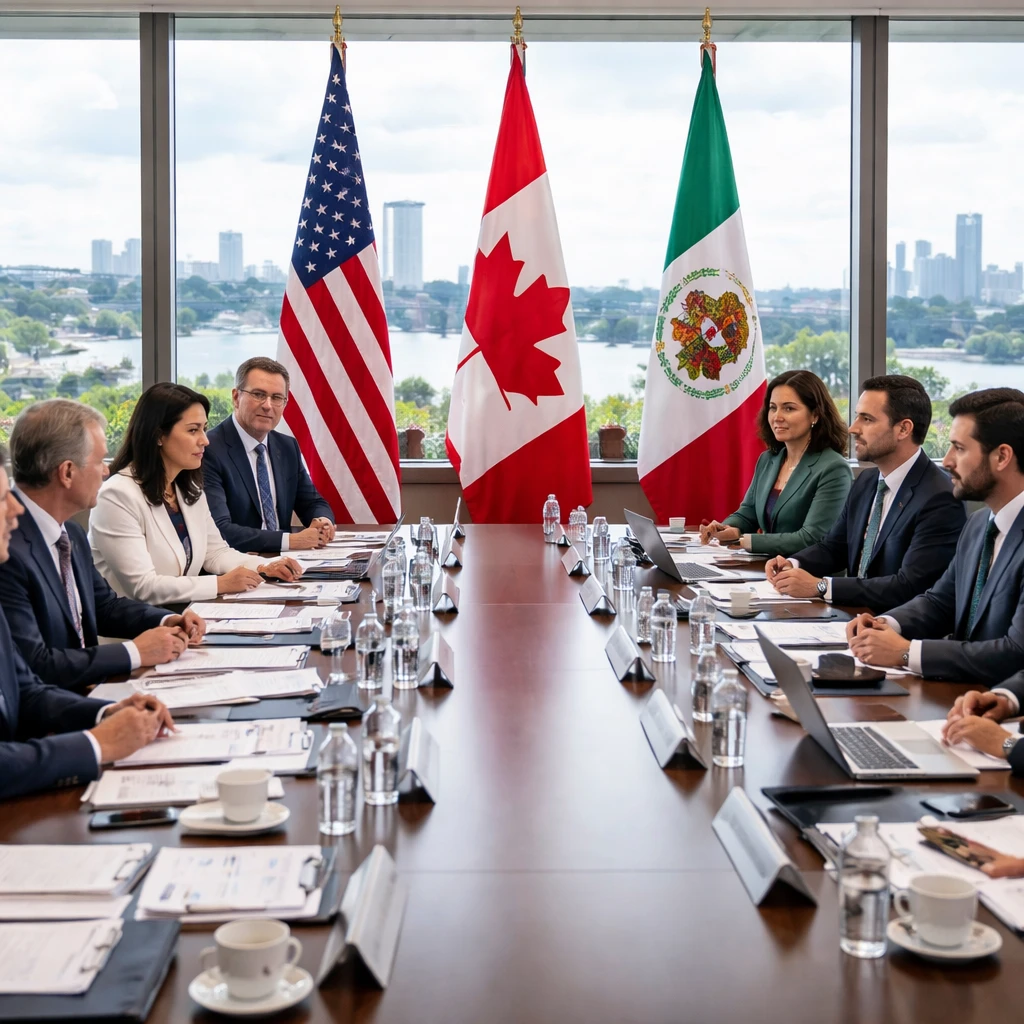
The United States, Canada and Mexico will convene on July 1 to conduct the statutory six-year review of their trilateral trade agreement, USMCA, after a period of heightened tensions between Washington and Ottawa. The review mechanism was established during the U.S. administration elected in the first term of President Donald Trump. The U.S. chief executive has been noncommittal about the agreement's renewal.
Relations between Ottawa and Washington have been strained enough that, according to reports cited by U.S. trade officials, Americans' comments about Canada have provoked consumer responses north of the border - with Canadians reportedly cutting back on travel to the United States and curbing purchases of American goods. Infrastructure projects have also been affected, with the opening of a new bridge linking Windsor, Ontario and Detroit delayed.
A spokesperson for Canada's minister responsible for U.S. trade declined to comment on the list of irritants set out by the U.S. Trade Representative’s Office (USTR) in its 2026 National Trade Estimate report released earlier this year. Below is a catalog of the specific areas the USTR highlighted as problematic for U.S. exporters or producers.
Dairy and supply management
Washington has singled out Canada’s supply-managed sectors for dairy, poultry and eggs. The U.S. asserts that Canada’s production quota system, coupled with tariff-rate quotas, restricts market access for American exporters. Tariffs levied on imports that exceed quota limits can surpass 200 percent, the U.S. report says. The United States also criticized how Canada administers the dairy import quotas created under USMCA and raised questions over milk pricing policies and the broader implications for U.S. dairy market access. Canada’s government, led by Prime Minister Mark Carney, has previously stated that supply management will not be placed on the negotiating table.
Buy Canadian procurement measures
The USTR accused Ottawa’s new Buy Canadian initiative of favoring Canadian firms and domestically produced steel, aluminum and wood in major public contracts. Washington further objected to provincial procurement measures adopted by Ontario, Quebec and British Columbia that the U.S. says restrict or disadvantage U.S. suppliers competing for government business.
Wine, beer and spirits distribution
Several Canadian provinces operate government-controlled liquor boards to manage alcohol distribution. The U.S. report says these systems impose barriers on U.S. producers, including listing restrictions, pricing rules and distribution requirements. The issue became more contentious after several provinces halted distribution of U.S. alcohol products in response to tariffs levied by the Trump administration on Canadian goods last year. Ontario Premier Doug Ford has said he will not restore U.S. liquor to provincial shelves until those tariffs are removed or a new trade deal is secured.
Digital services tax and online media rules
U.S. trade officials said they continue to monitor Canada's digital services tax. Although Ottawa pledged to repeal the tax, the USTR noted the measure had not been formally eliminated by the end of 2025. The U.S. also raised concerns about Canada's Online News Act, which requires major digital platforms to compensate Canadian news organizations, as well as online streaming rules that obligate certain services to contribute to Canada’s broadcasting system. The Canadian government has signaled it will step back from plans to force entertainment companies such as Netflix to contribute to Canadian productions, citing concerns about potential costs to consumers.
Agriculture and seeds
The U.S. criticized aspects of Canada’s seed registration system, describing it as slow and cumbersome and saying it limits market access for some U.S. seed and grain exports. Washington also continues to object to Canadian restrictions on imports of certain fresh fruits and vegetables.
Intellectual property
Canada remains on the USTR’s Watch List for intellectual property protection. The U.S. enumerated concerns about counterfeit and pirated goods, citing sales at locations including Toronto’s Pacific Mall, and flagged issues related to patent protections and the treatment of geographical indications.
Labor enforcement
While Canada has put in place measures intended to prevent the importation of goods produced with forced labor, the U.S. says enforcement is insufficient and that such goods could still enter the Canadian market. The report noted that earlier this month Canada introduced new legislation intended to strengthen the ban on imports produced with forced labor.
Alberta electricity market
The USTR relayed complaints from stakeholders who say the Alberta electricity market disadvantages U.S. power producers. The U.S. contends that electricity generated in neighboring Montana is given lower priority than equally priced power produced in Alberta, which in turn limits U.S. access to the province’s energy market.
Pharmaceutical pricing
U.S. industry groups argue that Canada’s Patented Medicine Prices Review Board depresses prices for innovative medicines by excluding the United States and Switzerland from the basket of comparator countries used to benchmark patented drug prices. The U.S. position is that this methodology artificially reduces the price and perceived value of innovative medicines in the Canadian market.
Washington’s compilation of concerns spans a wide array of sectors - from agriculture and food processing to pharmaceuticals, energy, digital services and intellectual property. The July 1 review will bring the three trading partners together to assess the state of the agreement in light of these and other issues.