
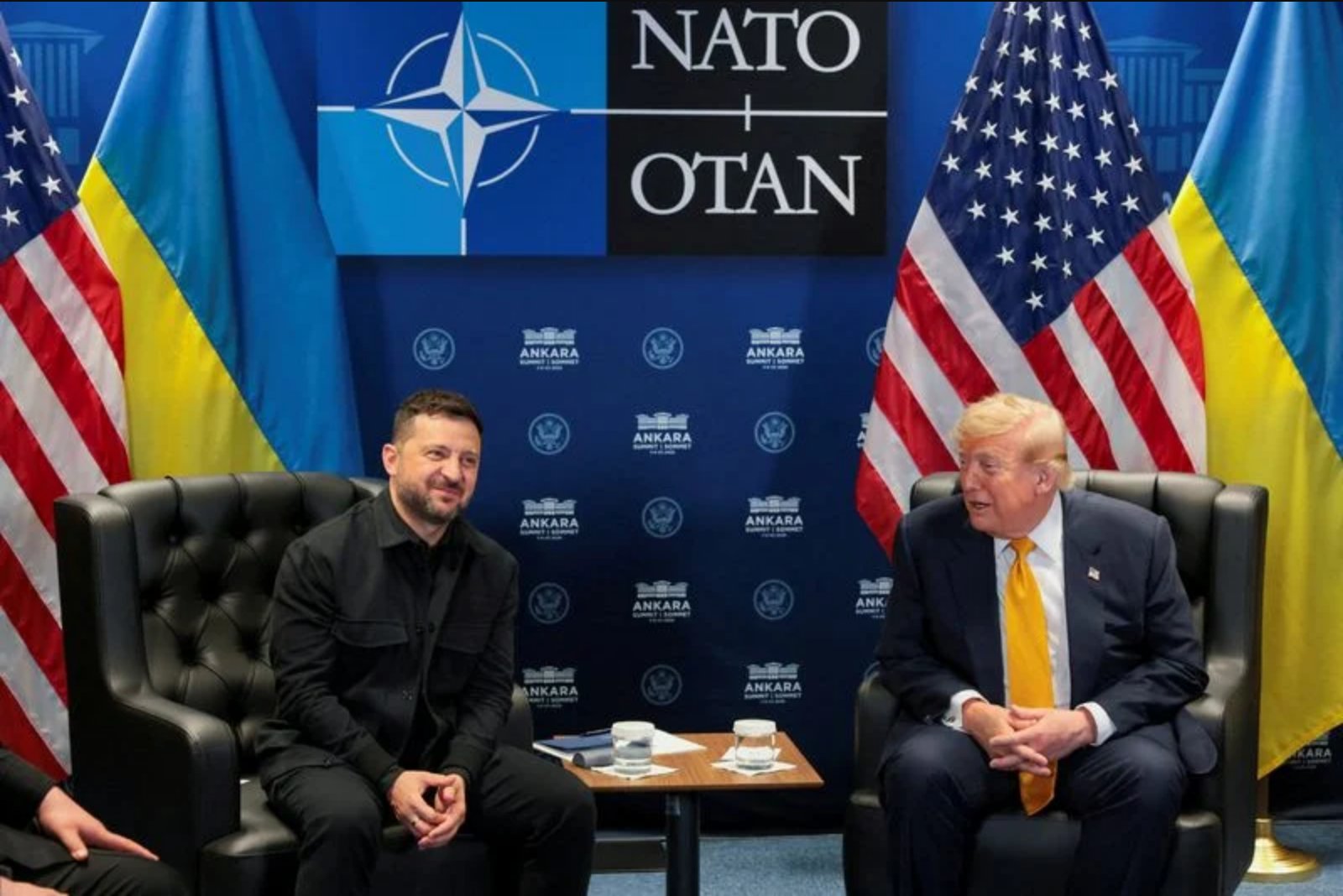
President Donald Trump’s pledge to permit Ukrainian production of U.S. Patriot air defence interceptors marks a notable improvement in relations with Kyiv, but defence specialists warn that moving from promise to production will take significant time. In the short term, the practical impact on Ukraine’s capacity to stop Russian ballistic and hypersonic missiles appears limited.
The commitment was made when Trump met Ukrainian President Volodymyr Zelenskiy at a NATO summit in Ankara on Wednesday. It follows months of fraught interactions between the two leaders, including a public clash at the White House in February 2025, and was hailed in Kyiv as a diplomatic victory. Yet experts emphasise that political approval is only the first step in a long and technically demanding process to produce Patriot interceptors outside the United States.
Patriot interceptors are essential to Ukraine’s defence against long-range ballistic threats. Ukrainian officials note the Patriot is the sole system in their current inventory capable of stopping Russian ballistic missiles. Russia’s recent campaign of missile strikes has placed heavy pressure on Ukraine’s air defences; this month Kyiv has managed to shoot down only four of the 54 ballistic missiles launched at it, underlining the shortage of effective interceptors.
Production challenges and timeframes
Industry analysts and missile experts stress that setting up a licensed production line for either the Raytheon-made PAC-2 interceptors or Lockheed Martin’s more complex PAC-3 interceptors requires building assembly facilities, qualifying subcontractors, and establishing secure supply chains for scarce components. Fabian Hoffmann, a missile expert at the Norwegian Institute for Defense Studies in Oslo, said the initiative is unlikely to deliver interceptors for at least 12 months and could take significantly longer. "Short term, the impact will be very limited," he said.
For context, Hoffmann pointed to a 2024 agreement in which Raytheon arranged for MBDA to make GEM-T interceptors for the PAC-2 system in Germany; first deliveries under that deal are not expected before early 2027. Efforts to negotiate PAC-3 production in Germany have not so far yielded results.
A Lockheed Martin spokesperson told reporters the company was focused on supporting the U.S. government and its allies, and suggested further inquiries be directed to the White House. Raytheon did not reply immediately to requests for comment.
Where production might take place
Officials and sources familiar with discussions say production of new interceptors would most likely begin in Europe - Germany being a prime candidate because it already has a domestic production chain for PAC-2 interceptors. Two sources said it would be safer to manufacture in Germany or another European country initially and then shift production to Ukraine once the war has ended.
Serhii Beskrestnov, an advisor to Ukraine’s defence ministry, warned on Telegram that it remains unclear how long subcontractors would need to scale up manufacturing of scarce components. Zelenskiy said technical teams would work quickly to resolve details, but stressed his desire for production to start "in Ukraine as soon as possible." He also said a shipment of PAC-3 interceptors from the U.S. was expected in "coming days."
Shortage scale and production capacity limits
Experts estimate that Russia is producing at least 700-800 Iskander ground-launched and Kinzhal hypersonic air-launched ballistic missiles per year. Using the assumption that three Patriot interceptors are needed per ballistic missile to secure a reliable interception, analysts calculate Ukraine would require roughly 2,400 interceptors annually if Russia continues at that rate.
Meeting that figure via licensed production within Ukraine would be extremely difficult. Hoffmann noted Lockheed delivered just over 600 PAC-3 interceptors last year and aims to scale output to about 2,000 by 2030. By contrast, a Ukrainian plant might be capable of producing only 200 to 300 interceptors a year, he said.
These production limits underline why even a licensed facility in Ukraine would not quickly eliminate the interceptor shortfall. The scarcity of interceptors is compounded by the technical difficulty of building systems capable of intercepting missiles that travel at many times the speed of sound - a capability that defence analysts describe as among the most demanding in missile technology.
Alternatives and interim measures
Given the constrained outlook for Patriot production, Zelenskiy has called for a Plan B - an alternative to relying solely on PAC-3 interceptors. He has pointed to a nascent European missile-defence initiative named Freya, led by Ukrainian company Fire Point. Fire Point is seeking European suppliers to provide radar, data uplink and seeker modules that could be integrated with its existing missile technology.
The aim is to develop a cheaper alternative to the Patriot and to have it ready before year-end, though analysts caution the project is uncertain. Jack Watling of the Royal United Services Institute described the Freya effort as "a long shot but if it works, the reward is enormous." Watling also noted other European options that may be feasible, such as the SAMP/T NG system from Eurosam, which he said would mainly require technical adjustments and radar calibration.
Zelenskiy said he hoped France would soon supply such systems. He has additionally asked allies to transfer missiles from their own stockpiles and supported a NATO-coordinated financing arrangement under which European allies and Canada would send funds to the United States to buy U.S.-made weapons for Ukraine.
Strategic choices for Kyiv
With Russia continuing to strike Ukrainian cities and critical infrastructure, Kyiv faces stark decisions about what to protect. Hoffmann noted the reality that with limited interceptors "You can only defend a very small number of the targets that you would like to defend, so you need to figure out which ones those are." Ukraine is prioritising protection for energy, manufacturing and military infrastructure by placing key facilities in concrete shelters or underground, but Hoffmann suggested the country’s best option might be to increase offensive operations.
Zelenskiy has proposed negotiating moves, including floating the idea of a truce on long-range attacks, an approach Moscow has rejected. He has also pursued pressure on Russia through attacks on its energy infrastructure, sometimes deep inside Russian territory, in an effort to bring Moscow to the negotiating table.
Immediate outlook
Analysts and officials agree that while Trump’s offer to allow production of Patriot interceptors is politically meaningful, it will not solve Ukraine’s immediate shortage of interceptors. Building the necessary industrial base, securing components, and transferring technology are lengthy processes. In the meantime, Kyiv will have to balance scarce defensive resources, continue to request missile supplies from allies, press for coordinated procurement financing, and pursue alternative missile-defence projects that remain unproven.
The combination of sustained Russian missile output, limited available interceptors globally, and long lead times for establishing production lines means Ukraine will confront difficult choices about what to defend and how to stretch limited air-defence assets for the foreseeable future.