
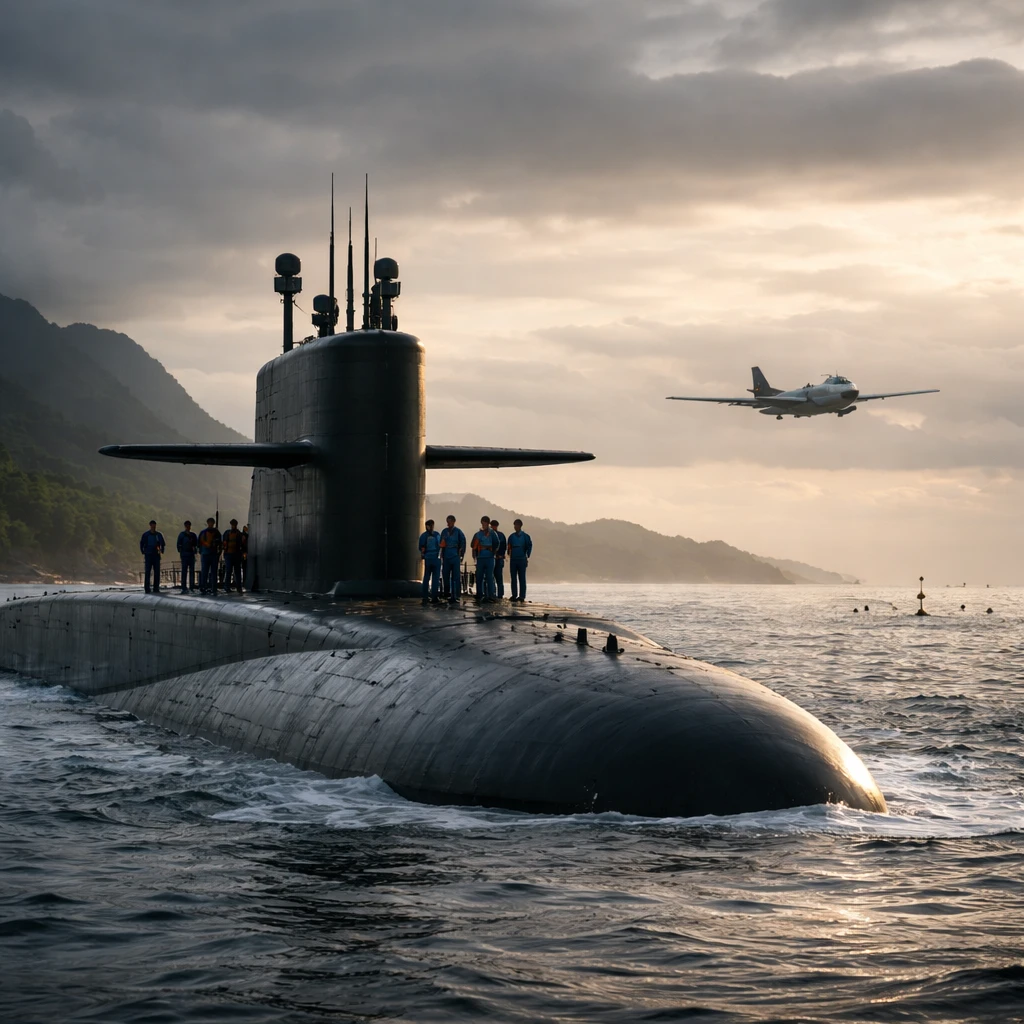
China’s test launch on July 10 of a ballistic missile from a submarine into the southern Pacific has drawn attention from analysts and diplomats as a probe into operational aspects of the country’s evolving sea-based nuclear deterrent. The exercise, which used a missile fitted with a dummy warhead, allowed military planners to assess complex tasks that go beyond the missile’s technical performance - notably the command, control and communication procedures required to operate nuclear-armed submarines undetected.
Security scholar Collin Koh of Singapore’s S. Rajaratnam School of International Studies said the launch likely served as more than a straight technical trial. He suggested Beijing’s evaluators would have scrutinised the operational procedures alongside the weapon systems themselves, and that the exercise signalled China is approaching a credible operational strike capability from its submarine force. Koh noted the possibility that even if Chinese submarines cannot position themselves to reach the continental United States, they could still threaten U.S. territories such as Guam and Hawaii.
The launch prompted criticism from regional governments and drew a specific characterization from the United States, which described the missile as an intercontinental ballistic missile that landed in the southern Pacific Ocean. Chinese state media and officials framed the event as a routine military drill, saying it was not directed at any particular country or target and that the exercise was conducted professionally. The Chinese defence ministry did not immediately respond to requests for comment.
Analysts and academics identified the submarine involved as one of China’s six Type-094 nuclear-powered ballistic missile submarines, commonly referred to as SSBNs. State media described the platform as a strategic missile submarine but did not name the class explicitly. SSBNs are large, nuclear-powered boats built to carry and launch intercontinental-range nuclear missiles while at sea.
China’s SSBN operations, particularly those based out of Hainan Island, are closely monitored by regional military attaches and analysts because of their central role in providing Beijing with a second-strike capability. If nuclear-armed submarines can remain undetected, they preserve the ability to retaliate if land-based forces were disabled in a first strike. That survivability underpins the logic of a sea-based leg of the nuclear deterrent and is aligned with China’s publicly stated policy of not being the first to use nuclear weapons.
Tracking and monitoring Chinese SSBNs is an active task for the United States and its partners. Military attaches and analysts say efforts to follow Chinese submarines include deployment of naval vessels, networks of underwater sensors placed in strategic chokepoints, and air patrols using P-8 Poseidon aircraft equipped with maritime surveillance systems. Such tracking operations are expected to intensify as China’s submarine capabilities expand.
A Pentagon report from 2022 noted that China had begun mounting near-continuous deterrence patrols with its SSBN fleet. The United States, Russia, France and Britain have long operated sea-based nuclear deterrents, and India is also developing SSBN capability, according to observers who track these forces.
Some scholarly analysis this week, published by the Bulletin of the Atomic Scientists, examined China’s nuclear arsenal and noted uncertainty over whether SSBNs on patrol carry nuclear warheads. The study highlighted that while U.S. officials have not publicly confirmed the presence of nuclear warheads on Chinese sea patrols, some U.S. officials reportedly conveyed that assessment privately to the study’s authors. The analysis also pointed to domestic political dynamics as a limiting factor, saying "President Xi Jinping’s purge of military officials - including leaders of the People’s Liberation Army’s rocket force - make it seem unlikely that nuclear warheads would be handed over to the military under normal circumstances."
Observers say the precise location of Monday’s submarine launch and the exact missile model used have not been publicly confirmed. Still, the ability of China’s SSBNs to manoeuvre beyond coastal waters without detection is expected to be a central focus of any internal review of the exercise. Analysts note that China’s current Type-094 class is scheduled to be succeeded by a newer, quieter design now under development, which would improve stealth and survivability.
To reach the continental United States with its most advanced submarine-launched missile, the JL-3, a Chinese SSBN would need to transit beyond the South China Sea into the wider western Pacific - a movement that could increase exposure to foreign naval surveillance. The JL-3, which was publicly exhibited in a Beijing military parade in September 2025, is believed to carry multiple independently targetable warheads and has an estimated range of 10,000 km (6,214 miles).
China’s Global Times newspaper framed the launch as further strengthening of Beijing’s so-called nuclear triad - the combined ability to deliver nuclear weapons from land, sea and air. In an editorial the paper argued that enhancing this triad would deter external powers and their regional partners from applying maximum military pressure or pursuing pre-emptive strikes, a stance the editorial said would lower the risk of large-scale conflict.
Monday’s submarine-launched test represents the most significant long-range ballistic missile trial by China since September 2024, when the People’s Liberation Army fired a missile from a mobile launcher on Hainan Island into the southern Pacific. The recent launch again brought submarine-based operations and the broader question of China’s sea-based nuclear posture to the forefront of regional security discussions.
As analysts and military attaches review the test, attention will remain on the operational lessons Beijing extracts - particularly regarding communications and command arrangements for nuclear-armed submarines - and on how those lessons inform future patrol patterns, platform development and deployment decisions.