
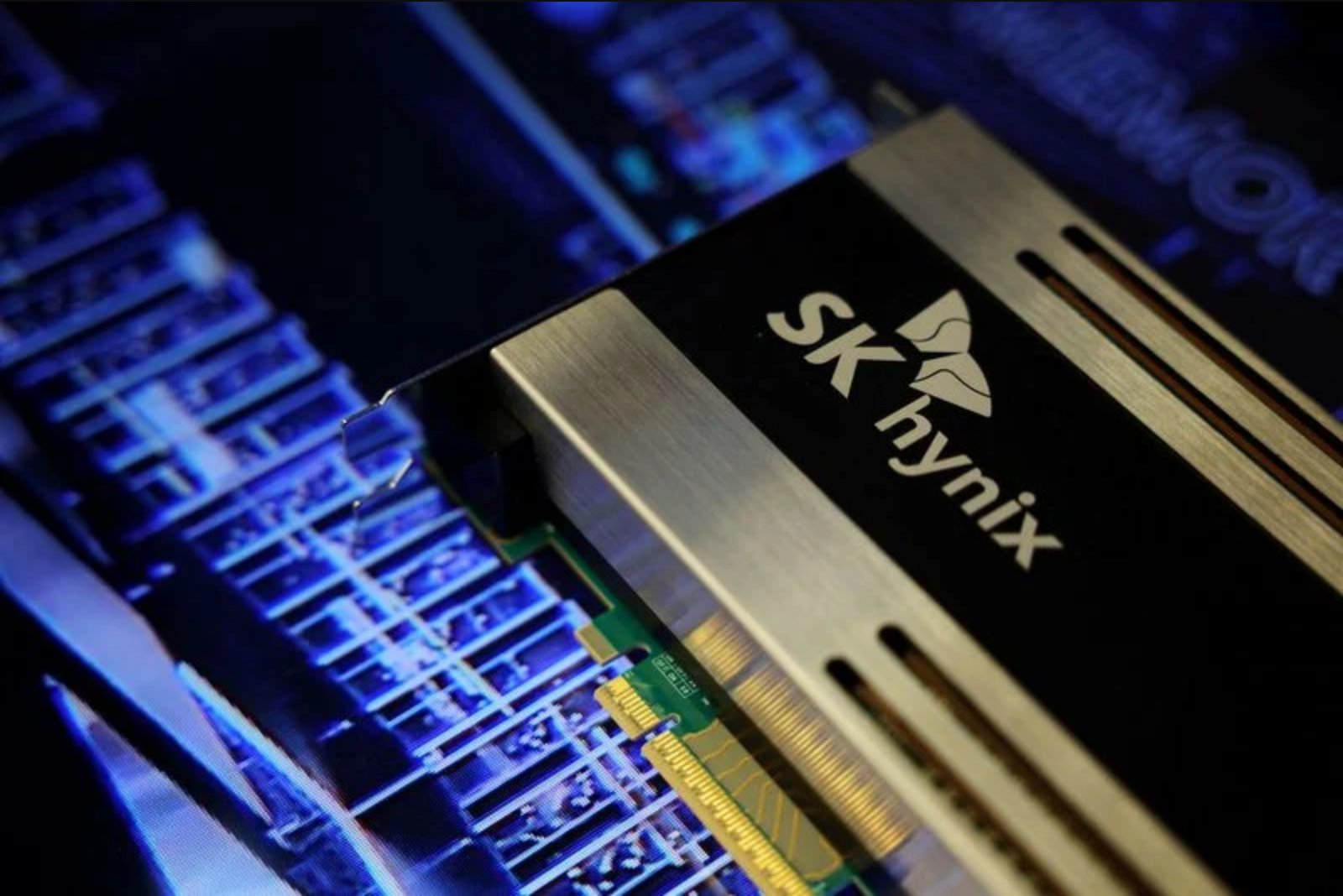
July 10 - SK Hynix kicked off U.S. trading after completing a $26.5 billion offering, a move that will broaden its investor base and provide fresh capital for factory expansion. The timing of the listing - coming after a recent cooling in chip stocks - will be watched closely as a barometer for investor appetite in companies tied to the AI investment cycle.
Chip equities have pared back some of their earlier gains, with SK Hynix itself down roughly 25% from a record high reached two weeks ago, even as the stock remains about 650% above levels from a year earlier. That divergence highlights how sharply sentiment has swung in a market that has become heavily focused on beneficiaries of AI-driven capital expenditure.
Market participants described the current backdrop as intensely crowded. Thomas Hayes, chairman at Great Hill Capital in New York, said the semiconductor sector has become one of the most heavily trafficked trades, and that issuers and bankers are tapping demand by bringing deals to where investor interest is concentrated.
The company sold American Depositary Receipts at $149 each - a 2.7% premium to its average share price over the prior three trading days - with ten ADRs representing one common share. Following the transaction, SK Hynix’s Korean-listed shares rose 2.2%, to 2,233,000 won (equivalent to $1,479.98) in Seoul on Friday.
Strategic rationale and market positioning
Listing on Nasdaq gives the Icheon, South Korea-based firm direct exposure to the world’s deepest investor pool and positions it as a straightforward U.S. vehicle for the AI-memory investment theme. Analysts and market observers note the move was designed to capture both demand and the valuation premiums U.S. chip stocks typically command relative to Seoul-listed peers.
SK Hynix is the world’s largest manufacturer of high-bandwidth memory (HBM) chips, components integral to the data-processing workload of AI-focused graphics processing units made by firms such as Nvidia and AMD. A surge in spending on advanced GPUs has tightened HBM availability and lifted prices, elevating HBM producers in investors’ rankings as essential "picks and shovels" suppliers to the AI build-out.
The offering is unusually large - the second-largest U.S. share sale since SpaceX’s record IPO last month - and will fund new factory construction while making the company more accessible to U.S. portfolios. Some analysts expect the U.S. listing to help narrow the valuation gap between SK Hynix and U.S.-based competitors by improving comparability and liquidity.
Valuation and peer comparisons
Despite the company’s dominance in HBM, valuation metrics remain lower than some U.S. peers. According to LSEG data, SK Hynix trades at roughly 6.8 times forward earnings, while Micron - its U.S.-based competitor - is trading near 13 times. Micron’s shares have surged about 711% over the past 12 months, underscoring investor enthusiasm for memory suppliers perceived to benefit from AI-driven demand.
Giuseppe Sette, co-founder of an investment analysis platform, noted that the Nasdaq route is the most direct way for U.S. investors to access the AI-memory narrative, and that SK Hynix timed the listing to tap higher valuations. He cautioned, however, that later entrants seeking capital in this theme may face a more selective market.
Demand outlook and lingering questions
Large technology companies are committing substantial resources to accelerate AI capabilities, and that spending has pushed cloud and AI infrastructure capital expenditure forecasts materially higher in the near term. A recent BofA Securities note referenced in the market expects global cloud and AI infrastructure capex to approach $1.5 trillion by 2027, implying a 40% to 50% year-over-year increase.
Yet some investors and strategists are beginning to weigh the limits of that spending boom. Concerns about the return on extraordinarily large infrastructure investments have grown, raising the possibility that major hyperscalers could decelerate their hardware procurement. Renaissance Capital’s Matt Kennedy highlighted industry-specific oversupply risks, and noted that investors will evaluate recent volatility alongside the prior year’s rally when deciding whether to add exposure.
Currency information disclosed alongside trading updates lists $1 as equal to 1,508.8000 won.
What the Nasdaq debut signifies
SK Hynix’s U.S. listing crystallizes several concurrent market themes: the concentration of investor demand around AI beneficiaries, the premium afforded to U.S.-listed chip names, and the question of whether elevated capex by cloud and AI leaders can be sustained without creating cyclical surplus. The success of the ADR sale - and how the stock performs in the weeks ahead - will serve as a visible measure of how confident U.S. investors remain in the durability of the AI spending cycle.