
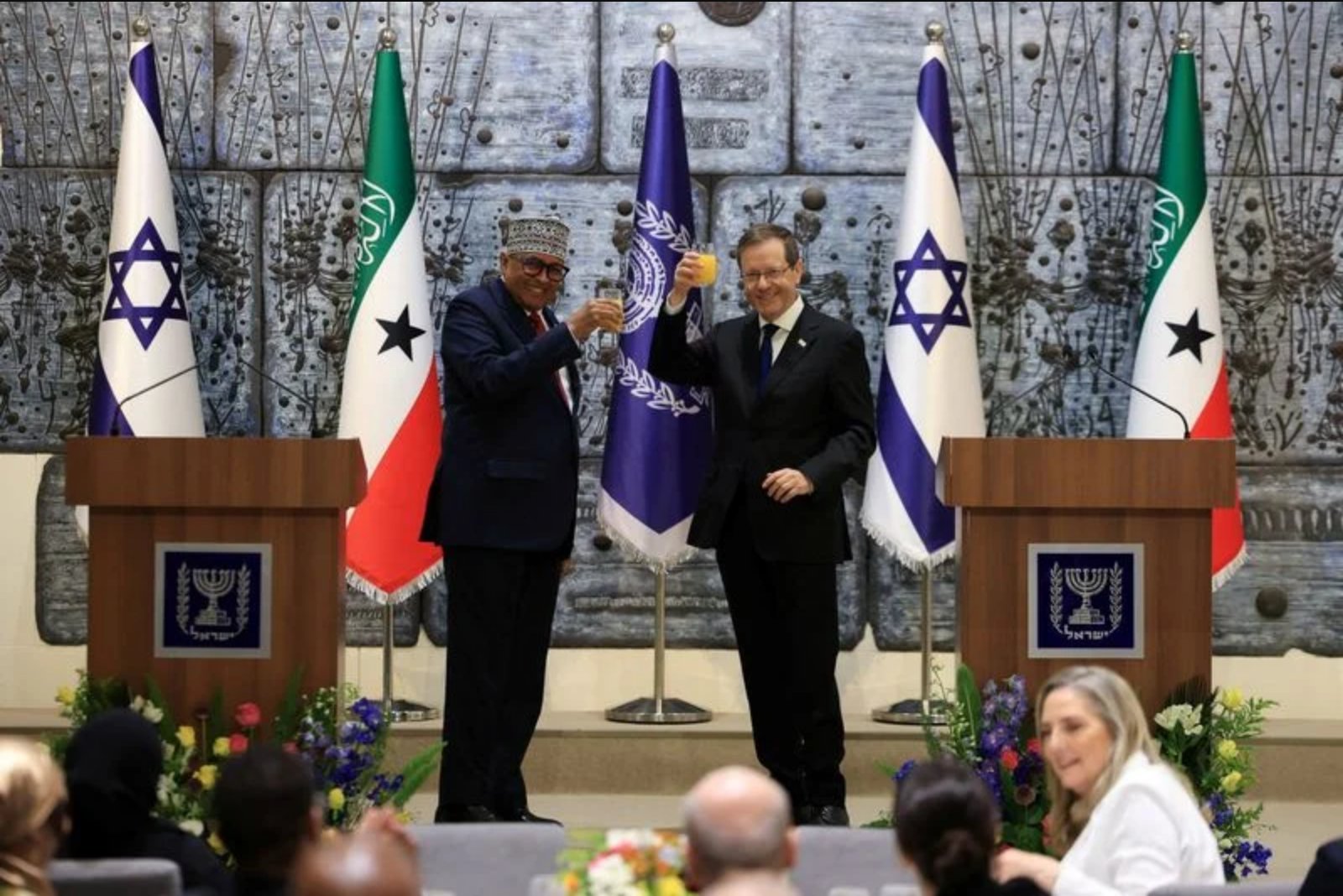
Somaliland's Defence Minister Mohamed Yusuf Ali said on Wednesday that Israel does not have a military base in Somaliland, but acknowledged that Israeli personnel are assisting with training for Somaliland's police and armed forces. His comments came during a business forum in Tel Aviv attended by a large Somaliland delegation that accompanied President Abdirahman Mohamed Abdullahi on his first official visit to Israel following formal recognition by Israel in December.
Yusuf Ali dismissed recent reports suggesting Israel was negotiating to establish a military base in Somaliland as "rumours." "There is no Israeli military presence or military bases in Somaliland," he said. "But Israel is helping Somaliland ... they are supporting to train some of our police and military."
The visit was organised around a conference hosted by Israel's foreign ministry. Somaliland leaders used the platform to appeal for Israeli investment and technological cooperation in a range of civilian sectors, including agriculture, livestock, water management, renewable energy, healthcare and cybersecurity.
President Abdullahi, addressing participants at the conference, described Israel as a "valued and reliable friend" and said, "Somaliland is open for business, and Somaliland is ready for Israeli investment," highlighting the territory's "vast natural resources" and its strategic position as a maritime gateway to Africa.
Israel's Foreign Ministry director general Eden Bar-Tal said that Israel's decision to recognise Somaliland had created a "significant and unique advantage" for Israeli entrepreneurs seeking opportunities there. Michael Lotem, Israel's ambassador to Somaliland, declined to comment on the reports of a military base.
Israel's defence minister, Israel Katz, said after meeting Abdullahi that he sought to deepen security, economic and diplomatic ties with Somaliland and characterised both parties as combatting "terrorist" elements in the region. Katz added: "For many years we cooperated under the radar in a series of operations that will remain secret."
Despite those assurances, the move has drawn criticism from Somalia, which rejected Israel's recognition of Somaliland and described it as a "deliberate attack" on Somali sovereignty. Media reports from the Somali Guardian have claimed that Israel opened an intelligence base in Somaliland and that discussions were under way over a possible Israeli military base. Yusuf Ali insisted those accounts were incorrect.
Several countries have asked whether recognition by Israel could be intended to secure military access to a location from which Israel might counter activity by Yemen's Houthi movement. The Houthis have fired rockets at Israel during the two-year Gaza war and their attacks on vessels in the Red Sea have disrupted shipping in that corridor, a point cited by officials and analysts questioning the strategic implications of the Israel-Somaliland relationship.
In February, President Abdullahi said that while Somaliland hopes for future military cooperation with Israel, the establishment of Israeli military bases had not been discussed. During the recent trip he reiterated the economic and technological priorities of the delegation, emphasising interest in Israeli expertise to improve agricultural productivity, livestock systems, water and energy management, and to broaden healthcare and cybersecurity capabilities.
Context and next steps remain limited by the differing narratives from involved parties. Somaliland is pushing to convert recognition into tangible investment and technological partnerships, while Israel has said its recognition is not intended as a hostile act toward Somalia. Meanwhile, lingering reports and regional apprehension about the possible military uses of access to Somaliland continue to generate uncertainty.