
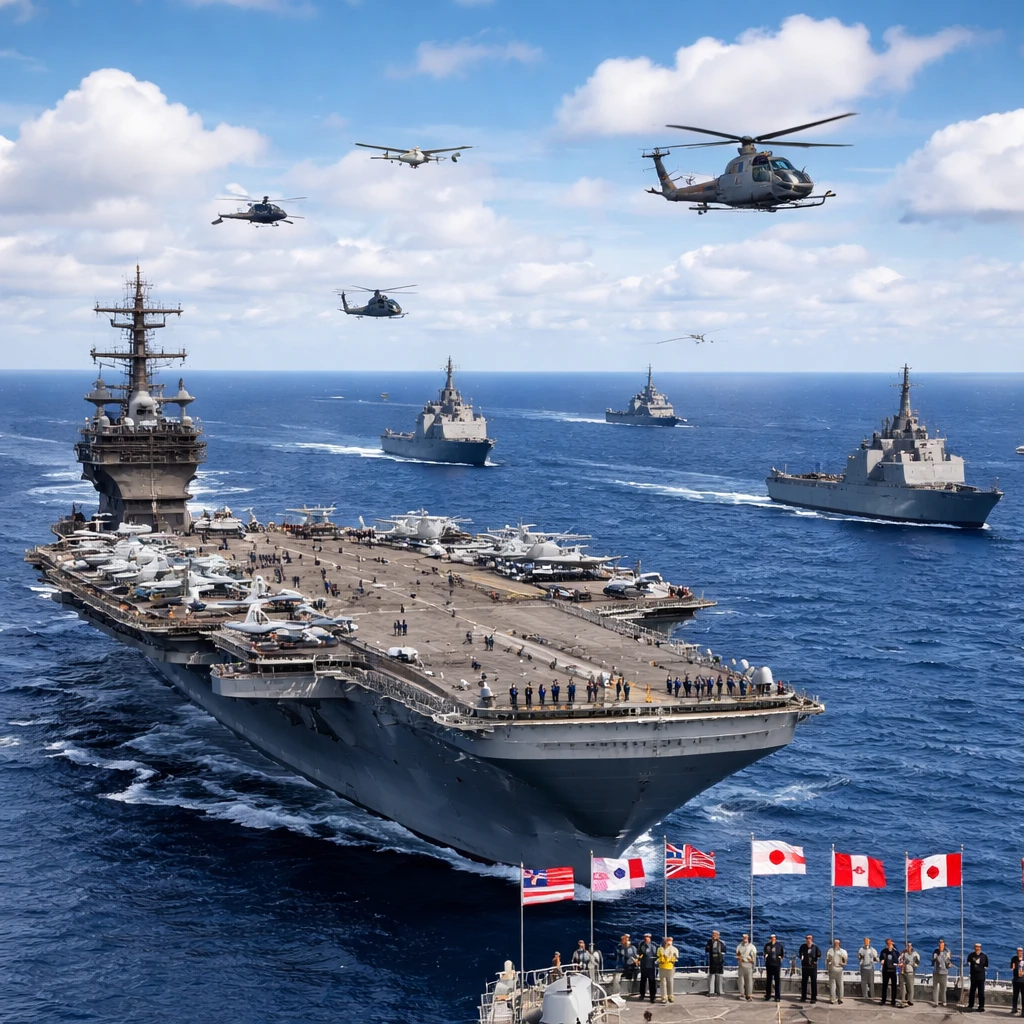
The United States and partner nations wrapped up the largest Rim of the Pacific maritime exercise on Friday, a five-week operation that drew roughly 30,000 personnel from 30 countries and put multinational naval and air capabilities through an intensive series of drills.
Participants executed in excess of 500 maritime exercises and about 2,400 air missions during Rimpac, providing a broad operational testbed for weapons, logistics systems, unmanned vehicles and multilateral command arrangements. Vessels and platforms ranged from the U.S. aircraft carrier Theodore Roosevelt to a Japanese Aegis destroyer, South Korean ships and a Canadian submarine.
Allied nations took on significant leadership roles inside the exercise. Only three of Rimpac's top-ranking posts were filled by Americans, with several partner countries holding senior positions across the command structure.
Organizers said the drills allowed participating forces to exercise complex capabilities, including testing maritime weapons and networking logistics across different national systems. Unmanned systems and command arrangements were singled out as key areas of focus during the five-week programme.
The expansion of the exercise occurs as regional tensions rise: China has adopted a more assertive military posture in the Asia-Pacific and North Korea continues to expand its nuclear programme. Those trends have driven a heavier emphasis on combined training and interoperability among U.S. partners.
The U.S. Pacific Command runs more than 100 joint exercises with regional partners each year. Other large-scale drills across the theatre have also grown in scale and scope, including Talisman Sabre in Australia, Cobra Gold in Thailand and Balikatan in the Philippines.
The Philippines participated in Rimpac with its coast guard for the first time, reflecting an effort to modernise forces amid territorial tensions with China in the South China Sea.
Despite the scale and intensity of the exercises, the drills exposed shortcomings in regional military integration. The Asia-Pacific region lacks a single, central alliance architecture akin to NATO, leaving partner forces to operate with disparate communications networks, radar systems, logistics arrangements and medical support structures.
Background concerns about U.S. reliability persisted during the exercises, linked to the political context of President Donald Trump's public criticism of alliances and his calls for partners to raise defence spending. The United States has also shifted some personnel and equipment away from the Asia-Pacific to support operations in Europe and the Middle East.
In response, several U.S. allies have increased military budgets and moved to purchase new platforms and systems. Greater defence spending on ships, missiles, radar systems and military communications could, according to observers, bolster demand for major American and allied defence contractors.
Key points
- The five-week Rimpac involved about 30,000 personnel from 30 nations and included over 500 maritime exercises and approximately 2,400 air missions.
- Warships and platforms taking part included the U.S. aircraft carrier Theodore Roosevelt, a Japanese Aegis destroyer, South Korean vessels and a Canadian submarine; allied partners held most senior roles in the exercise command.
- Increased defence budgets and procurement by U.S. allies could raise demand for suppliers of ships, missiles, radar and military communications systems.
Risks and uncertainties
- Persistent doubts about U.S. reliability following political criticism of alliances may affect partner confidence; this has potential implications for defence procurement decisions and alliance planning.
- Redistribution of U.S. personnel and equipment from the Asia-Pacific to support operations in Europe and the Middle East could limit forward-deployed U.S. resources available for regional contingencies.
- The lack of a unified alliance framework in the Asia-Pacific creates interoperability gaps across communications, radar, logistics and medical systems that complicate coordinated responses.
This exercise marks the largest single Rimpac to date and illustrates both growing military coordination among Pacific partners and the operational challenges that remain in aligning disparate national systems for coalition work.