
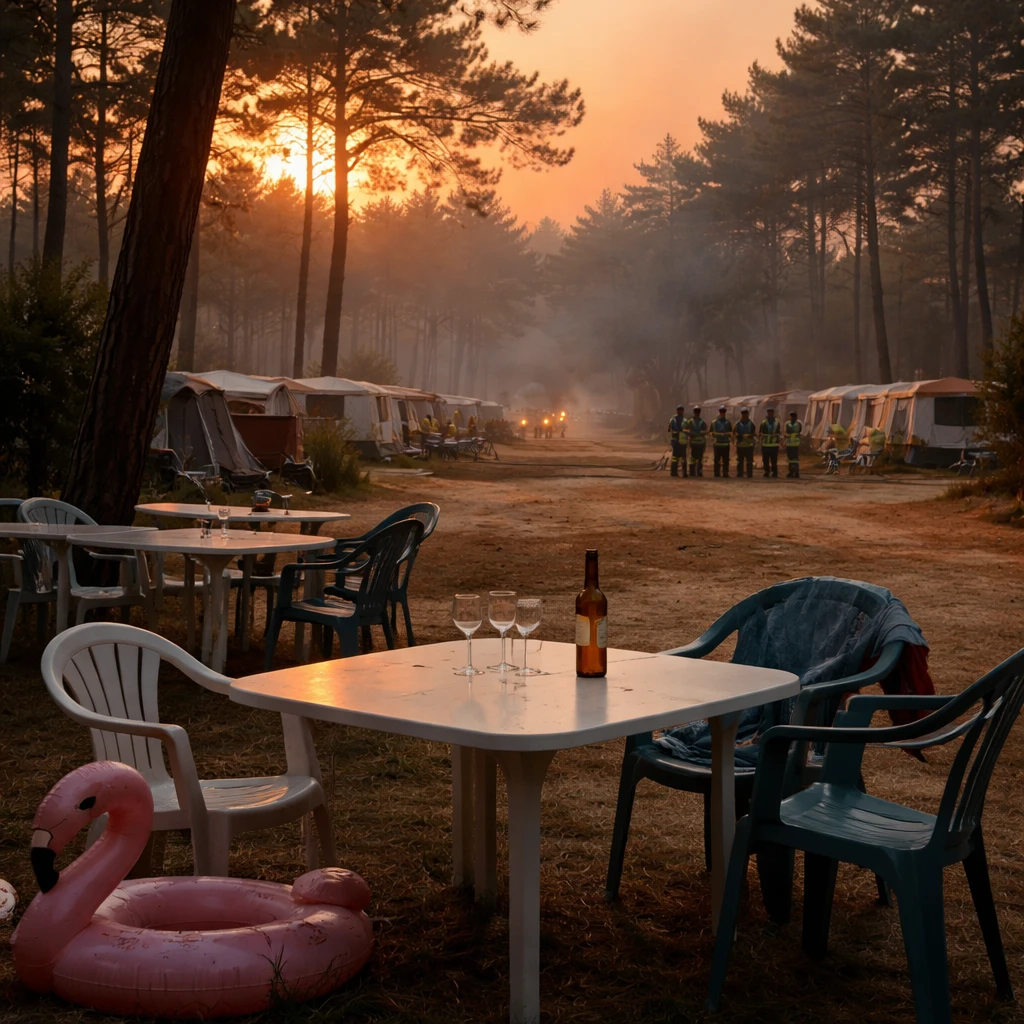
Around 8:30 p.m., as holidaying families were settling down to dinner, police delivered a short and stark order to evacuate. Flames from a wildfire were advancing toward the Domaine de La Rive campsite near Biscarrosse in southwest France. Manager Hadrien Folliot said he had little time to move roughly 1,200 holidaymakers from the site, one of 20 he runs in the region. Less than half an hour later the campsite was empty.
"They had to leave very, very quickly," Folliot recalled. "Many customers left their meals on the tables. They were in the middle of eating." The abrupt departure, he said, left tangible traces: an abandoned inflatable flamingo slowly deflating and a bottle of wine left open on a table. Folliot and his team returned to find the site spared by the fire, but he estimated losses at around €2 million, equivalent to 15% of his annual turnover. He added that insurance was unlikely to cover refunds or business lost because authorities had forbidden hosting holidaymakers during the emergency.
The episode at Domaine de La Rive is a vivid example of an intensifying hazard for an industry that has been central to French summer life for nearly a century. "Campings are located in forests, by the sea, and along rivers, which is why we are directly affected by wildfires," said Nicolas Dayot, president of France’s National Federation of Outdoor Lodging. "We need to find solutions. We are now in the 21st century, not the 20th." Dayot noted that France has about 7,400 campsites that form part of the country’s holiday infrastructure.
The Nouvelle-Aquitaine region, where recent fires in the Gironde and Landes departments erupted, is a major hub for camping. Dayot reported that 62 campsites had been evacuated in the wildfire-affected area, with one site completely destroyed and three suffering minor damage. He said flames at one campsite near Lège-Cap-Ferret were put out only two metres from tents that had been abandoned in haste during an evacuation visited alongside local firefighters.
July and August are critical months for the sector. Dayot said that August typically accounts for about 40% of campsites' annual business, and the fires have prompted many cancellations for the late July and August period. While the larger industry might absorb the immediate financial shock, Dayot warned that smaller family-run operators are particularly exposed to the disruption.
Faced with such risks, industry leaders say a range of adaptations is now under consideration. Suggestions include replanting vegetation differently around sites, redesigning the layout of pitches and facilities, and in some cases relocating entire campsites. Improving access to water for firefighting was also highlighted as a priority. "We have to re-learn how to live with the forest, with the climatic conditions we now face," Folliot said.
Beyond the practical and commercial implications, the developments touch on a wider cultural tradition. Sociologist Olivier Sirost, who has studied what the French call "le camping," traced the idea of vacationing in nature to Britain in the late 19th century and tied the emergence of camping in France to the paid holidays introduced by Leon Blum's Popular Front government in 1936. The camping boom accelerated in the 1960s and 1970s as cars and caravans became more prevalent, offering working families an affordable way to travel and spend summer time together.
The industry evolved further from the 1980s onward when it began to professionalise; at that time around half of campsites were still municipally owned. Today, more than 80% of French campsites are privately run, and some firms backed by investment funds own portfolios of up to 250 sites. That shift has gone hand in hand with changing consumer expectations and a process of gentrification in parts of the sector.
Nicolas Dayot put the average price of a campsite night at €22, compared with €116 for a hotel. At the same time, higher-end, 5-star camping venues have emerged that can cost around €2,000 for a week. Those venues often offer television, air conditioning and sizeable leisure facilities such as large water slides. "There is no longer much that is ecological about them," said film director Fabien Onteniente, whose popular "Camping" movie trilogy drew on the culture of such sites.
Onteniente, who experienced a wildfire at the Flots Bleus campsite where he filmed the trilogy, said the industry serves as a sort of laboratory in which aspects of contemporary French identity are shaped. That, he argued, underlines the need for the sector to adapt to hotter climatic conditions while preserving the social aspects that make camping distinctive. "Liberty, Equality, Fraternity. Fraternity is important," he said. "That’s what I love about campsites: People are together. They play games together. There is a good atmosphere. And then at the end of the holidays, people say: 'See you next year.'"
Industry officials said the fires had already driven cancellations and could have lingering effects on occupancy for the critical summer months. They stressed that while larger operators might withstand some of the losses, smaller family-run sites are at greater financial risk. Proposed responses range from relatively modest changes to vegetation and layout to more substantial measures such as relocating sites or bolstering water supplies to aid firefighting.
As French camping approaches its centenary, those involved in the business say the sector faces a choice: adapt to a changed risk environment or face repeated and potentially worsening disruption. For managers like Folliot, the recent evacuation was a practical and financial wake-up call. For many holidaymakers, the images of sudden departures and tents left standing a few metres from extinguished flames will be a reminder that even long-established leisure practices are now contending with the physical realities of a warmer climate and more intense wildfire episodes.
Exchange rate used in reporting: $1 = 0.8683 euros.