
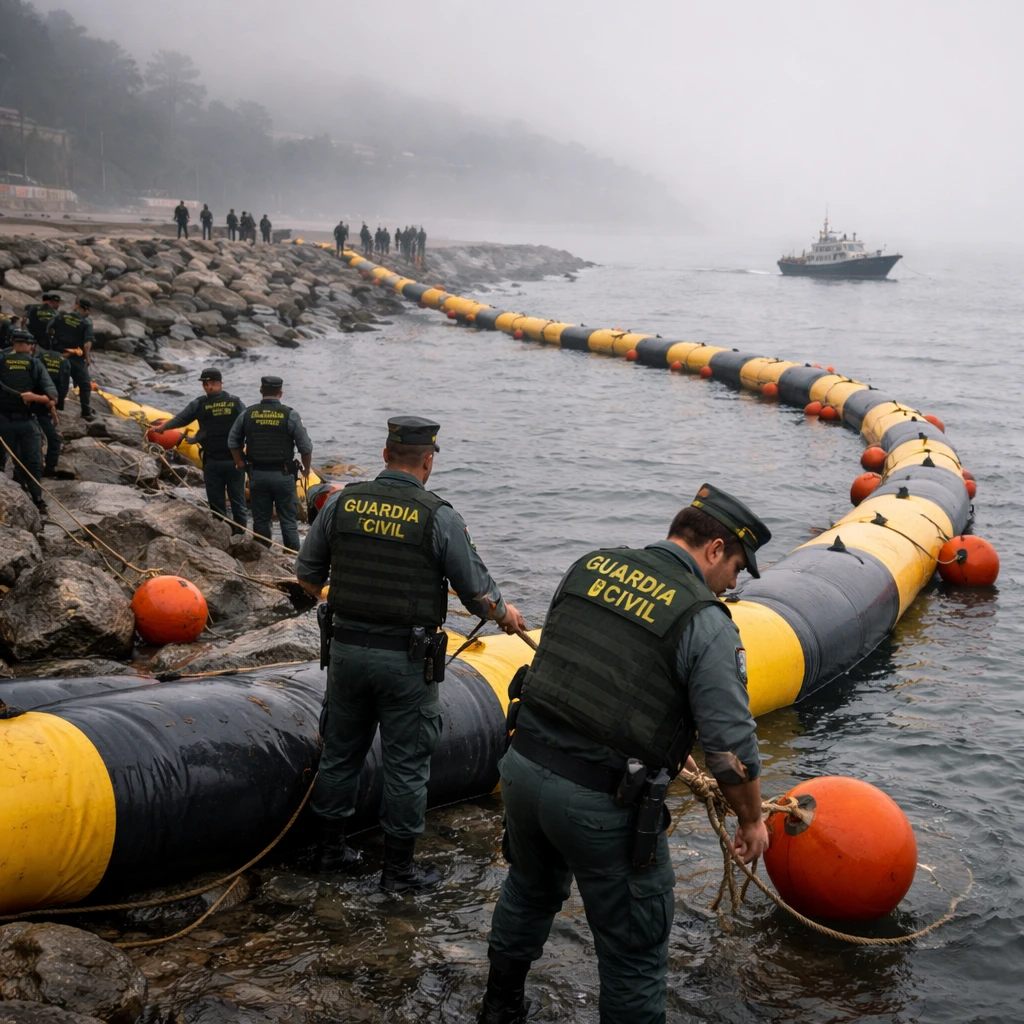
Spanish authorities said migrant crossings into Ceuta ceased overnight on Saturday as police and soldiers moved to secure the enclave's shoreline. The government said Civil Guard officers began laying a 500-metre floating barrier off the Tarajal breakwater - one of the primary access points used by people attempting to reach the tiny Spanish territory from Morocco - following a sudden and unprecedented surge that resulted in at least 67 deaths.
According to official figures provided by Madrid, around 50,000 people entered Ceuta by land and sea beginning on Thursday during the mass rush. Of that number, more than 48,000 returned to Morocco within 48 hours without major incident, Spanish authorities reported. Images seen by reporters on Saturday showed Spanish soldiers and police patrolling a largely empty, fog-covered Tarajal beach.
The government said Civil Guard police started placing the pneumatic barrier at 7:50 a.m. (0550 GMT) on the Tarajal breakwater. The floating system, installed in conjunction with a line of anchored naval buoys, is built to project 30 to 70 centimetres above the water line and to extend as much as one metre below the surface. Officials said a navigable channel will be left between segments of the barrier to permit Civil Guard vessels to patrol the area.
Authorities reported that at least 67 bodies have been recovered on the Spanish side of the frontier. The government attributed those fatalities to drownings and incidents in which people were crushed while attempting to climb the breakwater and the border fence. Spanish officials said many of the migrants were motivated by economic hardship and by rumours spread on social media.
Political and international reactions have been swift. Twenty-two EU governments wrote to Ireland, which holds the bloc's rotating presidency, requesting an emergency meeting of interior ministers to address the Ceuta crisis. Those governments said the crossings represented a challenge to the EU's external frontier and carried the risk of encouraging further illegal migration. The letter urged a coordinated response that could include additional support from the EU border agency Frontex and a review of cooperation with Morocco.
Not all EU members signed that letter - France, Luxembourg and Portugal did not add their names, nor did Spain and Ireland. Spain's centre-left Prime Minister criticized governments that had called for Spain's exclusion from the Schengen passport-free travel area, and urged EU leaders to convene interior ministers urgently. Meanwhile Italy's right-wing government announced it was suspending Schengen arrangements with Spain for one month.
Madrid has emphasized that the people who entered Ceuta irregularly are not free to travel onward to mainland Spain or to other countries within the Schengen zone. The Foreign Ministry said travellers leaving Ceuta by sea or air undergo police identity checks, which constitute a second layer of control in addition to measures at the land border with Morocco.
Spain has in recent years adopted a more open stance on migration compared with many of its European peers, introducing a programme to grant residency to more than half a million undocumented people. Government officials rejected assertions that that regularisation programme had incentivised the rush into Ceuta, noting that applicants must demonstrate residence in Spain before January 1, 2026, and must have five continuous months of residence when they apply.
Prime Minister Pedro Sanchez, who visited Ceuta on Friday, described the crossings as a violation of Spain's territorial sovereignty. Sanchez said that returns were being accelerated with Moroccan cooperation.
On the ground, security forces took visible measures to control access and monitor movement. The new pneumatic barrier and the line of buoys are intended to limit maritime approaches while permitting Civil Guard vessels to maintain patrols through the channel left between barrier sections. Spanish officials framed these installations as part of immediate efforts to prevent further dangerous sea crossings and to restore order after the exceptional influx.
Authorities declined to link the regularisation programme directly to the entry surge, reiterating the residency requirements for applicants. They also highlighted that the vast majority of those who entered were returned to Morocco within a short period and that the situation on Saturday appeared calmer, with patrols present but beaches largely empty.
The events in Ceuta and the Spanish response have exposed tensions within the EU over migration policy and the management of external frontiers. Calls for an emergency interior ministers meeting, requests for additional Frontex support, and the decision by some governments not to join collective appeals underline both the urgency and the political sensitivity of the incident.
As Spain accelerates returns and installs new maritime defences off Ceuta's shoreline, officials said they will continue identity checks on departures by sea and air and will keep Civil Guard and military patrols in place while the short-term measures are implemented and diplomatic steps are taken at the EU level.