
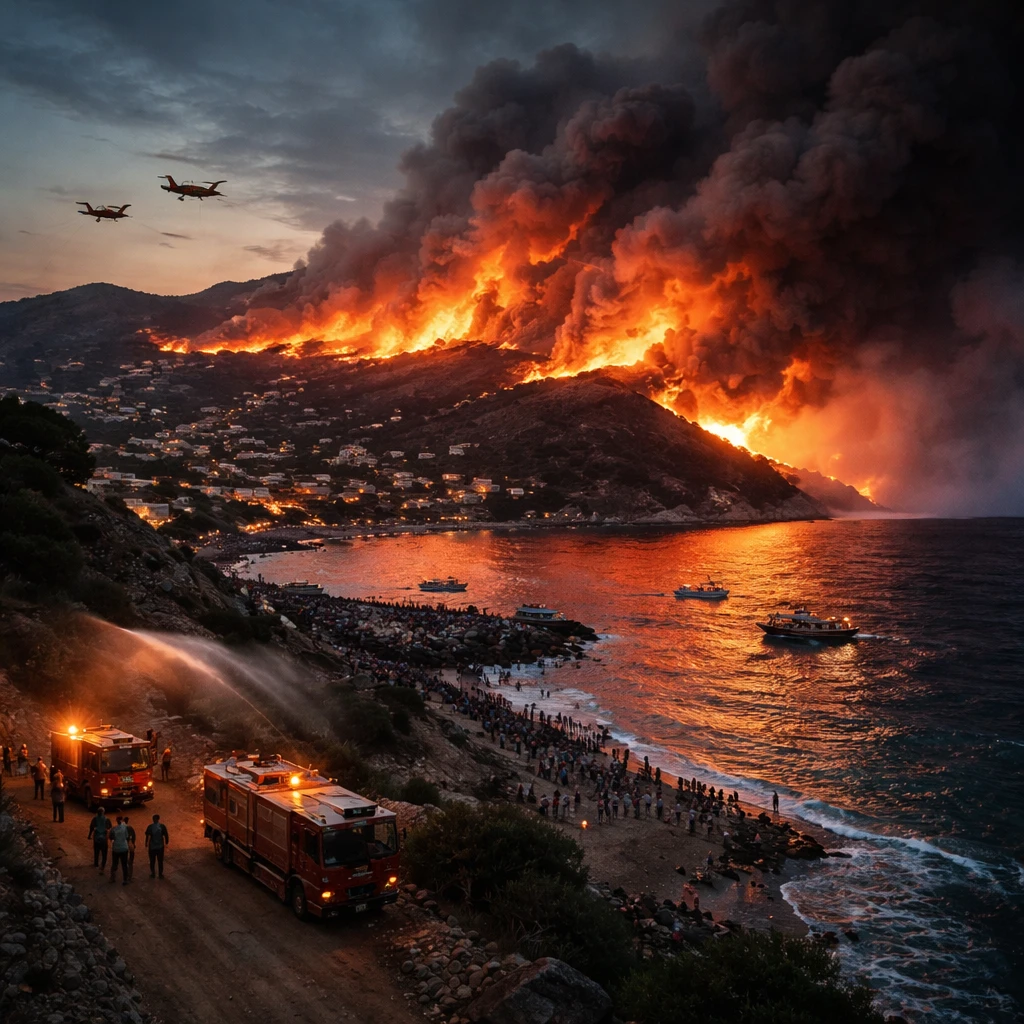
ATHENS, Aug 1 - Fierce winds fanned multiple wildfires across Greece on Saturday, including blazes close to the capital, prompting broad firefighting mobilizations and emergency evacuations. At the same time, authorities in Spain and France reported worsening conditions in several areas where large fires remain active or have reignited.
Summary of the situation
Europe's wildfire season has produced extensive destruction after a stretch of record-breaking heat and limited rainfall. Villages in both France and Spain have been destroyed, and hundreds of thousands of people have fled their homes and holiday accommodation. In Greece, where the season had been comparatively quiet until recently, gale-force winds helped fuel new blazes.
Developments in France
In southeastern France's mountainous Var department, a fire that had been brought under control three days earlier flared up again on Friday. Local reporting indicated the blaze swept across more than 1,000 hectares in a six-hour period. Nearly 2,500 people were evacuated overnight as reinforcements were brought in on Saturday ahead of forecast stronger winds that authorities warned could complicate containment efforts.
Spanish fire activity
Spain remained engaged in firefighting operations at several hot spots two days after the government declared an end to a national emergency tied to the large fires in central provinces. Conditions deteriorated in the northern province of Leon, where a new fire started on Friday night; officials said another remained active and a third was evolving favourably.
In neighbouring Zamora province, a fire that had scorched about 11,000 hectares improved sufficiently for 14 towns that had been evacuated to reopen and for restrictions to be lifted. In the eastern province of Castellon, the Vall d'Uixo blaze was reported stabilised on its seventh day after burning nearly 10,000 hectares, allowing all evacuated residents to return. Police said they suspected arson after finding two separate ignition points.
Major fires in central Spain, in the Madrid and Avila regions, which together burned over 70,000 hectares, were reported stabilised. Authorities also said a new outbreak near the San Juan reservoir was extinguished on Friday.
Greek firefighting operations and evacuations
Greek authorities issued emergency alerts for several areas for Saturday and warned of extreme wildfire risk in the regions of Attica and Evia. More than 300 firefighters, supported by 92 firefighting trucks, heavy machinery and aircraft, continued to battle a large conflagration in the region of Boeotia.
Over 200 residents of the town of Agios Vasileios, located about 80 kilometres northwest of Athens, were evacuated by sea as flames neared the area. Another 12 people escaping the same fire were taken from the beach at Porto Germeno by Greek Coast Guard patrol boats and a Fire Service vessel. Firefighting operations were also ongoing overnight in the regions of Argolida and Arta.
Heat-related deaths reported across Europe
Austria's Agency for Health and Food Safety reported a record 395 heat-related deaths for the month of June. Approximately half of the country's weather stations recorded temperatures of at least 35 degrees Celsius during June, and 15 stations logged readings of 39 degrees Celsius or higher.
Earlier in the week, health authorities in other European countries provided high-level estimates linked to the season's extreme heat: an estimated 2,877 heat-related deaths in Britain so far this year; 5,764 excess deaths in France between June 17 and July 2; and an estimate from Germany's RKI health body that 9,800 people had died so far this year in connection with the high temperatures.
Climate-linked impacts on power generation and river transport
Record low water levels along the Danube have cut nuclear power production in Hungary and reduced hydropower output in Serbia. River transport has been affected in Hungary, Serbia and Romania, with barges forced to significantly reduce loads to negotiate narrower shipping lanes. Serbia's fuel imports fell to a quarter of its July target as barges and tankers cut loads. Romania's state nuclear producer, Nuclearelectrica, shut one of its two reactors earlier this week because of low river levels, and the second reactor is expected to follow soon, a development that could deprive the country of a fifth of its electricity needs.
Outlook and constraints
Authorities in the affected countries continued to deploy additional personnel and equipment where possible and issued evacuation orders and emergency alerts to protect residents. Firefighters faced the dual challenge of gusting winds that can rapidly spread flames and limited natural resources such as water and river-borne fuel deliveries that are constrained by low water levels. Where investigators have found multiple ignition points, as in Castellon, police reported suspicions of arson.
Given the current conditions, officials across several countries warned that weather-driven changes, including stronger winds, could complicate containment efforts and force further evacuations.