
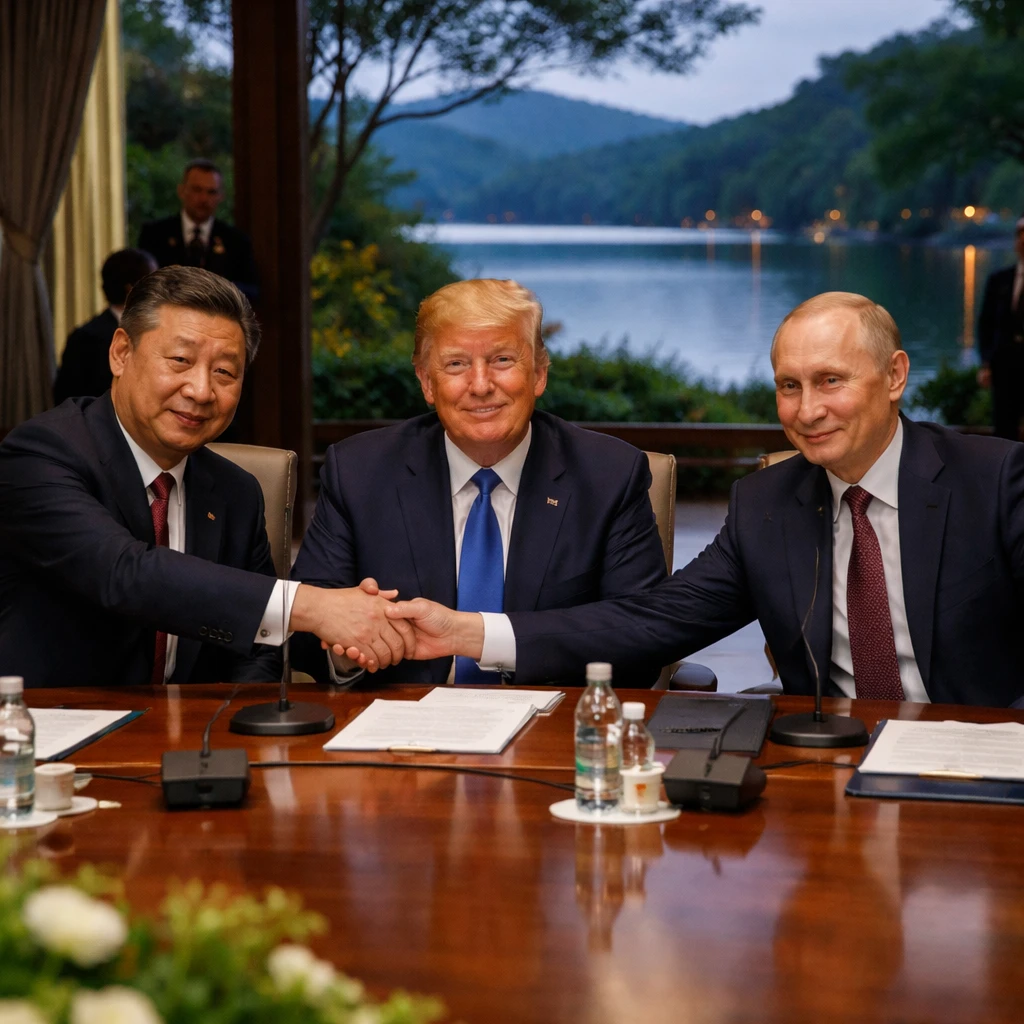
China, the United States and Russia concluded a rare three-way summit in Shenzhen with a joint "peace declaration" that emphasized the unacceptability of nuclear war but set no timetable or binding commitments for arms control. The document, issued at the end of the leaders' meeting, reaffirmed a shared principle - that a nuclear war "cannot be won and must never be fought" - and pledged dialogue on lowering nuclear risks and preventing proliferation, while omitting any immediate plans for a trilateral nuclear arms reduction treaty.
The declaration capped a three-day diplomatic tour by the US president through Asia. While the summit produced a public statement and diplomatic pageantry, it delivered few tangible policy victories. The gathering instead intensified scrutiny among US allies of the US president's relations with the Chinese and Russian presidents, both of whom he embraced in highly visible gestures at the meeting.
The three leaders pledged cooperation on several fronts in the declaration: reforms of the United Nations, increased supplies of fuel products for all countries, and defending the immunity enjoyed by state officials in international courts. The document did not make reference to Russia's war in Ukraine or the US-Iran conflict. After the meeting, the Russian president acknowledged that the document did not set ambitious objectives and emphasized the voluntary nature of its provisions, saying that no one would be compelled to implement its decisions.
Nuclear language without concrete steps
The declaration's most striking line - that nuclear war cannot be won and must never be fought - was accompanied by a pledge to "conduct a dialogue on reducing nuclear risks and preventing proliferation of nuclear weapons." The language did not include specific deadlines, verification mechanisms, or any endorsement of negotiations toward a trilateral arms reduction treaty, a proposal the US president has promoted previously.
China has long resisted the idea of a three-way treaty, citing the relatively smaller size of its nuclear arsenal compared with those of the other two powers. The summit statement therefore left intact longstanding differences among the three capitals over the shape of arms-control talks and the conditions under which they might proceed.
During remarks at the start of the meeting, the US president acknowledged the psychological difficulty leaders face in giving up nuclear weapons, saying: "It’s not an easy thing to do - give them up." He later described the meeting as going "great," rating it highly on a personal scale and saying it had built "fantastic relationships." He also announced he would hold a news conference in Washington at noon the following day.
Optics and diplomatic theater
The summit featured the kinds of public moments of camaraderie that have become hallmarks of the US president's diplomatic style. He greeted the Russian president as "my friend" and received a hug from the Chinese president. Such moments, following prior encounters with the North Korean leader and earlier summits with the Russian president, have drawn both praise for direct engagement and criticism for elevating authoritarian leaders to prominent public platforms.
Observers at the summit location saw the three leaders meet in a villa set among wooded hills beside a lake in the southern city. The setting and the visible cordiality among the participants underlined the summit's symbolic ambitions but did not alter the absence of concrete agreements on major security questions.
Reactions and political stakes
Reactions to the summit were sharply divided. Senior opposition figures in the US condemned the meeting, with one prominent senator calling it a historic embarrassment and accusing the president of seeking photo opportunities with adversaries. Arms control advocates welcomed the reaffirmation that nuclear war must not be fought as a positive rhetorical step but argued that much more substantial disarmament diplomacy is required.
European leaders convened a separate meeting in Berlin on the same day to express support for Ukraine and to caution against decisions about peace terms being made without European involvement. Germany's chancellor characterized any suggestion that a closed-group summit could settle broader geopolitical questions in the manner of past wartime conferences as unacceptable, and described the Shenzhen gathering as largely a photo opportunity. Standing with him, the US president's special envoy emphasized a desire for a peace deal with Europe aligned and said he believed the leaders had agreed to engage in multilateral talks with Europe.
Ukraine's president offered a subdued reaction when asked about the US president's greeting of the Russian leader, merely shrugging and moving on when approached by reporters.
Geopolitical winners and critics
Analysts said the summit afforded a diplomatic triumph for the Russian president, whose country faces economic strain and extensive trade restrictions. The summit gave him a platform alongside the leaders of two much larger economies and a degree of international visibility that critics said diminished the weight of existing international norms and institutions.
Commentators highlighted the summit's reference to protecting state officials from prosecution in international courts. That passage arrives more than three years after an international judicial body issued arrest warrants for senior Russian officials over alleged war crimes related to the conflict in Ukraine. Russia rejects those allegations.
One international affairs analyst said the provision signaled a pushback against international norms and courts, with the implication that the great powers would assert prerogatives that could leave smaller states disadvantaged. That same analyst argued the summit strengthened the Russian president's international standing and provided the US president with a symbolic photographic moment.
Domestic political context and aims
Analysts said the US president arrived in Shenzhen in part to shore up his domestic political standing after his party lost control of Congress in recent midterm elections. The president compared the summit's significance to the famed 1945 conference among major powers, saying the Shenzhen meeting was "bigger than Yalta." He defended his public friendliness toward the Russian leader by suggesting it is preferable to have leaders of nuclear-armed states as friends rather than adversaries.
The Chinese foreign minister indicated that the three countries would continue coordination at a working level following what he described as the "peace summit." The Russian president said the three powers shared many interests in resolving regional conflicts and mentioned, without elaboration, that the conflict in Ukraine was among those interests.
Next meetings and potential flashpoints
Looking ahead, there is potential for renewed diplomatic tensions when the US hosts the Group of 20 summit at a Florida golf resort later this month. The US president is expected to meet the Chinese president again there and has left open the possibility of another encounter with the Russian president. The Russian leader said he would consider attending, dependent on domestic considerations and after discussing attendance with the US president.
The summit in Shenzhen thus concluded with a document that reiterates high-level commitments and a set of public images that each leader can point to as diplomatic gains. Yet the absence of actionable agreements, specific timelines for dialogue, or involvement of other major stakeholders left many questions about how the leaders' stated aims would translate into policy changes or diplomatic breakthroughs.
Summary and immediate takeaways
- The three leaders issued a joint declaration emphasizing that nuclear war must never be fought and committing to dialogue on nuclear risk reduction, without setting a timetable or negotiating a trilateral reduction treaty.
- The declaration included pledges on UN reform, fuel product supplies, and immunity for state officials in international courts, while omitting direct mentions of the conflicts in Ukraine and between the US and Iran.
- The summit produced notable public gestures among the leaders and prompted sharp criticism from political opponents and some analysts, while offering diplomatic visibility to the Russian president.