
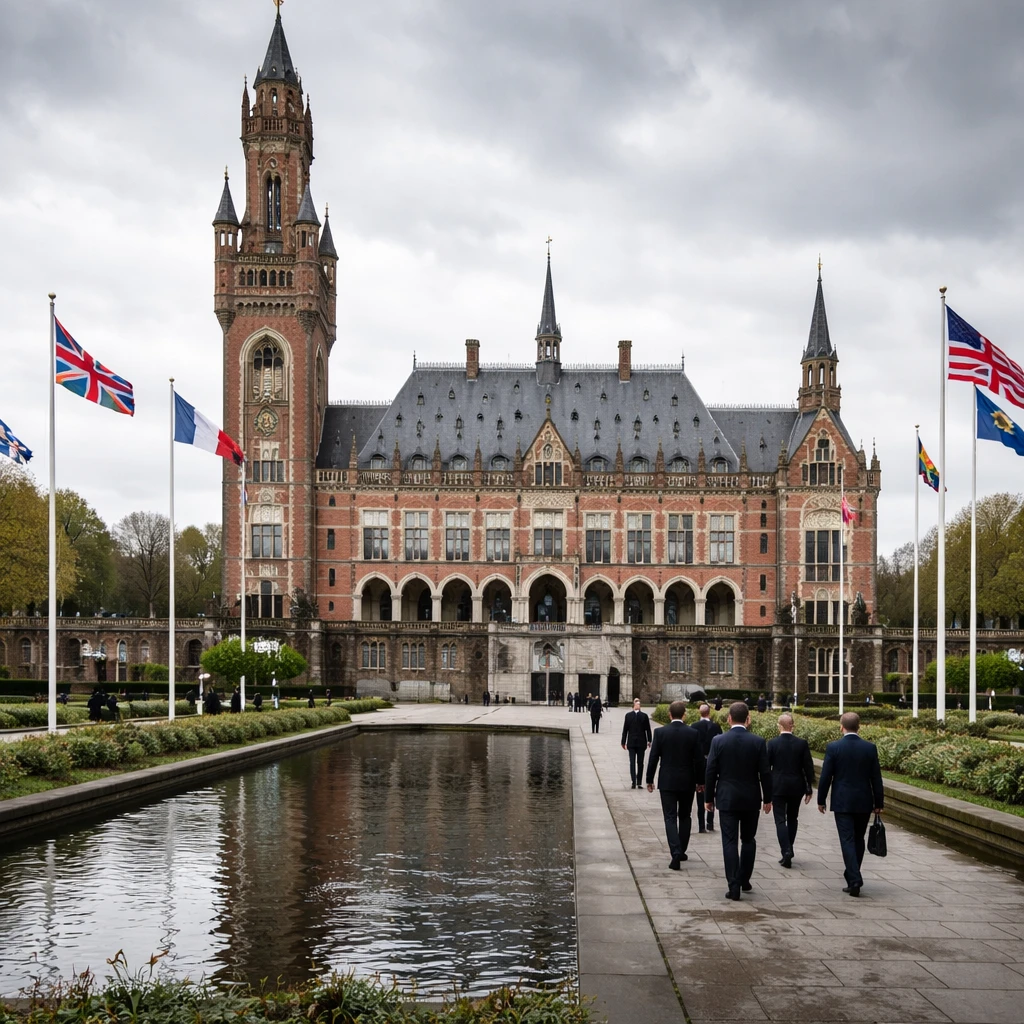
The International Court of Justice, commonly called the World Court, has taken a prominent position in international affairs following its recent ruling that Myanmar committed genocide against the Rohingya minority. The court is the United Nations’ main judicial forum for state-to-state disputes and plays a distinct role from other international institutions that try individuals for crimes.
Origins and purpose
The ICJ was created under the 1945 UN Charter to provide a standing judicial institution where countries could resolve disagreements through international law rather than by force. The court opened its doors for the first time on April 18, 1946, with the aim of offering permanent legal recourse for disputes among states.
Who can bring a case
All 193 members of the United Nations have the theoretical right to initiate proceedings at the ICJ. In practice, a subset of states - 75, as recorded - have submitted a separate declaration that gives the court jurisdiction allowing it to open a case immediately when a dispute arises. Beyond those declarations, the court also has competence over disagreements concerning the application or interpretation of more than 300 international treaties, including the 1948 Genocide Convention.
United Nations organs such as the General Assembly can also request advisory opinions from the ICJ on questions of international law. These advisory opinions are formally non-binding, but they frequently carry persuasive authority and are relied upon in legal reasoning within national courts.
Composition and authority
Located at the Peace Palace in The Hague, the ICJ is composed of 15 judges who are elected to serve nine-year terms. Decisions of the court are binding on United Nations member states and cannot be appealed. However, the court’s enforcement mechanisms are constrained; beyond the legal weight of its judgments and its moral authority, it has few direct tools to compel compliance, and members occasionally ignore rulings.
Types of cases and recent high-profile matters
The court’s docket has covered a wide variety of disputes: land and maritime border disagreements, hostage cases, and allegations of genocide, among others. Over time the ICJ’s caseload has shifted to include more claims that involve alleged state violations of human rights. Currently, around one third of the cases pending before the court relate to human rights concerns.
In 2023, the court drew international attention when South Africa brought a case accusing Israel of committing genocide in Gaza. The ICJ issued a number of emergency measures in that matter, but the court has said that the principal written and oral arguments are not expected until late 2029. Israel opposes the case and has stated that it respects international law.
The ICJ also responded early to the conflict arising from Russia’s full-scale invasion of Ukraine in February 2022. Following that escalation, the court ordered Moscow the next month to "immediately suspend the military operations". As with some other major matters on its docket, there has not yet been a final ruling in the Ukraine case.
Role and limitations
The ICJ serves as a legal forum aiming to settle disputes among states and to clarify questions of international law through binding judgments and advisory opinions. Its rulings carry official legal effect for member states, but the court's practical influence depends in large part on states’ willingness to comply and the international community’s response when decisions are ignored.
Conclusion
As the institution that states turn to for adjudication of legal disputes between governments, the ICJ occupies a central but complex role in the international legal system. It delivers judgments that are final and binding on states, adjudicates a spectrum of disputes including an increasing share of human rights cases, and faces operational limits in enforcing its decisions.