
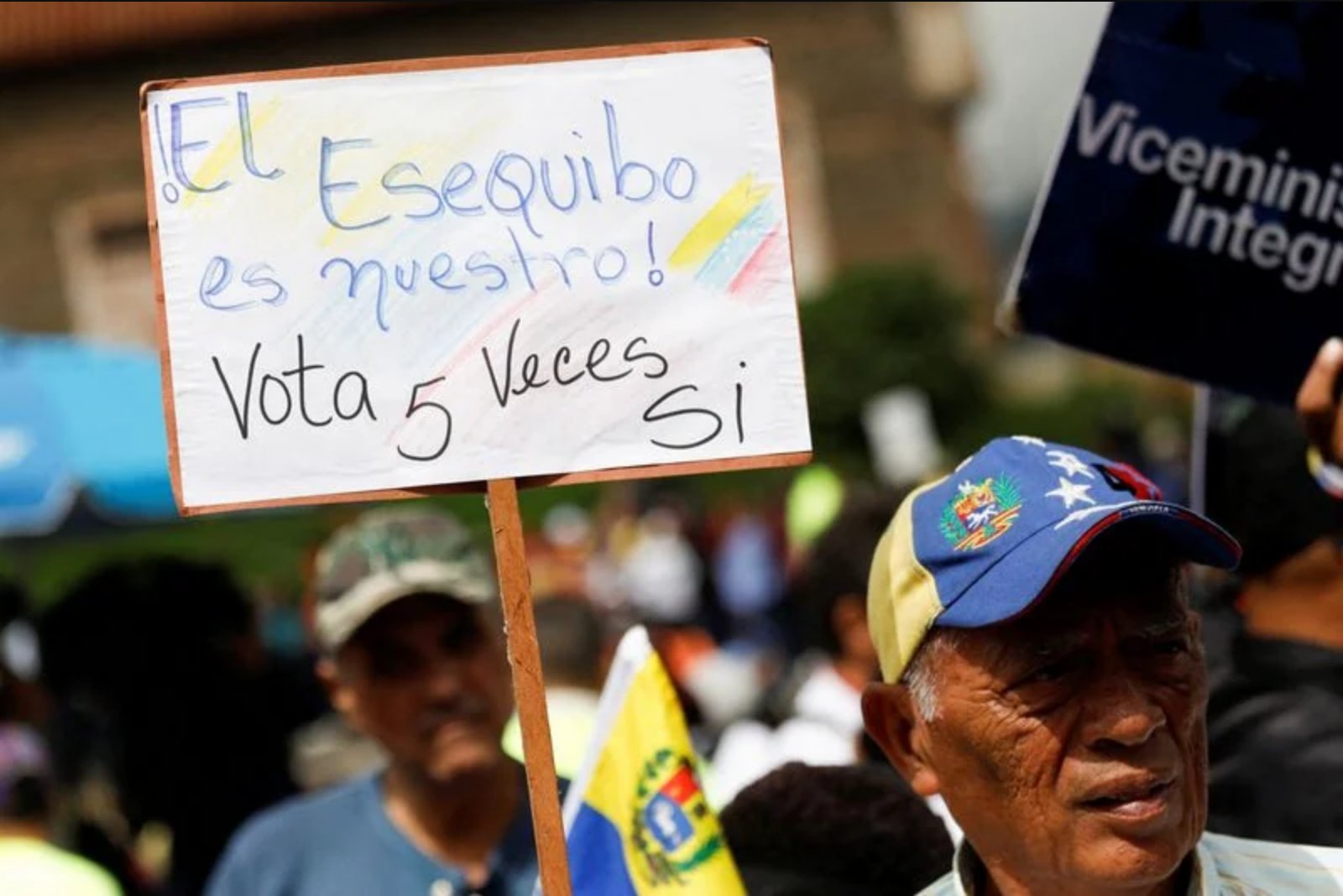
Officials in Guyana were taken aback in recent months when a senior U.S. policy official privately raised the possibility that the South American nation might consider ceding part of the Essequibo region to neighboring Venezuela, three people with direct knowledge of the discussions said.
The comments, which surfaced during a September meeting in Washington, prompted Guyanese leaders to seek urgent clarification from other U.S. diplomats. Those follow-up contacts, according to two people familiar with the exchanges, included repeated assurances that the United States' position on the Venezuela-Guyana boundary had not changed.
At the center of the episode was Jeremy Lewin, then the State Department's chief of policy planning, who told Guyanese Foreign Secretary Robert Persaud he could facilitate territorial talks with acting Venezuelan President Delcy Rodriguez, one of the people said. Two other people described Lewin as having floated the possibility of Venezuela taking partial control of the Essequibo, the sparsely populated western two thirds of Guyana that is rich in minerals.
In a separate interview, Lewin confirmed he had conducted "preliminary" discussions with representatives of both Guyana and Venezuela concerning the long-running dispute over the Essequibo. He said his conversations followed a letter from Rodriguez to U.S. President Donald Trump in May requesting U.S. mediation to promote direct talks with Guyana on the territory's status. Lewin also said Rodriguez raised the subject with him during a July meeting in Caracas.
Lewin characterized his outreach as directed and authorized by the White House. He said the discussions were confidential and that any suggestion he acted independently was incorrect. A person familiar with U.S. engagement on Venezuelan matters said Lewin had been delegated the topic by the White House.
Guyanese officials consider the Essequibo's status non-negotiable, the sources said, and were alarmed enough by Lewin's remarks to seek immediate clarification. The Essequibo, which contains deposits of gold, diamonds and bauxite, has long been claimed by Venezuela, but practically all other nations have treated the area as Guyanese territory.
The dispute escalated in prominence after large offshore oil discoveries by ExxonMobil beginning in 2015, which have helped spur rapid economic growth in Guyana. Those resources have sharpened international interest in the boundary question and prompted Guyana to seek legal resolution. In 2018 Guyana referred the matter to the International Court of Justice in The Hague, asking the court to uphold the border established by a 1899 arbitration decision between Venezuela and the former British Guiana.
When contacted, a State Department official responded by email that the department regularly receives and assesses a range of proposals and policy options from outside parties, but that its position on the Venezuela-Guyana boundary remained unchanged. The White House did not respond directly to queries about whether it had directed talks over the Essequibo or had received Rodriguez's May letter, referring questions back to the State Department.
The episode illuminates intensifying connections between the Trump administration and the Rodriguez government. Those ties have grown in the wake of an operation earlier this year in which Nicolas Maduro was captured and taken to New York to face narcoterrorism charges. The capture preceded a notable warming of relations between Washington and Caracas, with acts of engagement that include a recent meeting in Caracas where U.S. Pentagon chief Pete Hegseth met with Rodriguez and signed an agreement aimed at expanding military cooperation.
In a May 11 letter that Lewin provided and which he said he had shown to reporters, Rodriguez asked President Trump to help create conditions conducive to a rapprochement with Guyana, framing the issue as a "historic territorial controversy" to be addressed through talks. The authenticity of the letter could not be independently confirmed by the people who reported the episode.
Lewin said the White House asked him to carry out early, confidential conversations with both sides to better assess the matter for the administration. He told Reuters he had briefed Secretary of State Marco Rubio and White House officials after conducting those conversations. Lewin, a Trump appointee who left the State Department at the end of October, served as director of policy planning for roughly two months after being appointed in August. He has also been described as an alumnus of Elon Musk's Department of Government Efficiency.
According to two people familiar with Lewin's discussions in Caracas, he spoke with Rodriguez in July about the possibility of U.S. companies doing business in the Essequibo. During his September meeting with Guyanese officials in Washington, he described his close relationship with Rodriguez and indicated he could assist in arranging bilateral talks, one of the people said.
Sources differed on Lewin's exact phrasing during the meeting with Guyanese officials. But officials in Georgetown found the comments concerning enough to make immediate inquiries with other U.S. diplomats, who then reiterated that U.S. policy on the boundary had not changed, two of the people said.
Lewin declined to provide additional specifics about the confidential conversations, reiterating that he had acted at White House direction. He said any suggestion he had otherwise was unfounded.
Delcy Rodriguez, who served as vice president under Maduro before his capture, has publicly and repeatedly pressed Venezuela's claim to the Essequibo in recent months. At the United Nations General Assembly in September, she urged Guyana to enter into negotiations over the territory's legal status.
The long-standing contestation over the Essequibo dates back more than 180 years, with intermittent Venezuelan claims. The discovery of offshore oil near Guyana in 2015 by ExxonMobil heightened the stakes of the dispute, as the resulting oil production has been central to Guyana's rapid economic expansion.
Guyana is a country of about 1 million people located between Venezuela and Suriname on South America's northern coast. It is regarded as a close U.S. partner. Under the prior Maduro administration, both Washington and Georgetown had strained relations with Caracas. That relationship dynamic shifted following the U.S. operation that led to Maduro's capture earlier this year, which has opened channels for more direct engagement between the U.S. and Venezuelan leadership under Rodriguez.
Guyanese and Venezuelan government offices did not respond to repeated requests for comment. The episode leaves unresolved questions about the extent to which U.S. officials will engage in mediating the territorial dispute and what, if any, practical steps will follow from the confidential conversations Lewin described.
Summary of key developments and context:
- Senior U.S. policy planning chief held preliminary talks with Guyanese and Venezuelan representatives after a May letter from Rodriguez sought U.S. mediation.
- Guyanese officials were surprised by a suggestion that Guyana consider ceding partial control of the Essequibo and sought prompt reassurances from other U.S. diplomats that U.S. policy on the border had not changed.
- The dispute centers on the Essequibo region, long claimed by Venezuela and rich in minerals and proximate to major offshore oil finds that have driven Guyana's rapid economic growth.