
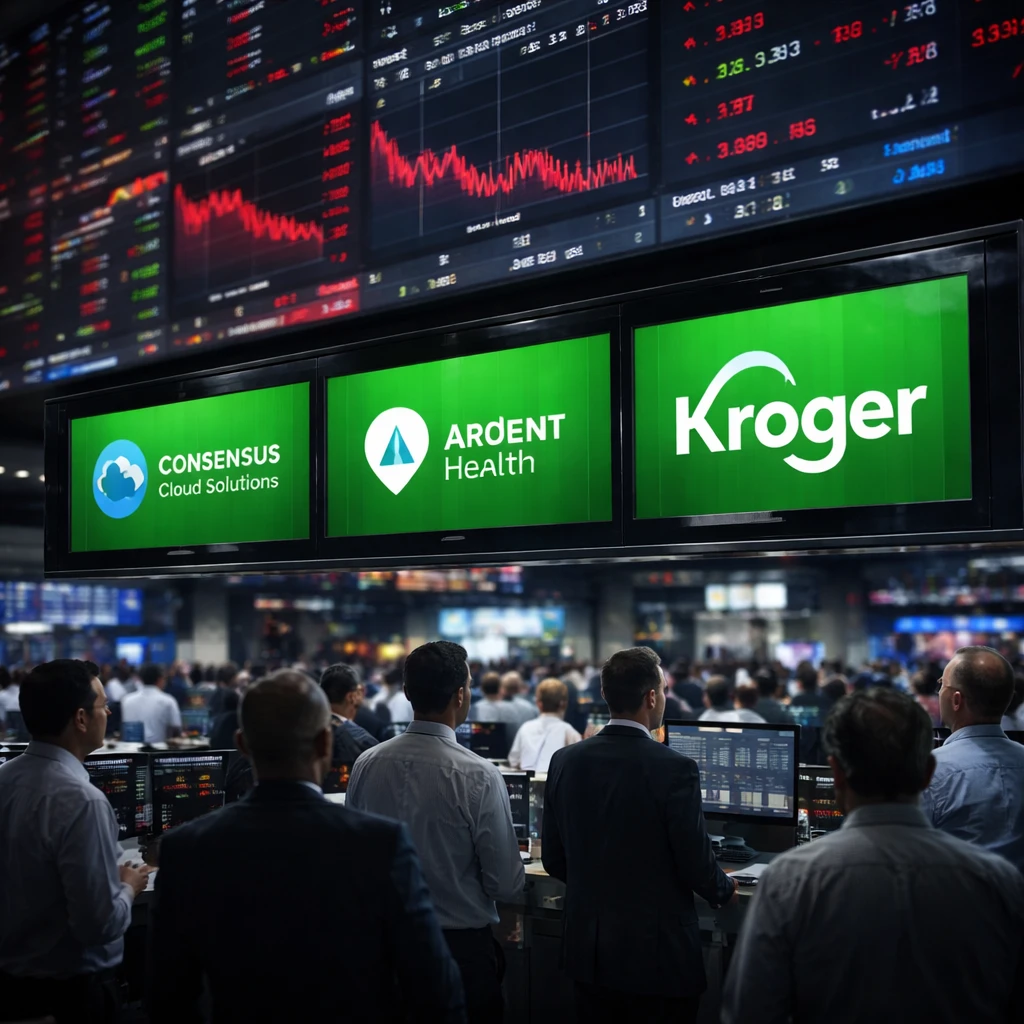
Wall Street suffered one of its roughest sessions in weeks on Thursday, with major averages sliding sharply as traders rotated out of some AI names and digested tighter policy talk from Federal Reserve officials.
The Dow fell 1,101 points, or 2.2%, to 49,097, while the Nasdaq dropped 2.25%. The S&P 500 lost roughly 2% for a sixth consecutive session. Volatility picked up alongside rising Treasury yields and hawkish commentary from officials - the 10-year Treasury yield is sitting at about 5.05% and the VIX index moved into the high 20s.
AI-focused stocks were a notable source of pressure. Nvidia declined for a sixth straight day, and AMD plunged about 9% following a short-seller report. The high-profile Nasdaq debut of Anthropic added to trading volatility; the stock had been priced at $83, opened at $111.50 and closed at $97.17, and activity around the listing prompted some investors to reduce positions in existing AI names to make room.
Performance contrast: Three AI-picked names still climbing
Amid the broader weakness, three equities selected by an AI-based selection process are higher in November and markedly above the prices at which the model added them. Each of the three stocks is up between 62% and 82% since the AI entry date. Below are the key financial and operational details provided for each company.
-
Consensus Cloud Solutions (NASDAQ: CCSI) - Up 82.3% since entry
Consensus provides secure digital fax and document management tools to hospitals and other businesses. The AI model added Consensus to its lineups on February 1 at $21.36. The stock closed at $38.93, and it is up 4.3% so far this month.
On a fundamentals basis, third-quarter revenue increased 3.7% to $91.0 million, with corporate revenue rising 9.1%. Adjusted earnings per share rose 8.7% to $1.50. Management raised its full-year adjusted EPS guidance to a range of $6.00 to $6.10. In addition, the board authorized a program of up to $348.2 million to retire its remaining 2028 notes.
-
Ardent Health (NYSE: ARDT) - Up 65.0% since entry
Ardent operates hospitals across multiple U.S. states. The AI added Ardent on December 1, 2025 at $8.79. The stock closed at $14.50 and has gained 20.5% this month.
Ardent reported third-quarter revenue of $1.62 billion, up 3.1% year over year. Adjusted EBITDA increased sharply to $137.7 million from $45.3 million in the prior-year period, and the company reported net income attributable to Ardent of $44.5 million compared with a loss a year earlier. Ardent raised the low end of its full-year adjusted EBITDA guidance to a range of $500 million to $535 million and added $25 million to its share buyback program.
-
Kroger (NYSE: KR) - Up 61.8% since entry
Kroger, the largest supermarket operator in the U.S., was added by the AI on December 1, 2023 at $41.99. The stock closed at $67.94 and has advanced 2.3% this month.
In the company update, second-quarter adjusted earnings per share rose 5% to $1.09. Kroger reported eCommerce sales growth of 20% and repurchased $1.0 billion of its stock during the quarter. The company increased its dividend by 11%, marking the 20th consecutive annual dividend increase, and reaffirmed adjusted EPS guidance of $5.10 to $5.30 for the year.
Plain-language caveats and limitations
All three names carry explicit cautions. Ardent's sharp earnings improvement is measured from a weak comparative base and its hospital admissions remain flat. Consensus is facing higher customer churn. Kroger has cut its identical-sales outlook. Each company has already experienced a significant price run-up, and in a volatile market environment any of these stocks could move lower.
These equities are drawn from two named AI strategies - Small-Cap Sprinters and Best of Buffett - which are part of a broader set of ProPicks strategies that use AI to identify, hold and rebalance U.S. stocks on a monthly cadence. Lineups within the strategies are subject to change as the model adds new opportunities and removes names that no longer meet its criteria.
How the AI selection and portfolio process is described
The selection engine operates at the start of each month and evaluates thousands of global equities using a combination of historical inputs, valuation signals and forward-looking growth metrics. The system processes more than 15 years of financial information across over 150 quantitative models to identify up to 20 high-conviction stocks per strategy based on projected medium-term upside potential.
Each strategy undergoes a monthly rebalancing routine where new candidates may be added, strong performers retained, and names that no longer meet threshold criteria are removed. To maintain a consistent performance benchmark, strategies apply equal weighting to every selected stock; investors remain free to apply their own allocations if they prefer a different weighting scheme.
The stated objective is to position capital in companies showing the best combination of momentum, valuation and business performance within the model's framework. Live performance has been recorded since the official launch of the "Beat the S&P 500" strategy in October 2023.
Final notes
Market participants should note that past performance does not guarantee future results. Pricing, promotional offers and subscription details mentioned are accurate at the time of publication but may vary by region and over time. The article also referenced a Fair Value tool that runs multiple valuation models to provide an aggregate estimate for stocks such as Nvidia, which can be used by investors seeking additional valuation context.