
WASHINGTON, June 30 - Inside each of the six Freedom 250 "Freedom Trucks" that will travel the country to mark the United States’ 250th birthday, visitors encounter an AI-generated portrayal of George Washington who greets them and declares, "Thy rights are a gift from God," under a ceiling emblazoned with the words, "In God We Trust."
The specially outfitted mobile museums have dispersed across the country on the eve of the July 4 holiday, with trucks operating as far west as Washington State and as far east as North Carolina. Organizers describe the fleet as a year-long tribute to the American Revolution and the nation that followed.
Rachel Reisner, a spokesperson for Freedom 250, said the effort "is sparking a unifying movement across all 50 states that celebrates the American spirit and showcases our nation at its best."
But the rolling museum has not been universally welcomed. Local media in Massachusetts in June reported that opposition from residents in one town led to the cancellation of a planned visit by a Freedom Truck. Critics have argued the exhibit and related events present an overly religious interpretation of American history and gloss over issues such as slavery and racial injustice.
Democratic lawmakers have raised concerns about the financial arrangements behind the trucks and other Freedom 250 activities. They contend that taxpayer funds and private donations tied to the effort lack sufficient oversight.
According to official grant information, the Institute of Museum and Library Services, an independent federal agency, provided a $14 million grant supporting the six trucks. That federal funding was coupled with $10 million supplied by Freedom 250.
A group of U.S. Senate Democrats on March 3 sent a letter to Interior Secretary Doug Burgum asking why government funds were directed to "a private entity that is unaccountable to the American people" and raising questions about whether those funds were being commingled with private dollars "potentially raised from foreign sources." Senate aides said the lawmakers had not yet received a response.
House Democrats have opened their own inquiry into whether money appropriated by Congress for "America 250" events has been redirected to the White House’s Freedom 250 celebration.
At a House hearing, Democratic Representative Jared Huffman of California criticized events supported by Freedom 250, including the truck exhibits, saying: "The soaring achievement of our secular enlightenment-based founding is obscured by a gauzy Christian nationalist fiction."
Republican members contested Democratic characterizations during hearings. Representative Bruce Westerman of Arkansas highlighted the Declaration of Independence preamble, noting the clause: "We hold these truths to be self-evident, that all men are created equal, that they are endowed by their Creator with certain unalienable Rights."
Civic watchdogs have also taken legal action. In May, Public Employees for Environmental Responsibility sued the U.S. Interior Department after the agency declined to fulfill a Freedom of Information Act request seeking documents related to Freedom 250 funding and activities. PEER said its queries included reports that federal employees were being used to promote a private entity, that funds were being employed to advance a partisan agenda, and that access to the former president was being sold.
"All these decisions on what events, what money to spend, the money comes in, where it goes out, it’s all in a black box," PEER senior counsel Aaron Lloyd said in a telephone interview. "I want the government documents that explain what money went where."
The White House did not provide a direct answer to questions about the role of religion within the truck exhibits or in other 250th anniversary programming. In an emailed statement, White House spokesman Davis Ingle said, "2026 will feature a renewal of patriotism and national pride."
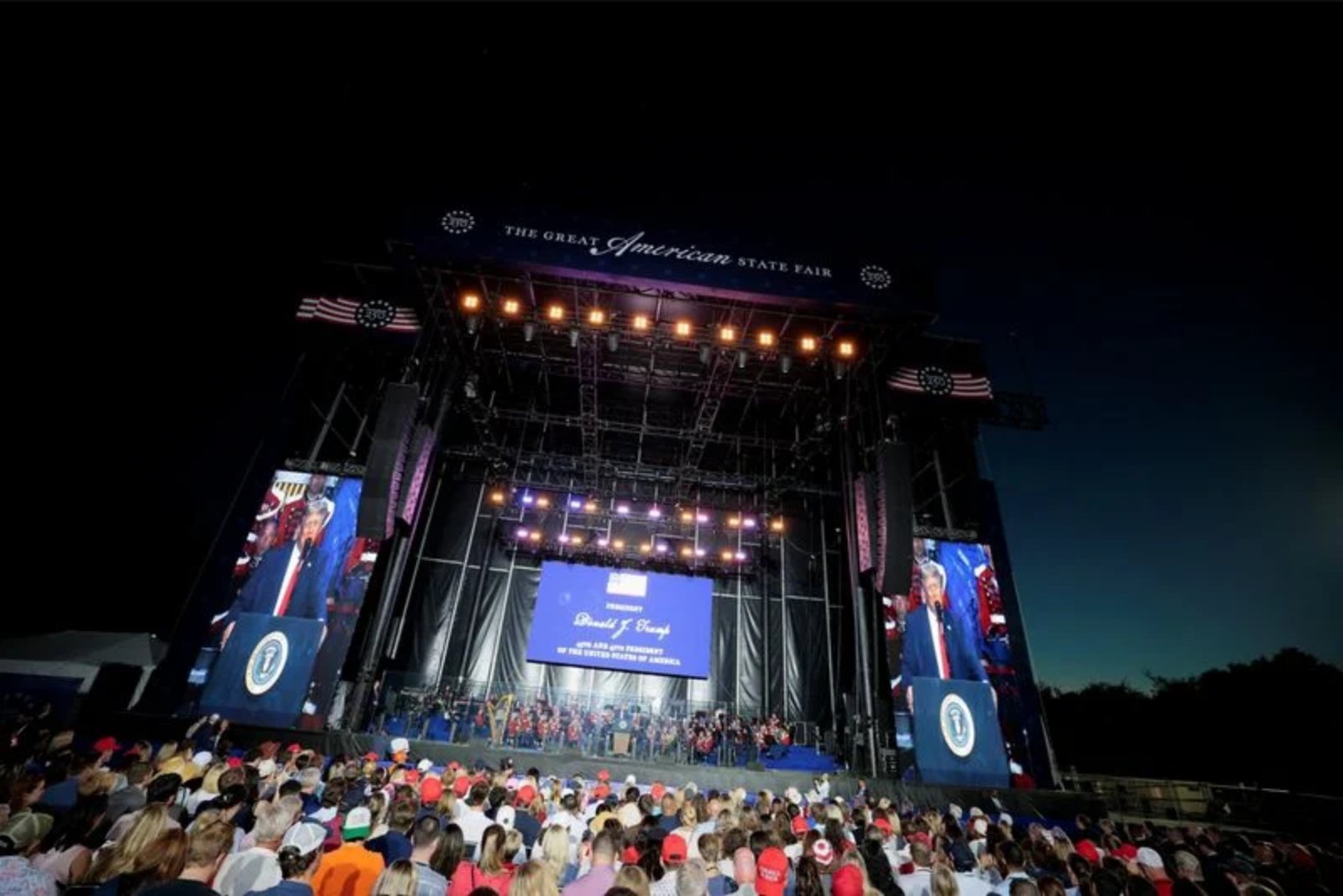
Religious expression has been prominently featured in some Freedom 250 activities. On May 17, one Freedom Truck - its side painted with an image evoking the painting "Washington Crossing the Delaware" - was parked a few blocks from the U.S. Capitol and served as the focal point for a daylong event titled "Rededicate 250: A National Jubilee of Prayer, Praise & Thanksgiving."
A White House webpage promotes a Freedom 250 "America Prays" initiative encouraging visitors to devote an hour per week to praying for the United States and its citizens. The page lists "pray.com" as a participant; the religious social networking site discloses that it collects user information that it may share with outside firms.
Content for the Freedom Trucks was developed by Hillsdale College, a private conservative Christian liberal arts institution, and PragerU, which is not an accredited university but a producer of so-called "edu-tainment" that espouses Judeo-Christian values.
PragerU has produced videos that include an exploration of how elections can be stolen, citing mail-in ballots as a purported mechanism for fraud - a line of argument that echoes allegations the former president has made repeatedly since the 2020 election - and a video titled "Pride Month Why do we do this?" that questioned June celebrations by LGBTQ communities. PragerU did not respond to requests for comment about any financial arrangements it may have secured from Freedom 250.
Some historians have raised questions about the prominence of religion-focused presentations in events connected to a commemoration of the nation’s founding. Kate Carte, a history professor at Southern Methodist University specializing in early American history, observed that during the Revolutionary era both Protestant British loyalists and colonial "patriots" tended to interpret their actions through religious frameworks. But she added in a telephone interview that the conflict between Britain and the colonies "really had nothing to do with religion."
Carte further noted that America’s Founding Fathers "were very aware that religion could be really divisive" and therefore rejected the idea of establishing a central national religion.
Survey findings cited in a 2023-2024 Pew Research Center study show religious affiliation remains varied: 62% of U.S. adults identify as Christians, with evangelical Protestants making up 23% of adults, the largest single faction. Approximately 29% of adults are religiously unaffiliated, a group that includes atheists and agnostics and 19% who describe their religion as "nothing in particular."
Religion is not the only flashpoint in America’s semiquincentennial. The Trump administration faces court challenges over efforts to remove or alter interpretive material in national parks, including exhibit content addressing slavery and climate change.
For those who remember the U.S. bicentennial in 1976, the current commemoration feels more contentious. Alan Spears, senior director of cultural resources at the National Parks Conservation Association, said the cultural landscape has shifted since then. He noted that 50 years ago the country was less engaged in public debate over the contributions of indigenous peoples, African Americans, and women. "The 1980s changed that," Spears said, adding that the nation has moved away from presenting its history primarily as images of "guys on horseback with swords."
The Freedom Trucks effort has become a focal point at the intersection of public celebration, religious expression, and questions about the stewardship of public dollars. Organizers promote a patriotic narrative and prayer-focused programming, while critics and some lawmakers press for greater transparency and contest the appropriateness of the tone and content of the exhibits. As the semiquincentennial year proceeds, the debate over how to commemorate the nation’s founding appears likely to continue.