
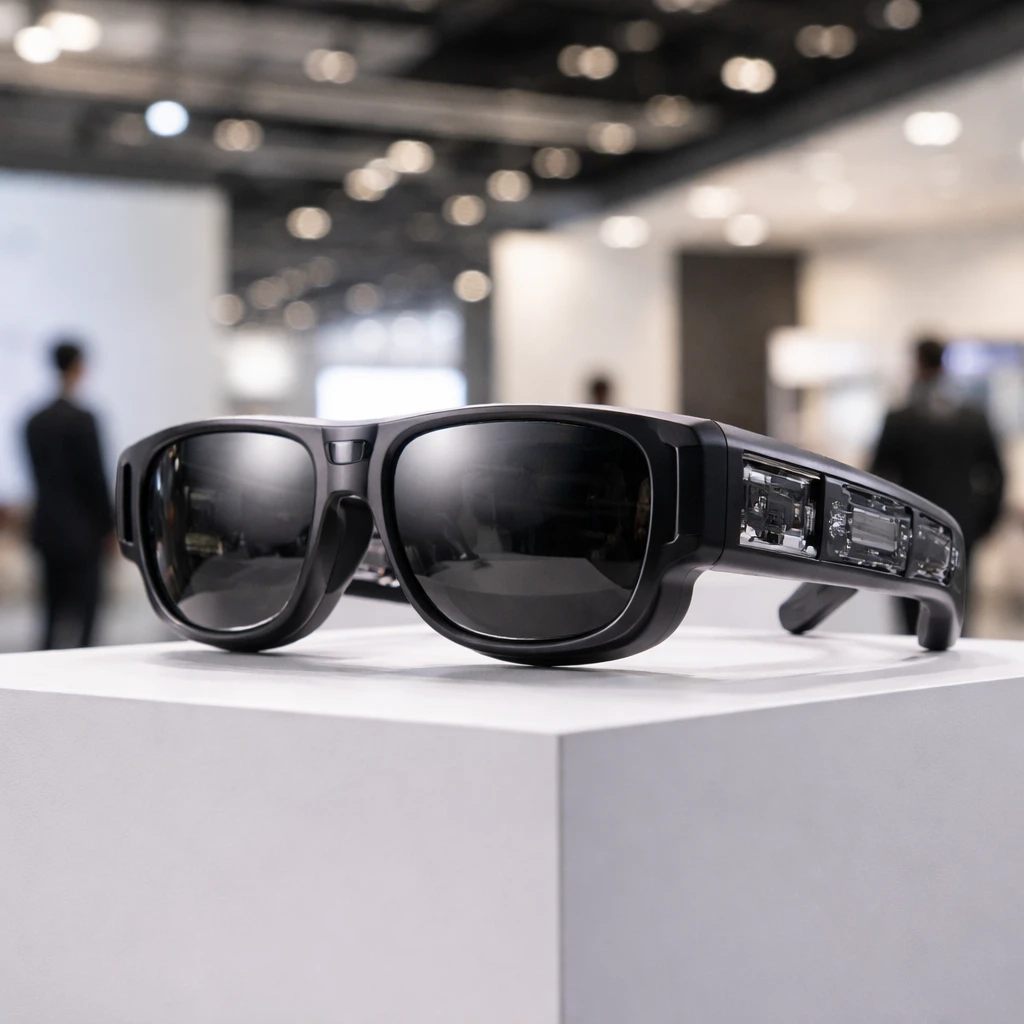
Snap Inc. suffered a sharp market setback Tuesday, with its shares falling 9.6% in the company’s steepest one-day drop since March after CEO Evan Spiegel introduced the company's first standalone augmented reality glasses and urged investors to back a future in which consumers adopt head-mounted computing.
The product, named "SPECS," was unveiled at the Augmented World Expo in California and positioned by company leadership as a post-smartphone device - a self-contained computer that does not require a tethered phone, external battery pack, or cables. Despite that pitch, investors reacted poorly to the device’s industrial design and its $2,195 price tag.
Wall Street commentary ranged from politely framed concerns to blunt skepticism. Citizens analyst Andrew Boone said the hardware resembles a "developer kit" rather than something a typical person would wear into a coffee shop, noting the glasses’ thickness and its architectural similarity to Apple’s larger Vision Pro goggles rather than Meta’s lighter Ray-Ban form factor. The implication from Boone’s comparison is that mainstream fashion appeal is likely years away.
Other analysts focused on the economics of adoption. Stifel’s Mark Kelley, who rates the stock Hold with a $5.75 price target, observed that the $2,195 price point will "likely keep adoption limited." Piper Sandler’s Thomas Champion, issuing a Neutral rating and an $8.00 target, echoed the concern that the pricing "could pose a challenge." Read together, those assessments suggest the product is priced for developers and affluent early adopters rather than Snapchat’s core user base of teenagers and young adults.
Snap has framed SPECS as an engineering statement. Its design packs two substantial processors and enough supporting hardware into a TR90 polymer frame for the glasses to weigh up to 136 grams - a weight the company notes is over three times that of a standard pair of Ray-Bans. The company says the device is a complete, standalone computing platform, an approach that emphasizes capabilities but also increases complexity, heft, and cost.
Those trade-offs are central to questions about who will actually buy the product. Snap benefits from an active developer ecosystem - the company has about 450,000 developers who have produced millions of augmented reality filters for Snapchat. Yet the user base itself skews young, and the demographic is not typically associated with making $2,200 purchases for a first-generation, thick-rimmed headset.
The launch arrives while Snap is attempting to rein in spending. The company recently eliminated about 16% of its workforce, roughly 1,000 jobs, in part to reduce cash burn. At the same time, activist investor Irenic Capital has publicly urged management to abandon costly hardware efforts and to concentrate on fixing Snap’s advertising business. Those dynamics frame the product rollout as a high-stakes gamble for a company under financial pressure.
By proceeding with the SPECS launch, Spiegel signaled that Snap intends to persist with its AR vision despite visible investor anxiety. That resolve comes as the stock is down by more than 30% year-to-date, and the competitive landscape includes Meta, which currently dominates the lower-cost segment of smart-glasses at a $350 price point.
For investors and the broader market, the reaction underscored immediate doubts about hardware strategy and near-term returns. For product and platform observers, the SPECS announcement highlights a classic tension - the trade between showcasing advanced, standalone capability and designing for the economics and form factors that drive mass adoption among core users.
Key takeaways
- Snap's stock fell 9.6% after the company revealed the $2,195 SPECS standalone AR glasses, marking the steepest one-day fall since March.
- Analysts described the device as bulky and expensive, saying it resembles a developer kit more than mainstream eyewear; they warn the price will limit adoption.
- The debut comes amid company cost cuts, pressure from activist investor Irenic Capital to abandon costly hardware efforts, and competitive pressure from lower-cost offerings.
What sectors are affected
- Technology hardware - headset design, manufacturing economics, and consumer wearables.
- Social media and advertising - implications for Snap's core ad-driven business and investor confidence.
- Consumer electronics retail - pricing and form-factor considerations for first-generation AR devices.
Risks and uncertainties
- Adoption risk: The $2,195 price point and bulky form factor may limit consumer uptake, affecting sales and hardware ROI - impacting technology hardware and consumer electronics markets.
- Financial strain: Snap recently cut about 16% of its workforce and faces pressure from activist investors to halt expensive hardware projects and refocus on advertising - relevant to social media and digital ad sectors.
- Competitive pressure: Lower-cost offerings from rivals, exemplified by a $350 smart-glasses option from a competitor, could capture mass-market demand and leave premium first-generation devices niche - affecting wearable market dynamics.
No additional forecasts or undisclosed internal plans are included in this report. The article reports only statements and figures provided publicly by company executives and named analysts.