
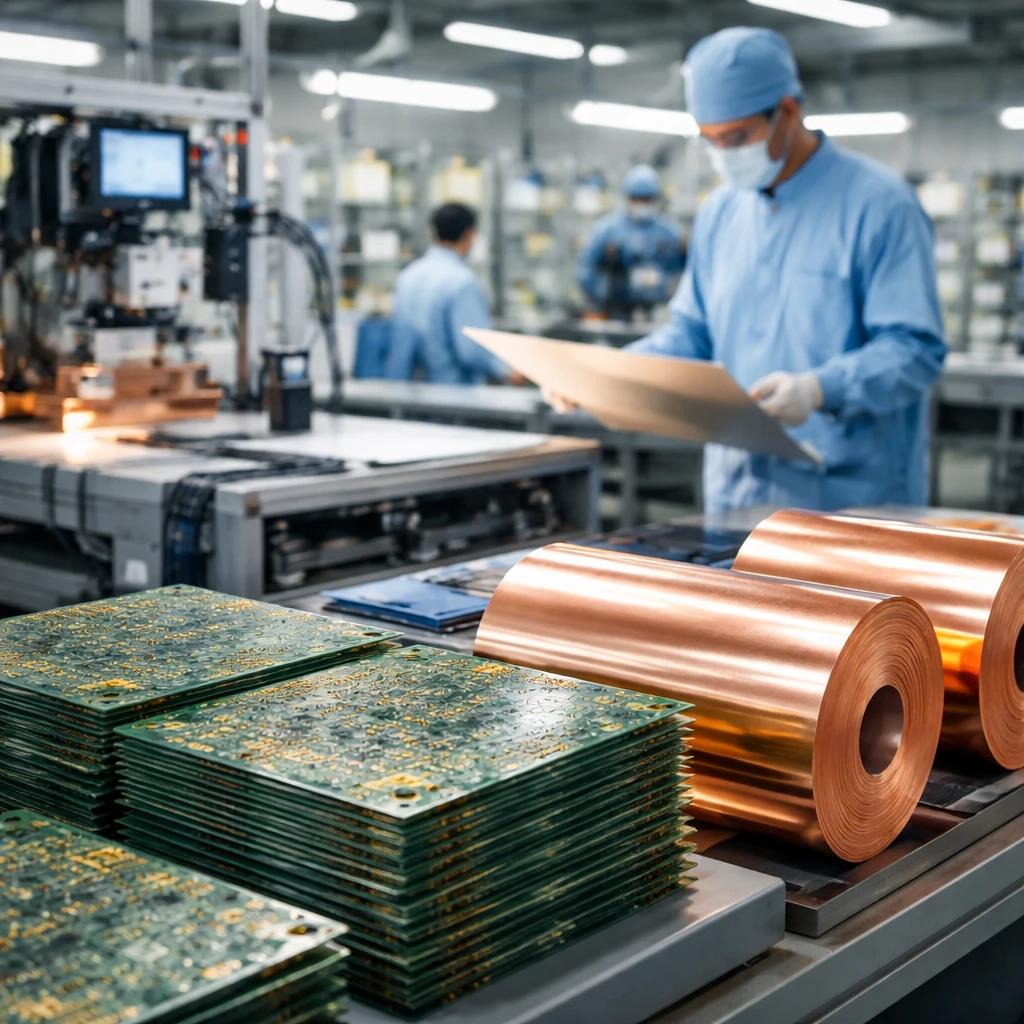
The momentum behind artificial intelligence-related investment continued to shift down the supply chain this week, feeding large gains in companies beyond chipmakers and hardware vendors. A Hong Kong-listed supplier of laminates, printed circuit boards and related chemicals led the move over the past 24 hours, delivering a volatile session that pushed its stock sharply higher.
Kingboard Holdings recorded a one-day increase of 20.5%, closing at HK$119.3, after announcing two material corporate actions. The company said its wholly owned arm, Kingboard Investment, would sell roughly 155 million shares of Kingboard Laminates at HK$76.0 per share, producing estimated net proceeds of about HK$11.77 billion (approximately $1.5 billion). Kingboard indicated the funds will be redirected into expanding PCB production capacity and accelerating research and development.
On the same day, the company implemented the fifth product-price increase of the year, raising prices across all FR-4 and PP product lines by 15%. Management cited persistently high copper costs and a tightening supply of glass cloth as the primary factors behind the decision to lift prices.
The liquidity move and price adjustments combined to send Kingboard's stock sharply higher for the month: the shares are now up +93.86% in June alone. The company has seen even larger appreciation since being selected by the AI-powered stock model in February of last year, with cumulative gains of +486.36% since that selection. The article notes the stock has nearly tripled during 2026 alone as demand for materials used in chipmaking and circuit boards accelerates amid broader AI deployment.
Kingboard's jump was the most eye-catching development in a month that has already produced substantial returns across hardware and materials suppliers. Within the same hardware and semiconductor-adjacent cohort, the article highlights earlier standout performers identified by the same AI-driven strategy: Veeco (NASDAQGS:VECO) was up +31.35% this month and Marvell Technology (MRVL) rose +27.00%.
Other notable performers recorded in June include:
- Amneal Pharmaceuticals (NASDAQGS:AMRX): +25.97% in June alone
- Onto Innovation (NYSE:ONTO): +23.64% in June alone
- Axcelis (NASDAQGS:ACLS): +17.57% in June alone
The gains are not confined to U.S. markets. Across the global strategies run by the same AI model, several companies posted outsized monthly returns, including Dian Swastatika (IDX:DSSA) at +55.49% in June, Intuitive (LSE:IIG) at +44.44%, and Tokyo Electron (TSE:8035) at +37.30%.
Kingboard was singled out in the article as the session's explosive performer. The capital-raising plan via the sale of Kingboard Laminates stock is expected to produce roughly HK$11.77 billion of net proceeds. Management said proceeds will be used to fund PCB capacity expansion and to accelerate R&D efforts. Those strategic priorities were announced in tandem with the company’s fifth price increase of the year, a round that sees FR-4 and PP prices lifted by 15% amid persistent copper cost pressure and constrained glass cloth availability.
Those actions helped propel the equity to the nearly 94% monthly gain referenced above. The article also reports that since the stock's selection by the AI strategy in February of the prior year, the share price has climbed +486.36%.
Closer to the U.S. market, Amneal Pharmaceuticals provided its own set of news items that supported the AI-driven strategy's earlier pick of the company. Amneal recently obtained FDA approval for a ready-to-use formulation of romidepsin, a cancer therapy. The approval includes six months of market exclusivity, which the company and the article frame as creating a period of limited near-term generic competition for that particular launch.
In addition, full-population results from the ELEVATE-PD study were released, the article reports. Those results reportedly reinforced CREXONT's ability to deliver meaningful clinical benefits for patients with Parkinson’s disease in real-world settings, supporting its ongoing commercial rollout.
Both regulatory and clinical developments in Amneal were presented as confirmation of the growth thesis the AI models identified earlier in the month.
The article outlines the machine-learning signals the AI engine detected in Amneal prior to the stock's June run. Key model findings listed include:
- Momentum building: The stock had already delivered an approximately 80% return over the prior year, and analyst price targets around $17 implied roughly 30% upside from then-current levels.
- Expanding margins: Gross margins were reported to have grown by 500 basis points year-over-year and were projected to reach about 45% in the current year. Adjusted EBITDA was said to have risen 19% in Q1 2026.
- Biosimilars opportunity: The acquisition of Kashiv BioSciences was described as opening access to a more than $100 billion biosimilars market, with six commercial products expected by 2027 and a combined revenue target of $4.3–$4.5 billion by 2030, a level roughly 40% above current revenues at the time of the article.
- Valuation disconnect: A price/earnings-to-growth (PEG) ratio of 0.04 was cited as indicating the stock was meaningfully undervalued relative to its growth trajectory, with the company having beaten earnings forecasts by around 65% in the prior quarter.
The article frames the FDA approval and ELEVATE-PD results as additional, tangible proof points that align with the data-driven rationale the model had used to identify the name earlier.
Readers are shown a broader performance record for the AI strategy. Several names called by the model since their selection have recorded double-digit percentage gains, including Consensus Cloud Solutions (NASDAQGS:CCSI) at +62.55% since chosen, Nucor (NYSE:NUE) at +61.22%, Molina Healthcare (NYSE:MOH) at +47.41%, Cardinal Health (NYSE:CAH) at +45.97%, and Texas Instruments (NASDAQGS:TXN) at +44.13% since their selection dates.
Since the proprietary AI models were launched in November 2023, the article states the process has compounded into a cumulative return of +227.24%, outperforming the S&P 500 by +150.15% over the same interval, according to the figures provided.
The article also outlines how the AI-powered stock-selection process works at a high level. At the start of each month the engine evaluates thousands of global equities, drawing on more than 15 years of financial data and over 150 quantitative models. It scores and ranks names based on historical performance, valuation measures and forward-looking growth metrics, and then highlights up to 20 high-conviction stocks per strategy with a projected medium-term upside potential.
Each monthly strategy undergoes a rebalancing process: new opportunities are added, strong performers are retained, and stocks that no longer meet the criteria are removed. Strategies use equal weighting across selected stocks to provide a consistent framework for performance tracking, though investors are free to set their own allocations.
The stated objective is to keep capital positioned in companies that demonstrate the strongest combination of momentum, valuation and business performance according to the quantitative signals the engine produces.
Practical subscription notes in the article remind readers that members who received the monthly-updated stock list for less than $7 a month were positioned in several of these names ahead of the rallies. The piece also says subscription pricing was accurate at the time of publication and that offers may vary by region.
Finally, the article references an additional product described as a chart-scanning Vision AI that detects setups and delivers suggested entry and exit points in under 60 seconds; users are reported to be seeing a high accuracy rate on selections, including on low-priced stocks.
Overall, the developments reported reflect a stretch of market performance where AI-related demand appears to be lifting not only chipmakers and equipment suppliers but also the chemical and materials companies that supply the circuit-board and packaging ecosystems that support broader semiconductor and AI hardware builds.
Key points
- Kingboard Holdings jumped 20.5% in a single trading session after announcing a major stake sale in its laminate subsidiary and a 15% across-the-board price hike for FR-4 and PP products; the stock is up +93.86% in June.
- Amneal Pharmaceuticals obtained FDA approval for a ready-to-use romidepsin therapy with six months of market exclusivity and released full-population ELEVATE-PD results supporting CREXONT's clinical benefit, developments that matched prior model signals.
- Proprietary AI models driving the stock selections analyze thousands of global equities using extensive historical data and multiple quantitative models, generating monthly lists that have produced notable cumulative returns since November 2023.
Risks and uncertainties
- Commodity and input-cost pressure: Persistently high copper prices and constrained glass cloth supply were cited as drivers of recent price increases, creating cost and supply uncertainties for materials producers and their customers.
- Dependence on AI-driven demand: The recent rallies are linked to accelerating demand for materials used in chipmaking and circuit boards; future performance may be sensitive to changes in that demand trajectory.
- Execution of capital redeployment: Kingboard plans to reinvest proceeds into PCB capacity expansion and R&D; the ultimate impact depends on successful execution of those investments.
Note: Subscription and product references in this piece reflect the descriptions provided and pricing claimed at the time of publication. The article does not make forward-looking promises beyond the documented announcements and model outputs cited above.