
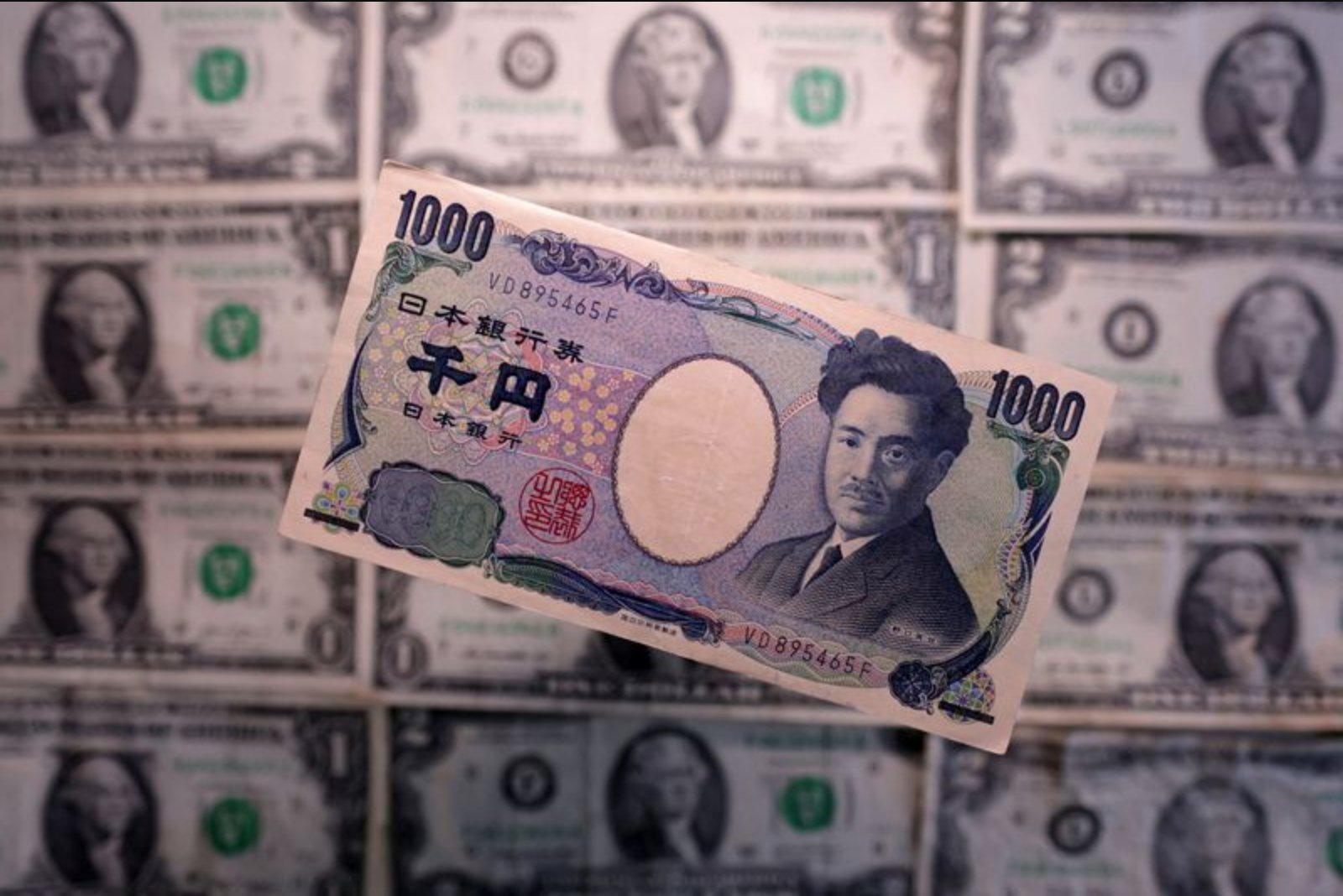
As the yen drifts back toward levels that triggered official market action a month ago, investors and policy watchers are recalibrating expectations about Tokyo's remaining capacity and appetite to defend the currency.
At the end of April and in early May authorities are believed to have executed multiple rounds of yen-buying intervention that together amounted to about $63 billion. That outlay is small relative to Japan's roughly $1 trillion in foreign assets, but traders generally view the notion of spending most or all of that stockpile as unrealistic.
"The more foreign reserves shrink, the more vulnerable Japan looks to speculators," said Daisaku Ueno, chief foreign exchange strategist at Mitsubishi UFJ Morgan Stanley Securities. With yen-selling pressure persistent, he added, "the war of nerves between the authorities and the market looks set to continue."
Yen support operations require selling foreign assets, and Japan held about $1 trillion of such assets at the end of April. After subtracting the roughly 10 trillion yen deployed in the April and May actions - about $62.78 billion based on calculations of Bank of Japan money market data - an estimated balance of around 150 trillion yen remains.
Goldman Sachs economist Yuriko Tanaka has framed that remaining sum as sufficient for "around 30 rounds" of intervention. Yet several analysts caution that running down foreign assets to exhaustion would be neither feasible nor desirable, in part because heavy sales would weigh on the market value of key holdings such as U.S. Treasuries.
Cooperation with the United States has been an element in past efforts to influence the dollar-yen rate. U.S. Treasury "rate checks" helped nudge the exchange rate lower in January, and several economists stress that "U.S. understanding is crucial" to sustaining the impact of any intervention. Takeshi Ueno, a senior economist at NLI Research Institute, warned that if Washington resisted such activity it "could invite speculative yen selling."
Authorities also face technical and reputational constraints. An International Monetary Fund standard ties frequent intervention to risks around a country's classification as having a "free-floating" exchange rate. Chief currency diplomat Atsushi Mimura has said such IMF rules would not constrain how many times the government can step into markets, while Akira Moroga, chief market strategist at Aozora Bank, argued that curbing excessive volatility takes priority and that losing a free-floating classification would not be a serious concern for policymakers.
Market prices show the currency easing to 159.65 on Thursday, its weakest level since April 30 - the date when Japan is suspected to have carried out its first intervention in nearly two years. The Ministry of Finance is scheduled to publish, at 1000 GMT on Friday, the total amount the government has spent on foreign exchange intervention since April 28.
Japanese Finance Minister Satsuki Katayama has repeatedly declined to confirm whether interventions have taken place, while stressing that officials remain ready to take "decisive action."
Underlying market forces have amplified the currency's slide. The yen has been pressured by a three-month-long Middle East crisis, which lifted energy costs and produced a terms-of-trade shock for Japan, a nation that imports nearly all of its oil. That shock has compounded a downward trend already in motion amid a Bank of Japan approach that has been cautious about raising interest rates, and expectations for expanded fiscal stimulus under Prime Minister Sanae Takaichi.
Where previous administrations weighed intervention decisions on the pace of exchange-rate moves, the current government appears more focused on defending a specific threshold - the 160 yen per dollar line. Some market participants are positioning on the assumption authorities will act to prevent moves beyond that level.
One dealer at a domestic bank reported that buy orders for dollars are clustering between 155 and 157 yen per dollar, reflecting both genuine importer demand and speculative positions. On the upper side of the trading range, the same dealer and other market participants expect that any further, larger intervention would likely arrive before the dollar reaches 162 yen.
"The government will want to defend that level at all costs," said a dealer at a domestic bank.
With the yen back in what many market participants view as a vulnerable zone, Tokyo's approach appears set to combine periodic intervention, public reticence on confirming operations, and reliance on international understanding to shape market behavior. How long that combination will keep speculative selling in check remains an open question for investors, importers, exporters and fixed-income market participants who watch the repercussions on asset valuations closely.