
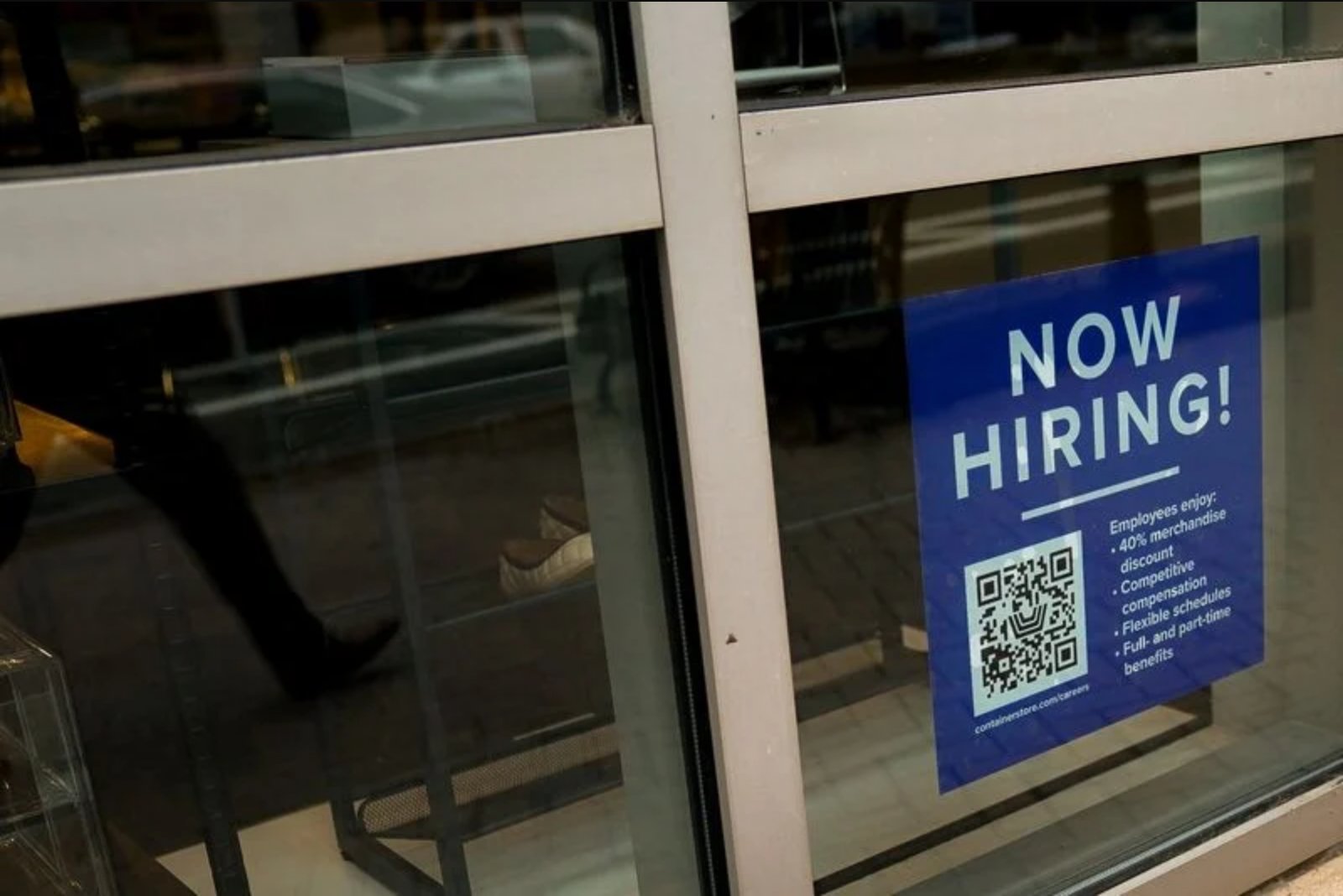
Economists surveyed ahead of the Labor Department's May employment report anticipated a moderation in U.S. payroll gains after two months of relatively strong increases, but still judged the labor market to be holding in a broadly stable position.
Consensus estimates from the Reuters poll placed nonfarm payroll additions at 85,000 for May, down from 115,000 in April and well below the 185,000 surge registered in March. The range of projections extended from 50,000 to 125,000. Even so, the expected May tally would sit above the monthly average of 76,000 recorded so far this year.
Forecasters argued the labor market's resilience reflects a mix of factors that have so far offset the inflationary impulse driven by a jump in oil prices linked to the Middle East conflict. Among those forces, fiscal elements - specifically tax and tariff refunds - have helped sustain corporate profitability, allowing many firms to avoid widescale layoffs and keep staffing levels relatively steady.
"I'm a bit surprised that things have held up as long as they have, but there's a couple of things that are playing out, tariff and tax refunds, those two factors, at least so far, have been sufficient to offset the higher gasoline and fuel prices," said Brian Bethune, an economics professor at Boston College. He added that tariff refunds likely in the range of $150 to $200 billion have buoyed corporate profits, noting that as a result corporations have not faced severe pressure and the economic environment remains positive, if not robust.
Economists expect limited scope for major revisions to prior payroll figures after the Bureau of Labor Statistics updated the "birth-death" model it uses to estimate employment changes from business openings and closures. That makes the survey's payroll forecast more directly comparable with the recent string of monthly data.
One focal point is the pace of job creation needed simply to keep up with the growth of the working-age population. Economists estimated that the economy must add between zero and 50,000 jobs per month to match that demographic increase - a so-called break-even range that has shifted lower amid an immigration crackdown that has reduced the labor force and thereby restrained upward pressure on the unemployment rate.
The unemployment rate itself was forecast to remain unchanged at 4.3% for a third consecutive month, though some economists allowed for a possible rounding to 4.4%. Either outcome would be interpreted as consistent with a stable labor market. Still, the labor force has contracted by about 500,000 since February, and a rebound in participation could lift the jobless rate.
Underlying the restrained pace of hiring, analysts highlighted historically low layoff figures as a key anchor keeping payroll totals positive even when gross hiring is subdued. The Federal Reserve's Beige Book, published midweek, noted that "hiring remained selective and primarily focused on critical roles or attrition replacement" in May, signaling employers continue to target specific needs rather than broad-based expansion.
Markets have incorporated the view that the U.S. central bank will keep its benchmark overnight interest rate in the 3.50%-3.75% range into next year. That expectation reflects the idea that stable labor market readings combined with inflation developments tied to energy prices will allow the Fed to pause while it assesses the fallout from the geopolitical shock.
The surge in gasoline prices - more than 40% higher since the Middle East conflict began - has fed into broader inflation measures, with the consumer price gauge accelerating at its quickest pace in three years in April, according to recent government data. Economists said the oil shock contributes to a cautious stance from employers, who have limited hiring as they weigh the uncertainties around input costs and demand.
Beyond energy-driven inflation, several sector-level developments were expected to influence payrolls for May. The transportation industry likely saw job losses following federal limits on commercial driver licenses for non-U.S. citizens, with economists projecting roughly 10,000 monthly losses in that sector. Federal government employment was also expected to decline further amid the administration's push to shrink the federal workforce, even as some agencies have begun moves to rebuild staff.
Labor-market disruptions were also anticipated from localized and company-specific events. A strike involving some 4,000 members of the Harvard Graduate Students Union was projected to weigh on hiring in the education sector. Economists were split on how quickly the fallout from the bankruptcy of Spirit Airlines would register in payroll data. Meanwhile, healthcare continued to be viewed as a steady source of job creation due to an aging population, and leisure and hospitality firms were expected to add positions in part because of early recruitment tied to upcoming soccer World Cup tournaments.
Economists at JPMorgan pointed to recent acceleration in payrolls that had been concentrated in industries with higher shares of non-citizen workers, and argued that the uptick could persist. "Although immigration enforcement remains high, it is not in the headlines as much these days, and immigrants at risk of deportation could have become more focused on finding work given limited savings," they wrote.
That concentration of job growth in particular industries underscores the uneven nature of labor demand across the economy. It also ties back to the demographic and policy factors that have tightened labor supply and altered the break-even employment rate.
Analysts emphasize the pause in large-scale layoffs has kept the labor market in what some economists call a "slow-hire, slow-fire" equilibrium — a state of low churn in which employers replace departing workers selectively but refrain from major hiring drives. That balance gives policymakers latitude to keep rates steady while monitoring inflation and the longer-term effects of the geopolitical shock on prices and activity.
Stephen Douglass, chief economist at NISA Investment Advisors, described the outlook as one of continued stability but not a robust rebound. "The risk is tilted toward the unemployment rate creeping higher over the next 12 months or so, and that will be enough to get the Fed to deliver a few more cuts after the war is resolved conclusively," he said. His view reflects the possibility that, even if payrolls hold up in the near term, the balance of risks points to a gradual easing in labor market tightness over the medium term.
In sum, the anticipated slowdown in May payroll growth was portrayed by economists as a partial step back from a recent uptick in hiring that leaves the broader labor market fundamentally intact. Low layoffs, fiscal support through refunds and pockets of sectoral hiring - notably in health and hospitality - contrast with headwinds from higher energy prices, tightened immigration enforcement and targeted disruptions in transportation and education. How those factors evolve will shape both near-term payroll readings and Fed deliberations about the path of interest rates.
Summary - Economists expect modest moderation in May payroll growth to about 85,000 jobs, a mark below April and March but above the year-to-date monthly average. Low layoffs, tariff and tax refunds supporting corporate profits, and selective hiring are keeping the labor market stable, while gasoline-driven inflation, immigration-related labor force shrinkage and several sector-specific disruptions are restraining broader hiring.