
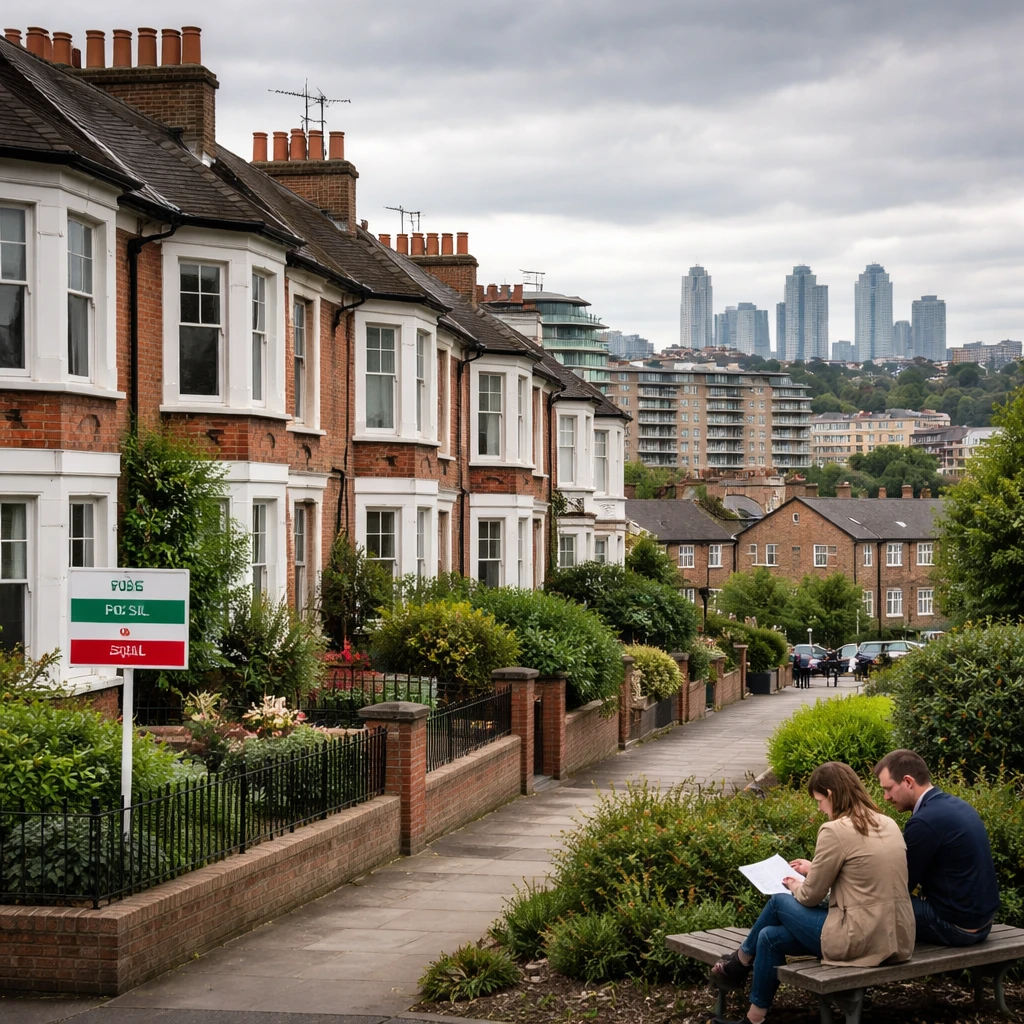
British house prices showed little net movement in May, with mounting regional divergence as the North continued to outperform the South, according to mortgage lender Halifax.
The average UK house price stood at A3298,806 in May, down 0.1% from A3299,251 in April - marking the second straight month of a 0.1% monthly decline. On an annual basis, growth in house prices nudged up to 0.5% from 0.4% the previous month, while Halifax reported a 0.2% fall on a quarterly basis.
Regional trends were pronounced. Northern Ireland recorded the highest annual increase in the UK, with prices up 7.8% year-on-year to an average of A3227,177. Halifax attributed the region's performance to constrained housing supply and comparatively stronger affordability. The rise represented the largest annual gain across the UK and the region's strongest six-month outcome.
Other parts of the country that posted positive annual moves included Scotland, where prices rose 3.8% to reach an average of A3222,650; the North East of England, up 3.1% to A3181,703; and the North West, which saw a 3.0% annual increase to A3248,304. Wales recorded marginal annual growth of 0.1%, with the average property valued at A3230,355.
By contrast, housing markets across southern England remained fragile. The South East experienced the steepest annual decline, with values down 2.1% to A3382,704, while London saw prices fall 1.5% to A3534,375. Halifax also noted that annual house price growth among first-time buyers was subdued at 0.3%.
Amanda Bryden, head of mortgages at Halifax, pointed to geopolitical developments as a factor influencing property price behaviour. She said: "Property price trends continue to reflect the uncertainty linked to developments in the Middle East." Bryden added that, despite recent cuts to mortgage rates, higher inflation expectations had kept borrowing costs above levels seen at the start of the year, "continuing to stretch affordability for many buyers and temper demand." She also observed that housing market activity had nevertheless "held up well", with transaction levels remaining relatively stable.
Official statistics presented a mixed set of signals on market activity. HM Revenue & Customs data showed seasonally adjusted residential property transactions fell 3% in April to 101,030, down from 103,910 in March. However, HMRC said transactions in the April-to-June quarter were provisionally running about 1% higher than in the prior three months.
Mortgage approvals painted a more encouraging picture. Bank of England figures indicated approvals for house purchases rose 3.1% in April to 65,945, the highest level since January 2025 and 9% above the level recorded a year earlier.
Survey evidence from the Royal Institution of Chartered Surveyors (RICS) pointed to ongoing softness in demand. New buyer enquiries remained weak, with a net balance of 34% of surveyors reporting a decline in April compared with 40% in March. Agreed sales were broadly unchanged, with a net balance of 36% reporting a fall versus 35% a month earlier. New instructions improved slightly, with a net balance of 3% reporting a decline, compared with 6% in March.
Looking ahead, Halifax's Bryden highlighted the continued influence of borrowing costs and consumer confidence on market activity. She said: "Looking ahead, borrowing costs and consumer confidence are likely to continue shaping activity in the coming months, with house prices expected to remain broadly stable while interest rates stay elevated." She added that "a return to sustained house price growth is dependent on an improvement in the inflation outlook and a fall in mortgage costs."
Separate data from Nationwide confirmed the broadly steady picture. Nationwide's seasonally adjusted house price index dipped to 515.3 in May from 516.0 in April, with annual growth holding at 0.5%.
Summary of key metrics cited:
- Average UK house price in May: A3298,806 (down 0.1% month-on-month)
- Annual UK house price growth: 0.5% in May (up from 0.4% in April)
- Northern Ireland: +7.8% year-on-year to A3227,177
- Scotland: +3.8% to A3222,650; North East: +3.1% to A3181,703; North West: +3.0% to A3248,304
- South East: -2.1% to A3382,704; London: -1.5% to A3534,375; Wales: +0.1% to A3230,355
- First-time buyer annual growth: 0.3%
- HMRC transactions in April: 101,030 (3% decline from March)
- Bank of England mortgage approvals in April: 65,945 (up 3.1% month-on-month; 9% above year-earlier level)
- Nationwide house price index: 515.3 in May (from 516.0 in April)
The data together sketch a market in which headline national figures appear flat, but where regional differences and affordability pressures are shaping local outcomes and buyer behaviour. Policymakers, lenders and market participants will be watching inflation expectations and mortgage pricing for signs that could alter this equilibrium.