
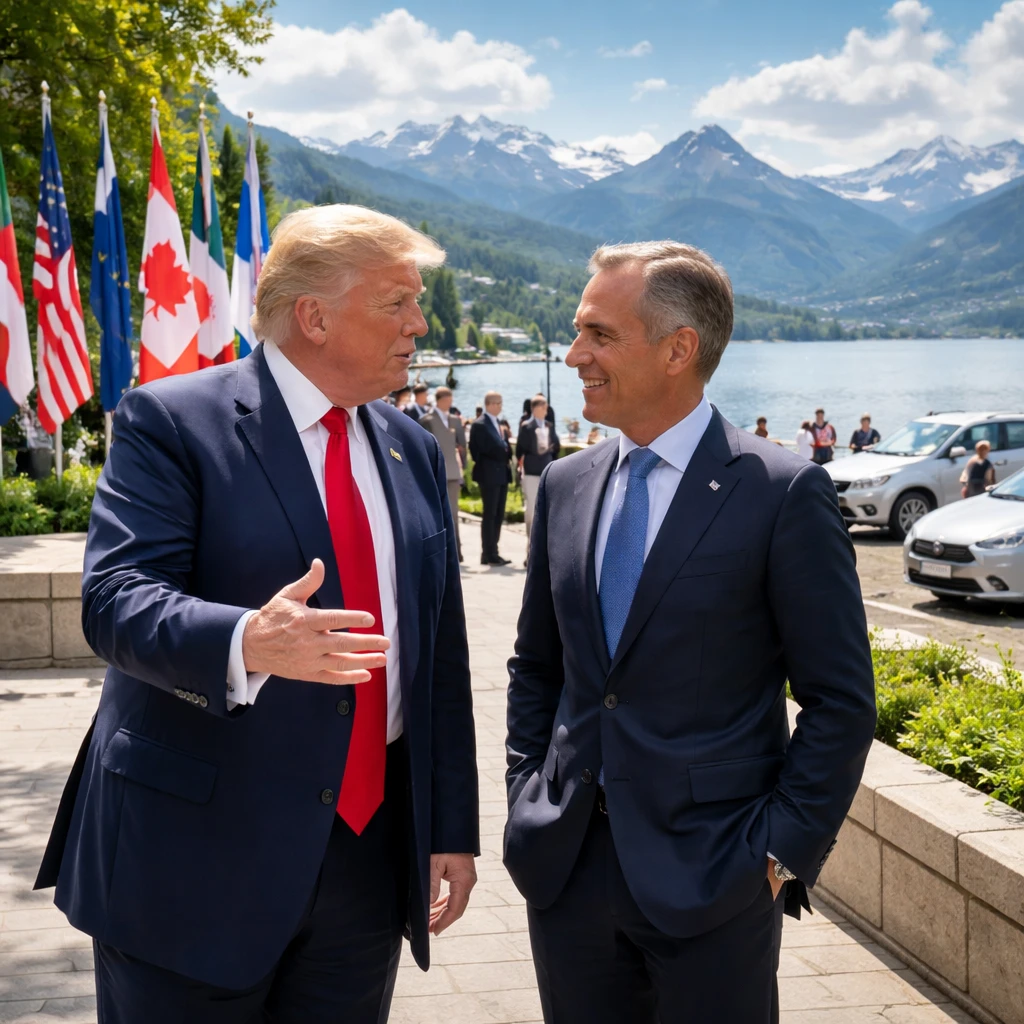
Canadian Prime Minister Mark Carney said Wednesday that President Donald Trump voiced support for Canada’s trade arrangement with China that imposes a cap on electric vehicle imports, during conversations at the Group of Seven leaders summit in Evian, France.
The accord, first disclosed when Carney visited Beijing in January, permits up to 49,000 Chinese-made electric vehicles to be imported into Canada within a 12-month window at an approximate tariff rate of 6%. The quota is intended to rise gradually. That represents a sharp departure from the tariffs Canada had previously applied to these vehicles, which exceeded 100%.
"He likes the structure, actually," Carney told reporters on Wednesday, adding, "We had a follow-up conversation." A microphone captured an exchange on Tuesday in which Carney explained the cap to Trump, saying, "I thought you'd actually like that," and Trump responding, "that's good." Carney said Wednesday that Trump had raised the topic during their discussion.
The leaders did not hold a formal bilateral meeting at the summit, although Carney said they spoke on a range of matters over the course of the event.
Notwithstanding the reported presidential approval, parts of the U.S. administration have publicly criticized the Canadian arrangement. Washington continues to impose a 100% tariff on electric vehicles imported from China and is implementing a software ban on those vehicles on national security grounds. The difference in approaches keeps the Canada-China agreement a point of friction as Ottawa seeks reductions in U.S. tariffs on foreign-built cars.
Dominic LeBlanc, the Canadian minister charged with negotiating tariffs, met with U.S. Trade Representative Jamieson Greer at the summit on Tuesday. LeBlanc described the encounter as a "constructive meeting," but he did not specify whether concrete progress was achieved on lowering U.S. tariff levels.
Separately, Canadian Industry Minister Melanie Joly is in China this week holding meetings with Chinese automakers as part of Ottawa’s effort to secure joint ventures that would produce electric vehicles on Canadian soil.
Carney emphasized that the deal "creates the possibility - possibility, not the certainty in any way - that this commercial relationship develops, and there's Chinese investment in Canada." He was careful to note the government’s conditions for any such investment: it must involve "material Canadian production." Carney added that Ottawa would not accept so-called knockdown kits, a practice where vehicles are largely assembled in China and then shipped abroad for only final assembly.
The arrangement and the discussions at Evian underline competing policy choices across allied governments on how to manage the rapid expansion of electric vehicle supply chains while protecting domestic production and addressing national security concerns. For Canada, the arrangement represents a calibrated opening to Chinese-made EVs coupled with explicit protections intended to encourage onshore manufacturing. For the United States, stronger trade and security measures remain in place.
Key points
- Canada and China agreed on a quota allowing up to 49,000 Chinese EVs into Canada over 12 months at about a 6% tariff, replacing prior duties of more than 100%.
- President Trump told Canadian leaders he "likes the structure," according to Mark Carney, though the U.S. government continues to enforce a 100% tariff and a software ban on Chinese EVs.
- Canadian officials are pursuing joint ventures and insisting any Chinese investment include material Canadian production, rejecting knockdown kit arrangements.
Risks and uncertainties
- Diplomatic friction: Divergent policies between Canada and the United States on tariffs and security measures could complicate negotiations to reduce U.S. duties on foreign-built cars - impact: automotive and trade sectors.
- Investment conditionality: The requirement for "material Canadian production" creates uncertainty for potential Chinese investors and automakers considering joint ventures - impact: manufacturing, supply chains, and capital projects.
- Regulatory divergence: The U.S. software ban and 100% tariff on Chinese EVs may restrict market access and fragment North American EV supply chains - impact: automotive, technology, and national security-related procurement.