
Indonesia's highest constitutional court on Thursday concluded that the government's large-scale free meals programme must be accounted for separately from the education budget, with the separation to take effect by 2028 at the latest. The judges also suggested that the government move more quickly and implement the split as early as next year.
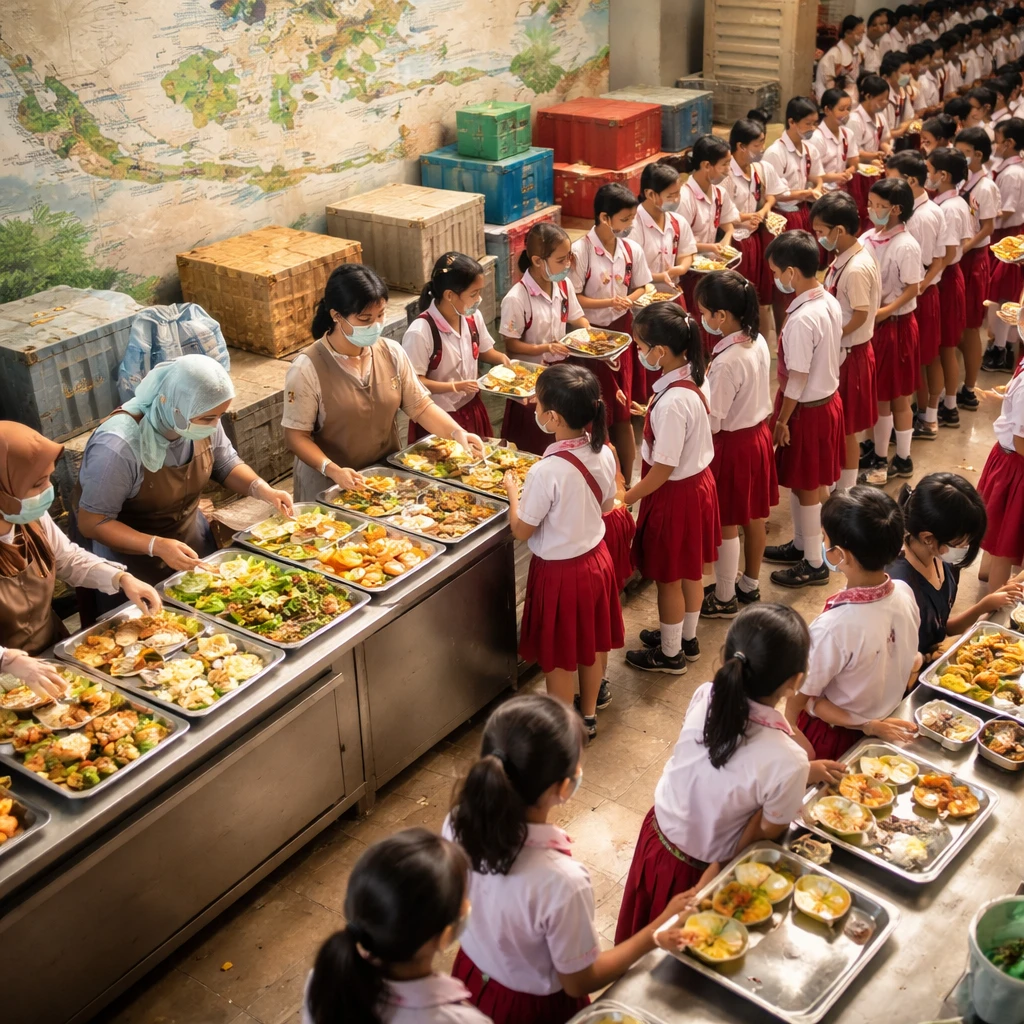
The programme, launched in 2025, aims to provide meals to 83 million school children and expectant mothers as a measure to tackle under-nutrition and stunting. But its wide scope and the logistical complexity of delivering food across an archipelago of 280 million people have produced a weighty fiscal commitment that the court found incompatible with being bundled inside operational education spending.
Chief judge Suhartoyo said the free meals budget must be separated from the education operational budget starting from 2028 at the latest, and the panel of judges recommended an earlier separation if feasible. The ruling was issued after students and educators challenged the 2026 state budget law, which classified the free meals programme as an "educational provision" and included it in the operational allocation for education.
In the 2026 budget, the finance ministry set aside 769 trillion rupiah for education, of which 223 trillion rupiah was allocated to the free meals programme. The government defended that allocation in court on the grounds that improved nutrition is part of the educational process.
Judge M. Guntur Hamzah said: "Adding nutritious meals as one of the education provisions ... creates imbalances in the proportionality of the education budget."
At the hearing, one witness, history teacher Iman Zanatul Haeri, spoke emotionally about the programme's impact on educators, saying it had coincided with the termination of teacher contracts and reductions in salaries. The court acknowledged that while the free meals initiative is a "real solution" for addressing stunting, it nevertheless requires its own dedicated allocation within the state budget to avoid distorting educational spending priorities.
The finance ministry declined to comment on the court decision on Thursday.
The verdict adds to a series of problems that have dogged the flagship scheme. The agency tasked with running the programme has experienced two changes of leadership within recent weeks, and authorities arrested the agency chief last month on corruption allegations tied to the programme. The government has already trimmed the 2026 budget twice and indicated that further cuts could be made.
Public sentiment has also shifted. A July survey by an independent pollster found that only 33.8% of respondents were satisfied with the programme, a drop of roughly 30 percentage points compared with last November. Against that backdrop, Indonesia will submit its 2027 state budget next month, and the court's directive now requires officials to present the free meals allocation as a distinct budgetary item within that broader process.
At the time of reporting the exchange rate was $1 = 18,075 rupiah.